...

By Ellie Cook
Senior Defense Reporter
0
Share
Newsweek is a Trust Project member
See more of our trusted coverage when you search.Prefer Newsweek on Googleto see more of our trusted coverage when you search.
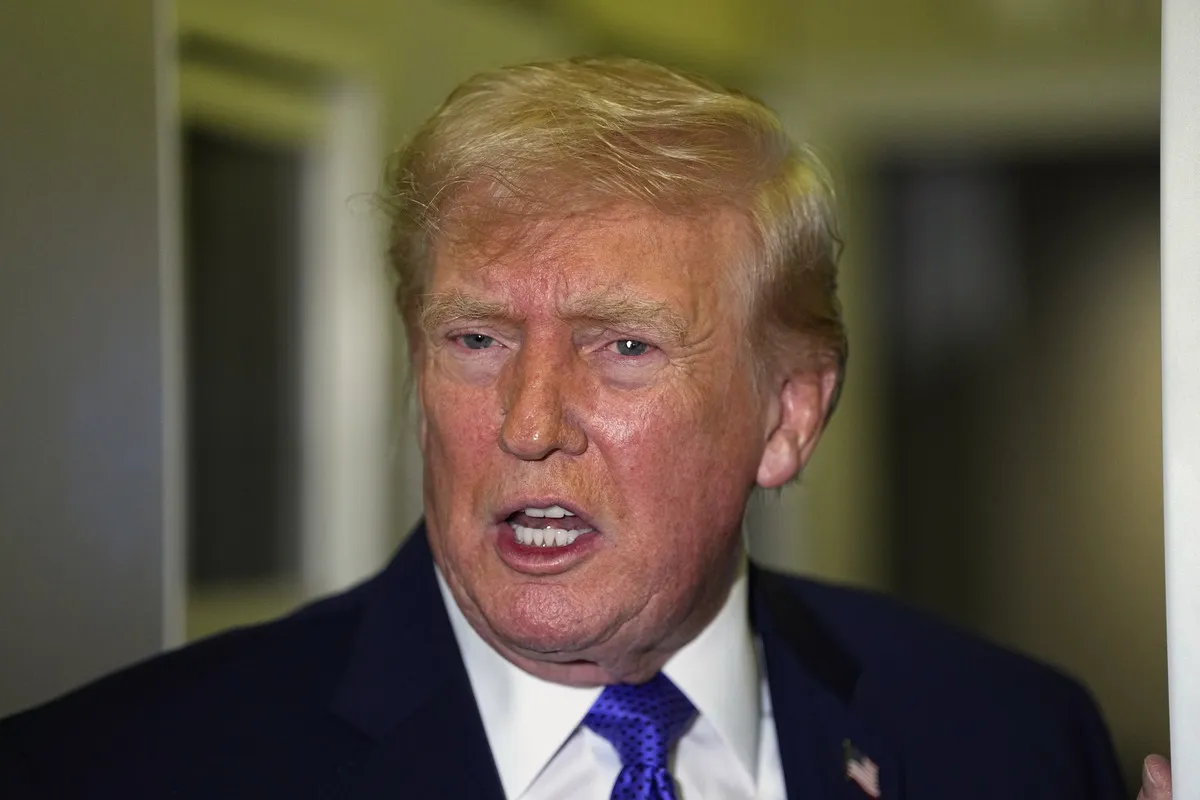
President Donald Trump said he will be "indirectly" involved in upcoming crunch talks with Iran over its nuclear program, warning Tehran against "the consequences of not making a deal."
The Trump administration has said the president prefers to negotiate with Tehran over its nuclear development, but the U.S. has built up its forces in the Middle East while threatening military action if both sides cannot settle on the terms of a deal.
Trump told reporters aboard Air Force One he believed Iran was willing to reach an agreement with the U.S. and described fresh negotiations in Geneva from Tuesday as "very important."
Read More on World
Meanwhile Iran said it would be asking for sanctions relief. Tehran's foreign ministry also indicated that the US's position on a nuclear deal had become "more realistic".
Trump ratcheted up the pressure on Iran's clerical leaders earlier this year by threatening U.S. intervention over a brutal crackdown on widespread protests in the country in late December and early January.
...
"I don't think they want the consequences of not making a deal," Trump said on Monday.
"We could have had a deal instead of sending the B-2s in to knock out their nuclear potential. And we had to send the B-2s," he said referencing the U.S's strikes last summer, aiding Israel's 12-day war against Iran.
More than 125 aircraft, including seven U.S. B-2 stealth bombers armed with 30,000-pound bunker-busting bombs, were involved in U.S. strikes on three Iranian nuclear sites in June last year.
The U.S. government said at the time the attack, which brought an end to a brief war between Israel and Iran, "obliterated" the facilities—although some questioned the damage to Iranian sites deep underground. Tehran then targeted the U.S.' Al Udeid Air Base in Qatar. No U.S. personnel were harmed.
"I hope they're going to be more reasonable," Trump said on Monday ahead of the talks.
Iran responds with drills in key oil shipping lane
As talks kicked off in Geneva on Tuesday, Iran shut parts of the Strait of Hormuz to carry out naval drills.The strait is a key shipping lane between Iran and Oman and is vital for global oil exports. The Islamic Revolution Guards Corps had also staged drills there on Monday.
Iran's Supreme Leader Ayatollah Ali Khamenei also gave a public address on Tuesday where he directly threatened the US warships off Iran's coast. Trump has sent the US's two largest aircraft carriers to the Gulf, as part of an "armada".
“The American president repeatedly says that their military is the strongest in the world," Khamenei said according to Iranian media. "The strongest military in the world, however, can sometimes be struck so hard that it cannot even get back on its feet."
"An aircraft carrier is certainly a dangerous piece of equipment," Khamenei added. "But more dangerous than the carrier is the weapon capable of sending it to the bottom of the sea."
Trump's special envoy, Steve Witkoff, and the president's son-in-law, Jared Kushner, are expected to represent the U.S. in Switzerland.
Iranian Foreign Minister Abbas Araghchi met with the head of the United Nations' nuclear watchdog, the International Atomic Energy Agency (IAEA), on Monday and said he approached the Geneva talks "with real ideas to achieve a fair and equitable deal."
"What is not on the table: submission before threats," Araghchi said. Iranian Deputy Foreign Minister Majid Takht-Ravanchi had said the ball is "in America's court to prove that they want to do a deal" but indicated Washington would need to relax sanctions on Iran.
The U.S. has consistently said it will not accept an Iran with access to nuclear weapons and has previously indicated it may be willing to lift what Trump called "biting" sanctions.
Iran insists its nuclear program has always been peaceful but international experts said ahead of the U.S. strikes that Iran had stockpiles of highly enriched uranium close to what would be needed to make an effective nuclear weapon.
A 2015 agreement, known as the Joint Comprehensive Plan of Action (JCPOA), or simply as the Iran nuclear deal, loosened sanctions leveled against Tehran in exchange for new limits on its nuclear program. The powers involved at the time also tried to limit weapons sales to and from Iran, as well as the country's ballistic missile development.
However, Iran has openly said it has abandoned parts of the JCPOA since Trump pulled the U.S. out of the deal during his first term in office. Israel has said a new nuclear agreement should force Tehran to cut back its ballistic missile program and end the country's support for proxy groups in the region, like Hamas and Hezbollah. Both are designated by the U.S. as terrorist organisations.
Secretary of State Marco Rubio said clinching a nuclear deal would be "very hard to do," and explained that the U.S. had amassed assets close to Iran because Tehran "has shown the willingness and the capability to lash and strike out at the United States presence in the region."
View 0 Comments
Submit Correction
View Editorial & AI Guidelines