10
Loading video...

By Sam Stevenson
Associate News Editor
0
Share
Newsweek is a Trust Project member
See more of our trusted coverage when you search.Prefer Newsweek on Googleto see more of our trusted coverage when you search.
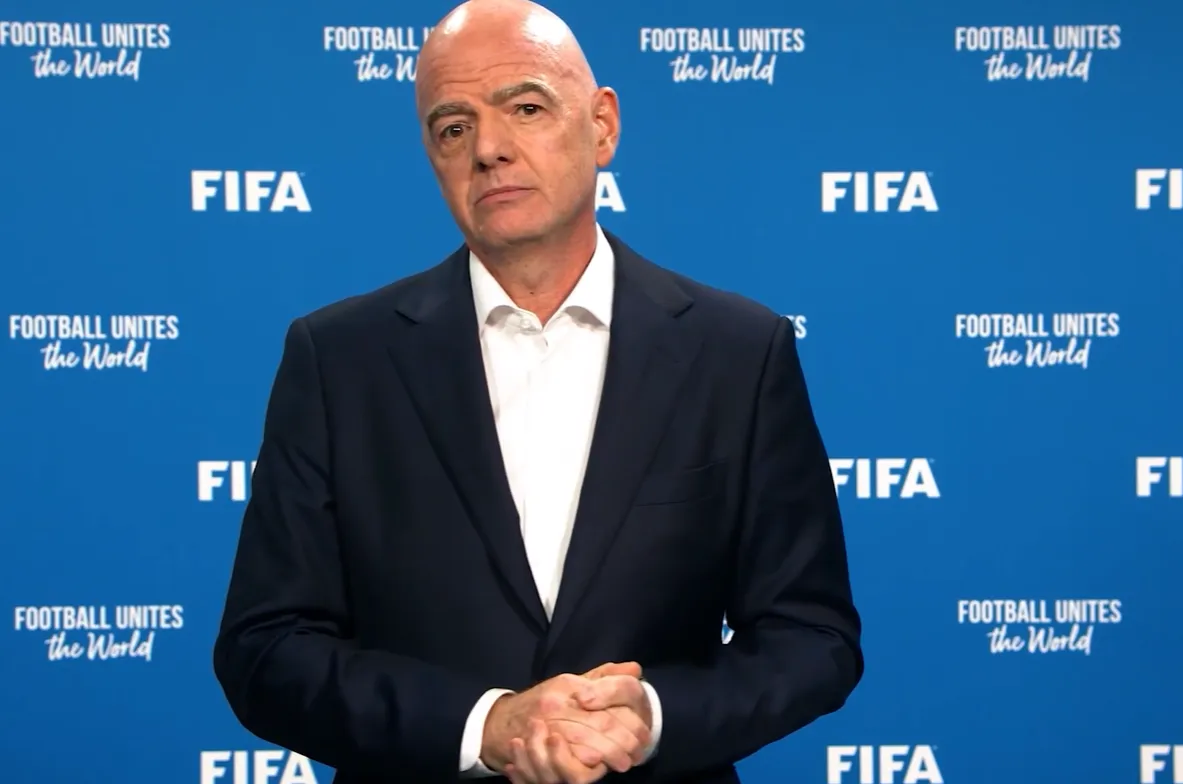
FIFA President Gianni Infantino is facing calls to resign after his controversial plan to bring private investment into the World Cup collapsed following a backlash from major football confederations.
FIFA has canceled plans to seek outside investors for a proposed commercial subsidiary built around the World Cup, shelving a $20 billion project that had drawn substantial opposition and criticism.
The reversal comes just days after Infantino unveiled plans for FIFA Forward Enterprise (FFE), a wholly owned subsidiary that would consolidate the governing body's commercial rights and event operations, including the men's World Cup and Club World Cup.
Read More on News
UEFA, the powerful European soccer confederation, said it would boycott the World Cup if the plan progressed, and two other confederations—The Confederation of North, Central America and Caribbean Association Football (CONCACAF) and the Asian Football Confederation (AFC)—opposed the proposal. Meanwhile, Infantino's senior adviser and former U.S. Soccer president, Carlos Cordeiro, resigned in protest.
UEFA welcomed FIFA's decision to withdraw the proposal, but said the episode had shattered confidence in the current leadership of world soccer.
In a statement, UEFA said the proposal had been "unanimously rejected" by its national associations and by "many other federations and confederations of all sizes around the world." It added: "The current FIFA leadership has not only lost UEFA's confidence but also that of many other members of the football family."
UEFA called the reversal "a victory for the whole game," saying it showed that football was "not for sale," while accusing Infantino's leadership of a "shabby, back room, opaque deal." UEFA added: "The proposal has gone. The task of rebuilding trust in FIFA has only just begun."
The proposal had quickly become a flashpoint over the growing role of private capital in global sports after reports that investors tied to the family of Trump's son-in-law were among those leading the proposed investor group.
In a statement posted to X on Friday night, Infantino said in part: "Having listened carefully to all the views, it has become clear that the project has created divisions of a nature that, regardless of the level of support, are no longer in the interest of the objective set out in the first place. Our purpose has always been - and will always be - to unite and improve. As a result, this proposal will not proceed."
FIFA said FFE could raise up to $4.2 billion from long-term investors buying minority, non-controlling stakes.
The organization said the money would have expanded development funding for its 211 member associations, while FIFA would keep control of football governance, competitions, the match calendar and all sporting decisions.
In a previously published FAQ, FIFA said the proposal had not yet been set up and would move forward only if backed by a majority of member associations and approved by the FIFA Council, and votes were clearly mounting up against the plan. The FAQ also said investors would have no role in decisions over FIFA governance, the World Cup format, tournament frequency, expansion or other sporting matters, but the attempt to reassure critics failed.
When approached for comment by Newsweek, FIFA said the plan would not turn it into a for-profit organization, would not amount to selling the World Cup, and would not create a future role or compensation package for any specific individual.
FIFA said that Thrive Eternal, a permanent capital holding company, was expected to lead the proposed investor group for FFE, subject to final agreements and required approvals.
Thrive Eternal was founded by Joshua Kushner, brother of Jared Kushner, who is Trump's son-in-law.
Separately from the proposed FFE investor structure, FIFA also opened a representative office at Trump Tower in New York, a move announced with Infantino and Trump at the Trump Organization's Manhattan headquarters.
Click each circle to see how FIFA, Infantino, J.P. Morgan, Thrive Eternal, the Trump Organization and the Trump-Kushner links connect.
The connections do not show that the Trump family would have controlled FIFA, but they do show how a proposed FIFA commercial company, an expected Kushner-founded lead investor and Trump’s visible relationship with Infantino became part of the same controversy.
Thrive Capital declined to comment when contacted by Newsweek by email on Wednesday morning.
A person familiar with Thrive’s position said Jared Kushner was not an investor in FFE or Thrive Eternal, and that Joshua Kushner, the founder and CEO of Thrive Eternal, had no role in the Trump administration.
Newsweek had received no reply as of Saturday morning from UEFA, J.P. Morgan, the White House and Jared Kushner via his investment firm Affinity Partners after asking for comment by email on Wednesday morning.
...
What FIFA Wanted To Build
FIFA framed FFE as a way to increase commercial revenue from its tournaments and send more of it to national associations.
The proposal would have put FIFA's broadcast rights, sponsorships, ticketing, licensing and tournament delivery inside a dedicated subsidiary.
FIFA said outside investors would not run soccer operations, would not control sporting decisions and would be investing in a FIFA-owned company rather than FIFA itself.
The immediate financial offer to member associations was significant. FIFA said each of its 211 members could access an optional $20 million in a one-off capital through a new FIFA Fast Forward Programme.
Regular Forward funding for each member association would also have risen from the budgeted $8 million for the 2027-2030 cycle to $20 million, then $22 million for 2031-2034 and $24 million for 2035-2038.
That is why the proposal became a voting and governance story. FIFA works on a one-member, one-vote model, giving smaller federations the same formal vote as the biggest soccer nations.
For associations that rely on FIFA funding, the offer of sharply higher development money could have carried real weight.
FIFA said the proposal was intended to unlock commercial value it said had "previously gone uncaptured," with the money intended to fund long-term development projects such as stadiums and national training centers that may be beyond the reach of a single FIFA Forward cycle.
Why UEFA Objected
UEFA responded with unusually blunt language and promised to boycott the World Cup. "It is not FIFA's to sell," UEFA said. "None of us are the owners of football."
UEFA's broader concern was that FIFA would be opening part of the World Cup's commercial future to private investors whose incentives may not align with federations, clubs, players or supporters.
"The soul and governance of football are not assets to trade—especially with zero transparency as to who gains financially," UEFA said.
FIFA rejected that framing, saying the World Cup was "not for sale."
Critics feared the opposite: that once investors were inside the structure, FIFA would face pressure to deliver growth through more events, more commercial inventory and a more crowded international calendar.
That tension had been building for years. FIFA has already expanded the men's World Cup to 48 teams and relaunched the Club World Cup on a larger scale.
FFE would have fitted into the same pattern: a more commercially ambitious FIFA under Infantino, and a European soccer establishment increasingly worried that the world governing body was becoming a direct competitor for revenue and attention.

...
Trump, Infantino and the World Cup Backdrop
The FIFA proposal came just after a World Cup staged across the United States, Canada and Mexico, during which Trump and Infantino repeatedly appeared together.
Trump signed an executive order in March 2025 establishing the White House Task Force on the FIFA World Cup 2026.
The order made the president chair of the task force and the vice president vice chair, with the administration saying the effort was intended to coordinate federal support for the tournament.
The White House Task Force page said the U.S. hosted matches across 11 cities and projected major economic benefits from the competition, including $17.2 billion in GDP and more than 185,000 jobs connected to the FIFA World Cup 2026.
Infantino’s relationship with Trump has drawn attention beyond tournament logistics.
FIFA created a FIFA Peace Prize and awarded it to Trump at the World Cup draw.
Infantino has also cast the just-ended World Cup as proof that FIFA can generate far more commercial value and use it to expand its development work.

The Governance Test
FFE was not the first attempt under Infantino to bring private capital closer to FIFA's tournament business.
In 2018, Infantino pushed a $25 billion proposal linked to new competitions, including an expanded Club World Cup. That effort also met resistance from UEFA and did not go through.
The latest failed proposal was more openly framed around a FIFA-owned subsidiary, minority investors and development funding.
But it raised similar questions: who should benefit from the World Cup’s commercial value; who gets to decide; and how much influence private money should have around a tournament many fans see as more than a product.
FIFA said it would keep control; outside investors would not run football operations; and member associations would receive more money for infrastructure, coaching, national teams, grassroots football and the women’s game.
Opponents saw a risk built into the valuation. If FFE was worth $20 billion, investors would expect that value to grow. That could have increased pressure on FIFA to expand competitions, create new revenue streams or make commercial decisions that reshaped the sport.

...
Who Else Pushed Back?
The backlash moved beyond UEFA's boycott threat.
CONCACAF said it was "deeply concerned by the lack of due process." The Asian Football Confederation said it was disappointed that a matter of such significance entered the public domain before its members had been able to examine and discuss it.
European Football Clubs, an influential group representing hundreds of clubs, said it learned about the proposal "without warning and through the media."
But the FIFA FAQ said the consultation process began on July 28 and that the administration would discuss the proposal with member associations and the FIFA Council.
Those objections suggested FIFA’s challenge was not only winning a formal vote. It also had to persuade major stakeholders that the proposal was transparent enough, that the safeguards were real, and that the financial upside will not come at the expense of trust.
Concluding his statement on X, Infantino said that "Moving forward, my intent is to bring all interested parties back together in the coming days and weeks in the spirit of shared interest in our game, and with the objective to continue growing football everywhere, particularly in those countries that mostly need our support."
Contact Newsweek editors on this story: Daniel Orton, James Debens, Anna Commander, Trevor Davies.
Update 08/01/26, 9:40 a.m. ET: This article has been updated following the withdrawal of the FIFA proposal.
View 0 Comments
Submit Correction
View Editorial & AI Guidelines