Newsweek/Getty

By Newsweek Editors
0
Share
Newsweek is a Trust Project member
See more of our trusted coverage when you search.Prefer Newsweek on Googleto see more of our trusted coverage when you search.
President Donald Trump celebrated his 80th birthday by turning the White House into a fight venue, and it didn’t take long for his critics to make the obvious comparison.
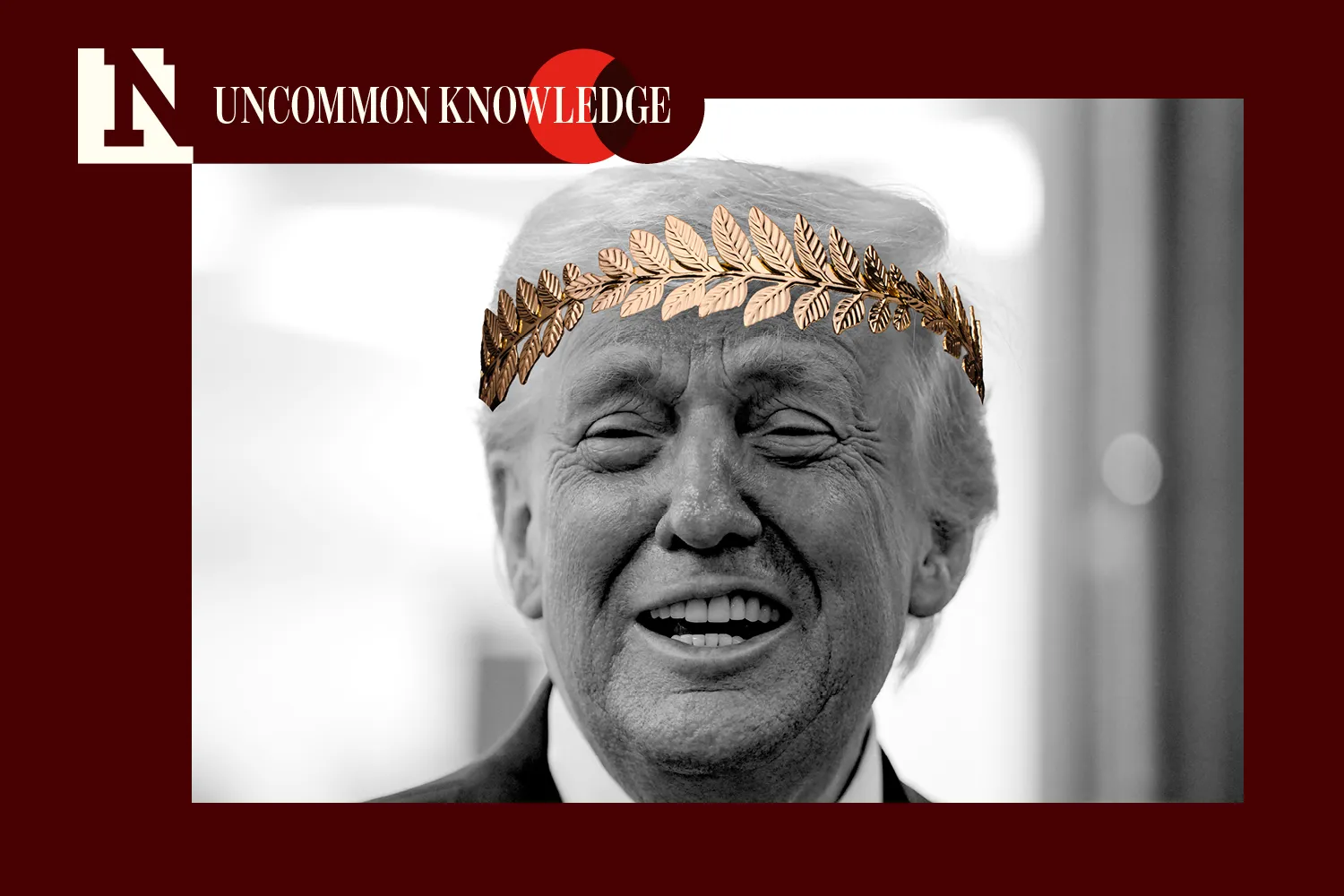
Fighters stepping from the Oval Office toward the Octagon, Trump and his impresario surveying the cage from the balcony, and a display of martial power before the national anthem. America’s liberal elite, with by turns a heavy sigh and a knowing smirk, predictably reached for its togas.
Read More on Analysis
Calling Trump a Roman emperor, even a wannabe Roman emperor, is both too flattering and too forgiving. To be fair, the glibness might be the point. The Romans we still talk about 2,000 years later are remembered less for their parties than for what they left behind: physical signs of empire that easily outlasted the men who ran it. Time will tell whether history is so kind to Trump.
But future history needs to be understood alongside past history. It’s not as if Trump is particularly novel when it comes to presidential spectacle or bravado. Trumpian displays of imperial excess should be understood as part of an America that has already survived Jacksonian mobs, Rooseveltian machismo, Wilsonian propaganda, Nixonian scandal, and Franklin Roosevelt’s four elections.
The really alarming comparison is not Trump versus Caesar, or even Trump versus his predecessors. It is Trump versus Xi Jinping. That is what true empire-building looks like.
Common Knowledge
The die was cast as soon as Trump announced the event, and the mockery continued in the hours and days after.
A commentator in The Atlantic pointed out that the steel dome on the South Lawn rose as high as the Colosseum’s top arcade and placed Trump "like a Roman emperor in his pulvinar—the imperial box," adding that the event "smacks of excess."
Another, in The Guardian, described Trump as akin to "some dysfunctional Roman despot eating grapes at the Colosseum" and argued that the spectacle announced: "The U.S. is him now." Vanity Fair simply called the South Lawn fight night an "imperial scene."
Uncommon Knowledge
The critics may be right about the vulgarity, but wrong about the novelty. Trump is not an emperor because he likes imperial kitsch. He is a president using a very American inheritance, but using it badly.
Theodore Roosevelt’s First Rule of Fight Club
Combative presidents are not new, though previously they had the courage to take part in the combat themselves. Around 1905, President Theodore Roosevelt invited the judo master Yamashita Yoshiaki to the White House to demonstrate jiu-jitsu. Roosevelt himself took part in the East Room demonstration, before spectators including William Howard Taft and members of the Roosevelt family.
Roosevelt also boxed in the residence. In a 1917 account that The New York Times published under the headline "Blind in Left Eye, Roosevelt Admits," he recalled that as president he had boxed with a young artillery captain who broke a blood vessel in his left eye, after which he could no longer see out of it.
Pete Hegseth would surely agree that the American psyche and its presidency have always carried a strain of theatrical masculinity: riding, hunting, soldiering, boxing, clearing brush at the ranch, landing on an aircraft carrier under a presumptuous "Mission Accomplished" banner. Trump’s version is television-age Rooseveltism with a promoter as much as it is modern-day gladiators.
Andrew Jackson’s Vulgar Crowd
Trump’s defenders call his vulgarity democratic, and his critics call it demagogic. We’ve been here before, too. President Andrew Jackson’s 1829 inaugural reception turned the White House into a populist crush.
Crowds surged toward the new president, punch spilled across the floors, men in muddy work boots stood on the upholstered furniture, and Senator James Hamilton, a Jackson supporter, described the scene as a "regular Saturnalia," in a future-proofed reference to the Roman festival. Jackson had already been denounced during the 1828 campaign as an American Caesar.
The Jacksonian presidency treated elite disgust as a purity test and cast the president as the voice of the people. Trump’s presidency belongs to that: not Rome imported into Washington, but American populism for a different era.
Woodrow Wilson’s Ugly Show
If the complaint is that Trump turned the executive branch into morally ugly entertainment, President Woodrow Wilson offers a far worse precedent. In February 1915, D.W. Griffith’s The Birth of a Nation was screened for Wilson in the East Room, to an audience that also included members of his cabinet and staff and their families.
Notorious now for its racist depictions of Black Americans and its lionizing of the Ku Klux Klan as defenders of the natural order, the film was given legitimacy through Wilson’s screening, and it was a huge commercial success. Though his precise views on the film are still debated, Wilson expanded segregation, partly under the guise of protecting Black Americans from themselves.
A White House cage fight is certainly coarse. Wilson’s screening added presidential prestige to a film that historians credit with helping relaunch the KKK as a mass movement. If Washington spectacle is an indication of a president advertising their own personal brand, one of these is more benign than the other.
Arch Triumphalist
Trump’s recent building program looks more damning for his critics because it seems so personal. The White House announced a 90,000-square-foot ballroom in 2025 at roughly $200 million, to be funded by Trump and "other patriot donors."
By March 2026, the estimate had doubled to $400 million while Trump insisted taxpayers would not contribute "10 cents." It’s now hit $600 million, with taxpayers projected to pay up to $300 million, according to leaked contractor documents reported by The Washington Post.
His proposed 250-foot triumphal arch is even easier material. When asked by CBS News who the arch was for, Trump pointed at himself and said, "Me." The finished arch is intended to stand more than twice the height of the Lincoln Memorial. Vietnam War veterans and an architectural historian have filed a federal lawsuit to block the arch because it will obstruct federally protected sightlines.
It’s excessive, but not unprecedented when you factor in Thomas Jefferson’s colonnades, Theodore Roosevelt’s West Wing, Franklin Roosevelt’s East Wing and Richard Nixon’s conversion of FDR’s swimming pool into the press briefing room. Harry Truman’s overhaul was more radical still: his project began in 1948, took four years, and changed the Executive Mansion more than the 1814 fire and produced much of the White House known today.
Trump, though, is behaving differently. A triumphal arch is Roman, but also not Roman. The Romans built arches to mark what the state had done. Trump wants one to mark himself, long into the future.
Et Tu, Xi Jinping
President Xi Jinping does not need an arch because he has something more durable: an official theory of why his rule need not end. In a 2021 essay collected in The Governance of China IV, Xi asks a question with a familiar echo for Western students of Roman history: "How can we break the historical cycle of rise and fall?" His answer is not to react to external criticism by opinion writers. It is party self-reform.
In classical Chinese political thought, the Mandate of Heaven gave the emperor the right to rule but made it conditional on benevolent conduct. Tyranny could mean the mandate had been lost and rebellion justified. Xi’s doctrine tries to keep the mandate while ruling out the rebellion. That is a recipe for true imperial power: not only no cage fighting allowed in Beijing, but no fighting allowed whatsoever.
After Franklin Roosevelt won four elections, America ratified the 22nd Amendment in 1951 to guarantee no president could ever do it again. In 2018, China went the opposite way, amending its constitution to delete the clause barring the president from serving more than two consecutive terms.
Against that backdrop, Xi’s China is displaying durable signs of Roman heritage that Trump’s America can only dream of. Rome left roughly 50,000 miles of paved road and an aqueduct system that moved water across the empire, and their remnants are still visible today. Augustus boasted that he found Rome a city of brick and left it a city of marble.
That’s amateur hour. China’s expressway network reached roughly 120,000 miles by the end of 2024, the longest on earth and more than double the United States Interstate system, according to its Ministry of Transport. The full road network is around 3.5 million miles.
In December 2025, with the opening of a line linking Xi’an and Yan’an, China’s high-speed rail network passed 31,000 miles, longer than every other country’s high-speed track combined, according to state. The first Chinese high-speed line had opened only in 2008.
If electricity is to modern societies what water was to Roman society, China is again leading the way. By the end of 2025, the National Energy Administration reported, the country’s wind and solar capacity had reached about 1,840 gigawatts, overtaking coal and gas for the first time and clearing a target Xi had set for 2030 roughly six years early.
In a single month in 2025, China was bolting down solar panels at a rate close to 100 per second. In 2024 it added more solar capacity than the rest of the world combined.
While Washington argues over who pays for a ballroom, Beijing is building for generations to come and doesn’t accept any arguments to the contrary. Which is what an empire does.
Seconds Out
That is the real sign of emperorship in the modern world. Not a cage fight or an arch. Trump’s critics would say that’s exactly the point: he’s not even very good at doing an impression of an emperor. In which case, what exactly are they criticizing? That Trump, or his supporters, are vulgar?
That might not be such a bad deal, because it implicitly accepts that America is still a republic and nothing Trump has done has changed that or suggested he has the power to do so. The U.S. is not, in fact, him.
You can criticize both Trump and Xi. But of all the criticisms of Trump, "emperor" is the one he should welcome, because it mistakes a man America can still vote out for the man who made sure his own country never could. It’s a criticism that says as much about his critics as it does about him.
It doesn’t mean he’s the president they want, or the president the republic needs. But some perspective is helpful. Xi doesn’t have the showmanship, but he’s more of an emperor than Trump has ever been. And the competition between the United States and China is shaping up to be rather more consequential than the one on the South Lawn for Trump’s birthday.
In a polarized era, the center is dismissed as bland. At Newsweek, ours is different: The Courageous Center—it's not "both sides," it's sharp, challenging and alive with ideas. We follow facts, not factions. If that sounds like the kind of journalism you want to see thrive, we need you.
When you become a Newsweek Member, you support a mission to keep the center strong and vibrant. Members enjoy ad-free browsing. Help keep the center courageous. Join today.


View 0 Comments
Submit Correction
View Editorial & AI Guidelines