Truth Social/@realDonaldTrump

By David Averre
0
Share
Newsweek is a Trust Project member
See more of our trusted coverage when you search.Prefer Newsweek on Googleto see more of our trusted coverage when you search.
Jair Bolsonaro came within a whisker of winning a second term as Brazil’s president four years ago, but instead ended up with a 27-year sentence for plotting a coup. Now, his eldest son wants to flip both outcomes.
Flávio Bolsonaro, the 45-year-old senator for Rio de Janeiro and firstborn to Brazil’s disgraced former president, is trying to unseat Luiz Inácio Lula da Silva, free his dad and restore the family dynasty to the presidential palace.
Part leadership bid, part personal vendetta, it’s a political storyline so juicy that Netflix executives are likely already figuring out who to cast in an eight-part dramatized documentary.
Read More on Analysis
But, just as every good drama series needs a wild-card character, there’s another person involved in this intense family affair: Uncle Donald.

...
U.S. President Donald Trump is an old friend of Bolsonaro Sr., and for proponents of the “Donroe Doctrine”—a Trump-backed vision of U.S. dominance in the Western Hemisphere—Brazil is one of the biggest prizes on the board. A Bolsonaro restoration would put a Trump ally in charge of Latin America’s largest economy, erode China’s influence and further Washington’s interests in its hemispheric backyard, experts told Newsweek.
First, though, Bolsonaro Jr. has to win—and any attempt by Trump to tip the scales in his favor before Brazil’s October 4 presidential election may give Lula all the ammunition he needs to vanquish the Bolsonaro clan once and for all.
The Heir Campaign
The presidential showdown between Lula and incumbent leader Bolsonaro Sr. in 2022 was unbelievably tense.
The campaign was marred by brutal exchanges: Bolsonaro Sr. labeled his opponent a “thief” and “ex-convict” who belonged back in prison—a reference to Lula’s 2017 corruption conviction, later overturned by Brazil’s Supreme Court. Lula, meanwhile, styled himself as a beacon of democracy protecting the nation against a “genocidal” former army captain.

...
Both were bloodied and battered, but Lula eked out the victory. He took 50.9 percent of the votes versus Bolsonaro Sr.’s 49.1 percent and secured his third presidential term in the closest election in modern Brazilian history.
In defeat, Bolsonaro Sr. took a leaf out of Trump’s book. First, he refused to concede. Then, he cried election fraud and cast doubt on Brazil’s electronic voting system. After that, he went a step further and paid the price. Last year, he was convicted of attempting a coup and is serving his sentence under house arrest due to mounting health problems.
One of his four sons has already been burned trying to save him. Former Brazilian congressman Eduardo Bolsonaro was found guilty by the country’s Supreme Court of lobbying United States authorities to intervene in his father’s legal battle. Now living in the U.S., he risks arrest if he returns to Brazil, where he faces a four-year, two-month prison sentence.
Flávio Bolsonaro is taking a different tack. Why try to defeat the Brazilian justice system from the outside when you can win an election and pardon your father from the presidential palace? On August 24, he officially launched his presidential campaign with one clear theme: revenge. And he has a real shot. A Quaest poll released August 14 put Lula at 43 percent and Flávio Bolsonaro at 40 percent in a hypothetical runoff—a statistical tie within the survey’s two-point margin of error. An August 24 BTG/Nexus survey had the pair at 46 percent to 45 percent respectively, with a two-point error margin.

...
Trump's Southern Strategy
For the U.S., Flávio Bolsonaro’s bid for the presidency goes well beyond a domestic political feud. The Donroe Doctrine—officially the “Trump Corollary” to the Monroe Doctrine—argues that Washington must “enlist” friendly governments and leaders willing to do business, to fight cartels and clamp down on immigration and to prevent “non-Hemispheric competitors” (read: China) from controlling strategically important assets.
As Latin America’s largest economy with vast natural resources, Brazil is therefore of utmost importance. But under Lula, Brasilia’s trade with Beijing reached a record $171 billion in 2025, more than double the volume of bilateral trade with Washington.
The gap has continued to grow this year, too; Brazil’s exports to and imports from the U.S. declined 12.2 percent and 10.4 percent in the first half of 2026, while exports to and imports from China grew 19.7 percent and 8 percent, according to Brazilian government figures.
“The Trump administration expects that Brazil, which has increased economic ties with China under Lula, goes back to its preferential, if not dependent, relations with the U.S,” Rafael Ioris, professor of Latin American history and politics at the Josef Korbel School of International Studies, told Newsweek.
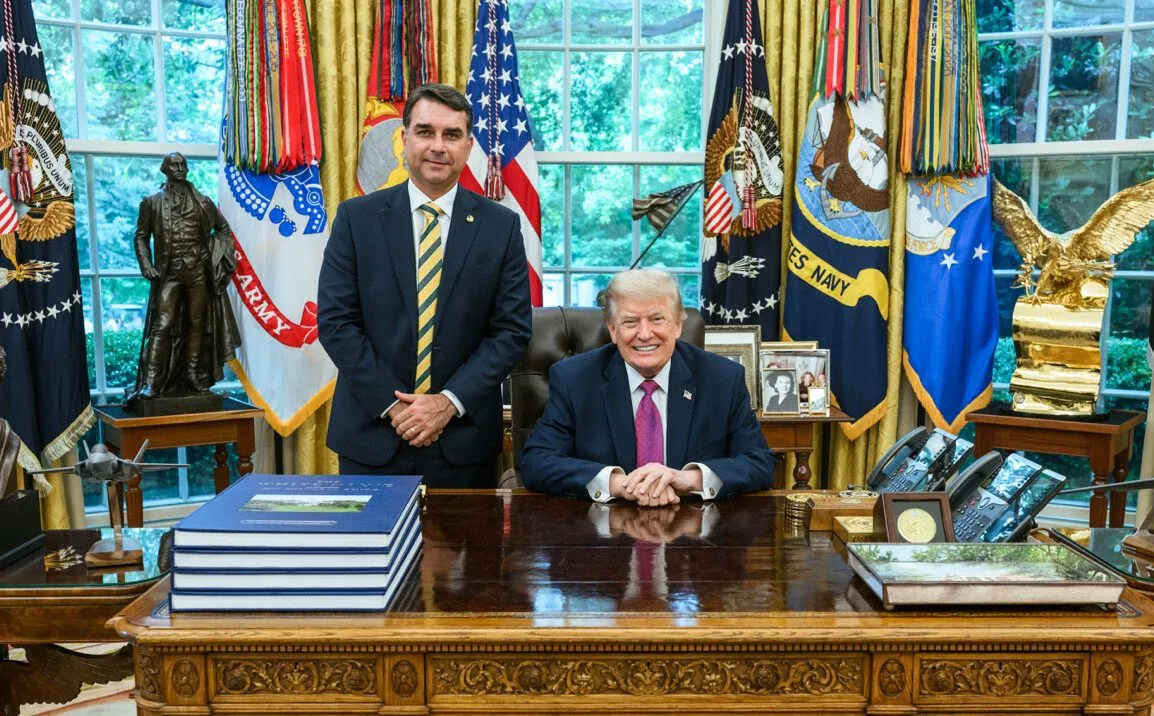
“This is not something that Lula is ready to accept. It is clear that President Trump, and especially Secretary of State Marco Rubio, believe that U.S. interests would be better promoted if the Bolsonaro clan returns to power, and they are right.” In May, Lula traveled to Washington to discuss the trade imbalance with Trump, and the pair agreed to establish a joint working group to try to resolve their disputes. Later that month, Flávio and Eduardo Bolsonaro made a visit of their own to the White House and effectively delivered the Donroe Doctrine pitch word for word to Trump.
First came the fight against organized crime. Flávio Bolsonaro, who intends to build several maximum-security detention facilities modeled on El Salvador’s infamous CECOT megaprison, asked Trump to designate Brazilian gangs Primeiro Comando da Capital and Comando Vermelho as terror organizations. Two days later, it was done.
Then, the discussion turned to commerce. “Flávio Bolsonaro pointed to rare earth resources as a potential area of cooperation between Brazil and the United States, and [he] is more likely to make concessions to the White House to restore trade relations,” Gustavo A. Flores-Macías, an expert on Brazilian politics and professor with the University of Maryland School of Public Policy, told Newsweek.

...
The Backfire Risk
Trump might want Flávio Bolsonaro in power, but his meddling in Brazil’s political affairs did nothing to save his father. The U.S. president openly endorsed his Brazilian counterpart in the run-up to the 2022 election, cast him as the only hope of preventing the rise of communism and socialism in Latin America, and peddled Bolsonaro Sr.’s criticism of his nation’s electronic voting practices to lay the groundwork for challenging an unfavorable result.
In the wake of Bolsonaro Sr.’s defeat and investigation into his plans to launch a coup, Trump went a step further, slapping 50 percent tariffs on Brazilian imports and sanctioning a Supreme Court judge, Justice Alexandre de Moraes.
The abuse of power went awry. The courts went ahead and meted out justice anyway, while Lula enjoyed a popularity boost as he wrapped himself in the flag, assuming the role of national defender against a bullying power. Lula has returned to the same playbook this election, accusing Washington of trying to influence the vote and casting Brazilian control of its minerals and economy as a question of national sovereignty.
Now, with around a month to go until the election, the conflict is escalating again. In July, Washington announced new tariffs on Brazilian goods, including furniture, ethanol, machinery, footwear and sugar. Brasilia refused visas to two U.S. officials, citing concerns the envoys had been sent to interfere in the elections. Washington then revoked the visa of the Brazilian ambassador, and the White House reportedly weighed up fresh sanctions against De Moraes.

...
The irony is that Trump does not necessarily need his old friend’s son in power to improve America’s ties with Brazil.
“Lula is a very pragmatic politician, willing to negotiate trade and other deals with whoever is in the White House,” said Ioris, pointing out that even powerful business groups typically aligned with the Bolsonaros have sided with Lula over Trump’s tariffs.
However, Trump appears committed to pursuing his pressure tactics in favor of Bolsonaro Sr.
“It would be more logical to negotiate with Lula…but, as much as it claims to be defending economic interests of the American people, the U.S. administration acts based on ideological motivations.” Flores-Macías, meanwhile, was skeptical about how much influence Trump can wield over Brazilian voters, given how polarized the electorate has become.
“If President Trump openly backs Flávio Bolsonaro, only a small share of voters might be persuaded. But, because favorable attitudes toward the U.S. have trended down in Latin America, any perceived attempts of meddling in elections might backfire.”
Both experts agreed on one thing, though—victory for Lula will leave Trump red in the face. “The Trump administration basically wants the region to remain aligned with, even better, subordinate to its plans for the hemisphere and…its hegemonic dispute with China,” Ioris said. “This would certainly tarnish the success that the administration has had thus far in reshaping the course of Latin America. Given the size of Brazil, this shortcoming would have great significance.”
So, Flávio Bolsonaro wants the presidency to restore his father; Trump would like the son to help restore American primacy in the Western Hemisphere. But if Uncle Donald tries too hard to save the Bolsonaro dynasty, he will only be helping the man who destroyed it in the first place.
The Netflix doc will be a good one.
View 0 Comments
Submit Correction
View Editorial & AI Guidelines