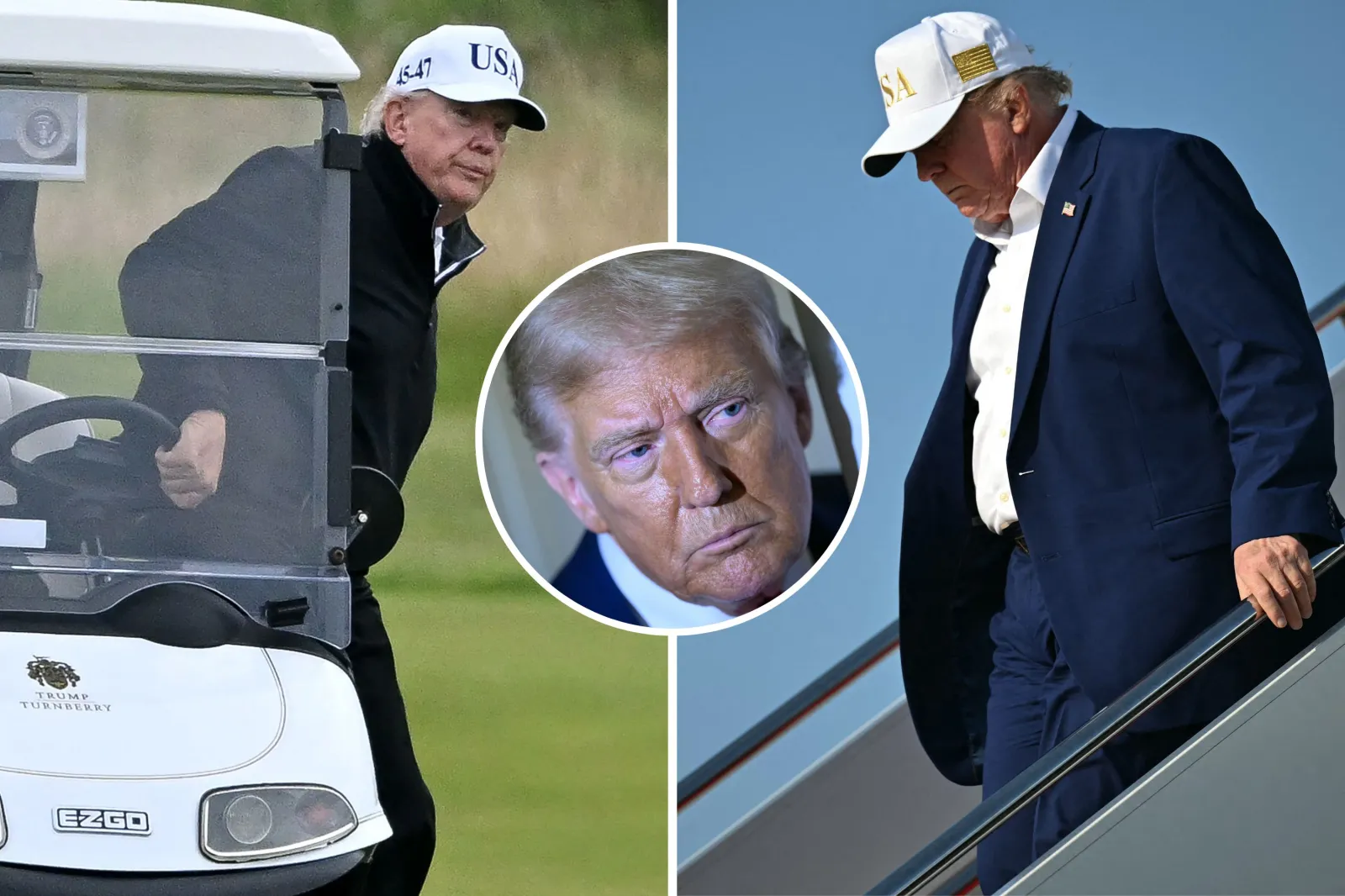
Getty Images/Newsweek illustration

By Newsweek Editors
0
Share
Newsweek is a Trust Project member
See more of our trusted coverage when you search.Prefer Newsweek on Googleto see more of our trusted coverage when you search.
President Donald Trump has spent much of his adult life making himself impossible to ignore. Last month, his security team faced the opposite problem: how to make him disappear.
Their answer was an airport catering truck.
The maneuver in Turkey was prompted, according to The Washington Post, by a credible Iranian assassination threat. It involved a decoy Air Force One, a second military aircraft, reporters who thought the president was still sitting on their plane, and the leader of the free world being spirited across an airport in a vehicle that carries airline meals.
Read More on News
It was not the first time that Trump has found himself concealed, bundled away or ushered through somewhere with more than a hint of slapstick.
Trump is the president, and he does face credible and sometimes life-threatening risks, so "hidden" needs a little latitude. Sometimes Trump was being protected from a genuine threat. Once he was evading protesters. On another occasion, he appears mainly to have wanted a steak. But all five are united by the same counterintuitive image: Trump trying not to be seen.
1. An Airport Catering Truck
At first, the July 8 flight out of Turkey was more about showmanship and nostalgia than security risk.
Trump had flown to the NATO summit in Ankara aboard a newly renovated Boeing 747 donated by Qatar. Before leaving, he announced that he would use the more familiar pale-blue presidential 747 for the first leg home to Britain, writing on Truth Social that he wanted to take the old Air Force One "for old time’s sake."
Trump said the Qatari jet had been sent ahead to RAF Mildenhall so American service members stationed in England could tour it, and he rejected the suggestion that anything else was involved. "There wasn’t a security concern," he said.
Trump boarded the old aircraft in Ankara in full view of the cameras. The press traveling with him naturally assumed that when the aircraft departed, the president would be on it. He wasn’t.
After boarding, Trump was secretly moved off the 747 in an airport catering truck and taken to a smaller Air Force C-32A, according to the Post. He then flew separately to Britain while the much larger and much more recognizable presidential aircraft continued as a decoy. Journalists aboard the 747 were instructed to keep their window shades closed and even some White House staff believed Trump was still traveling with them.
The reason was serious. The Post said that officials had intelligence of a credible Iranian assassination threat. Before leaving Ankara, Trump had acknowledged the danger: "I’m number one on the kill list for Iran." Asked whether that explained the plane switch, he added: "I don’t know. I can’t tell you that but I don’t really care."
The White House has still not publicly addressed the catering truck. Asked about the incident, communications director Steven Cheung defended the aircraft rather than the operation, calling the new Air Force One "a state-of-the-art aircraft that has been fitted with high-level security protocols that ensure the safety of the President and his staff."
He then offered the closest thing to an acknowledgment of the threat. "As the President has said recently, there are many enemies of America who have their sights on him, and we use every tool at our disposal to address those threats," Cheung said.
The deception was good enough that when the C-32A reached Britain, Trump was reunited with the presidential entourage before continuing home aboard the Qatari-donated aircraft. The traveling press did not learn what had actually happened until it was reported more than a month later.
Trump even supplied the punchline (that's another theme in this list). Asked after the journey why reporters had been ordered to close their shades, he said they had been "probably on a dangerous flight."
"But if I go, you go. Right?" he added.
Except he hadn’t. He had gone in the catering truck.
2. Into a Hyatt, Via the Freeway
Ten years earlier, Trump needed to disappear for a less exotic reason: he could not get into his hotel.
On April 29, 2016, several hundred protesters gathered around the Hyatt Regency near San Francisco International Airport, where Trump was due to address the California Republican convention. The crowd blocked his arrival route, forcing his motorcade to stop and his entourage to improvise.
They went in by the back.
The motorcade pulled off Highway 101 and the future president hopped a low wall behind the property, an indignity filmed from the air by a CBS News helicopter. Police, fencing and concrete barriers surrounded the hotel, giving the arrival less the appearance of a billionaire entering a Republican convention than somebody attempting to sneak into the service entrance.
Trump knew how ridiculous it looked.
"That was not the easiest entrance I’ve ever made," he told the audience once he reached the stage.
Then he landed the punchline: "It felt like I was crossing the border, actually."
That made a lot of sense in April 2016, because Trump's campaign was built partly around his promise to construct a wall on the Mexican border, while protesters outside the hotel included demonstrators carrying Mexican flags.
Trump described his own route that afternoon as being escorted "under a fence and through a field."
3. The Bunker Beneath the White House
The third hiding place was more conventional for a president.
On May 29, 2020, demonstrations over the killing of George Floyd reached the perimeter of the White House. Hundreds of protesters gathered outside, some throwing objects and tugging at barricades. Secret Service agents moved Trump into the underground emergency bunker beneath the Executive Mansion, where The Associated Press (AP) reported that he stayed for nearly an hour.
That's exactly what presidential bunkers are for. The problem came later.
News that Trump had been taken underground rapidly revived the nickname "Bunker Boy" among his critics. Trump, whose political persona depended heavily on toughness, objected to the idea that he had retreated from protesters and offered an alternative explanation.
He said the trip underground had been only a brief visit and was "more for an inspection."
His attorney general was less helpful. Bill Barr told Fox News in June 2020 that conditions outside had become "so bad" that the Secret Service recommended taking Trump downstairs.
So the dispute was not over whether the president had spent time beneath the White House, because he had, but over whether he had been hiding in the bunker or merely inspecting it.
Related Story

Trump Won the War on Wokeness. AOC Is the Proof.
4. An Armored Golf Cart
If a catering truck sounds like a suitable hiding place invented for Trump, the next getaway vehicle is even more on-brand.
On September 15, 2024, Trump was golfing at Trump International Golf Club in West Palm Beach when a Secret Service agent moving ahead of him spotted the barrel of a rifle pushed through the bush-lined fence at the perimeter of the course, roughly 400 yards away.
The agent fired toward the armed man. Trump was on the fifth hole, lining up a birdie putt with his playing partner, the real-estate investor Steve Witkoff, later Middle East envoy, while the agent swept the hole ahead of them. According to an account political commentator Sean Hannity gave after speaking with Trump and Witkoff, agents immediately covered Trump with their bodies.
Then the armored golf cart arrived. Witkoff told Hannity that a "fast cart" with steel reinforcement and other protection whisked Trump away. AP reported that agents moved him to the clubhouse, where he remained until he was taken back to Mar-a-Lago.
Trump later gave his own version. He said he had heard four or five shots and that "we got into the carts, and we moved along pretty, pretty good." Nonetheless, there was one important casualty of the security operation.
"I would have loved to have sank that last putt, but we decided, let’s get out of here," Trump said.
The incident was an apparent attempt on his life and deadly serious. But there remains something unmistakably Trumpian about the emergency response.
5. A Former Speakeasy, for Steak
The first four hiding places involved assassination threats, violent unrest or angry protesters. The fifth involved dinner.
A week after winning the 2016 election, President-elect Trump was discovering one of the less glamorous sides of becoming president: a small pool of journalists expected to know where he was.
At around 6:15 p.m. on November 15, Trump spokeswoman Hope Hicks told reporters that Trump had returned to Trump Tower for the evening. In pool jargon, a "lid" had been called and reporters could stop expecting further movements.
Trump then went out for steak. He and his family traveled to the 21 Club in Midtown Manhattan without the protective press pool. When reporters discovered what had happened, there was a frantic pursuit. One group jumped into a cab and went to the wrong restaurant. By the time journalists found the correct one, police had barricaded the entrance. Some reporters without press credentials were ordered a block away, where their view was obstructed by a dumpster.
The restaurant could scarcely have been better chosen for such a scene. The 21 Club, which closed in 2020, was a former Prohibition-era speakeasy. In its original incarnation, it had made its reputation partly from allowing wealthy New Yorkers to eat and drink somewhere authorities were not supposed to know what was going on.
Hicks said she had not known about the dinner and had not intended to leave the press "in the dark." The episode nevertheless added to concerns from the White House Correspondents’ Association about Trump’s refusal to establish a regular protective pool in case of a major emergency involving the president.
Bonus: The President Who Hid in a Bush
Trump at least had the impressive security apparatus of the American presidency. President Daniel arap Moi of Kenya had a bush.
In the early hours of August 1, 1982, members of the Kenyan Air Force attempted to overthrow Moi’s government. Word of the coup reached Moi’s escort commander by telephone at 3 a.m., according to Andrew Morton’s biography Moi: The Making of an African Statesman.
Moi’s security team decided his home at Kabarak was too vulnerable and urged him to move but Moi did not sound keen on hiding.
"No, I am not moving from this house. Do you think I am a coward?" he said.
His escort commander, Elijah Sumbeiywo, took hold of the president and said simply: "Let’s go!"
Sumbeiywo squeezed into his brother’s Peugeot. A convoy of guards’ cars drove several miles from Kabarak and headed into the bush, the president among them.
According to Morton’s account, Moi and his guards were to be hidden away in the scrub, without vehicles, tents or other visible supplies, until the news from Nairobi became clearer.
Meanwhile, the rebels seized Kenya’s national broadcaster and announced at dawn that Moi had been overthrown and replaced by a National Redemption Council. Loyal forces fought back and later that day, the coup was collapsing, while Moi remained president. He would stay in office until 2002.
Presidential protection has become rather more sophisticated since 1982 but the principle has not: find somewhere to hide where nobody would think to look.
For Moi, it was a bush. For Trump, it was a catering truck.
View 0 Comments
Submit Correction
View Editorial & AI Guidelines