10
Loading video...

By Gabe Whisnant
News Editor
0
Share
Newsweek is a Trust Project member
See more of our trusted coverage when you search.Prefer Newsweek on Googleto see more of our trusted coverage when you search.
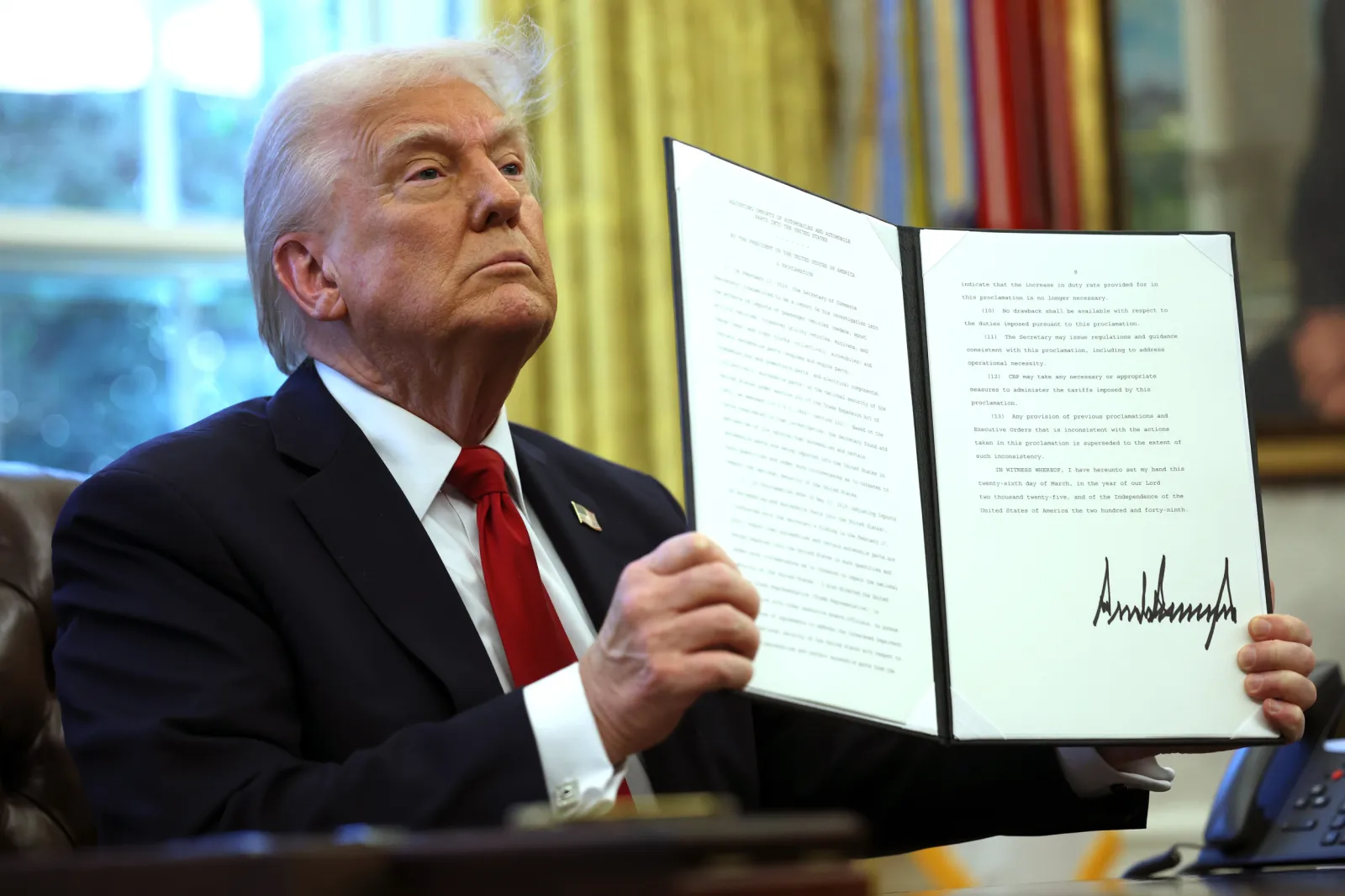
President Donald Trump announced Wednesday that he is imposing a 25 percent tariff on imported automobiles — a decision the White House says is aimed at boosting domestic manufacturing, though it could also strain automakers reliant on international supply chains.
Trump is calling April 2, when the tariff takes effect, "Liberation Day."
"This will continue to spur growth," Trump told reporters. "We'll effectively be charging a 25 percent tariff."
Read More on Politics
...
Why It Matters
President Trump's announcement of a 25 percent tariff on imported automobiles is expected to have sweeping implications for the auto industry and the broader U.S. economy. The White House projects the new tariffs will generate $100 billion in annual revenue, but industry analysts warn that the move could disrupt global supply chains and lead to higher prices for consumers.
Even American automakers source many of their components from abroad, meaning the tax hike—set to begin in April—could drive up production costs, limit vehicle availability, and reduce overall sales. Despite these concerns, Trump defended the tariffs as a way to bring manufacturing back to the U.S., calling current cross-border supply chains "ridiculous" and declaring, "This is permanent."
What to Know
Financial markets reacted quickly to Trump's latest tariff announcement. General Motors stock dropped about 3 percent, while shares of Stellantis, the parent company of Jeep and Chrysler, fell nearly 3.6 percent. Ford saw a slight uptick.
Trump has long touted tariffs as central to his economic strategy, arguing that taxing imports will encourage domestic production and shrink the budget deficit. However, experts say the transition to U.S.-based manufacturing could take years, as companies would need time to plan, construct, and staff new factories.
If fully passed on to consumers, the tariffs could raise vehicle prices by as much as $12,500, adding pressure to inflation—an issue Trump pledged to address during his return to the White House. With average car prices already near $49,000, many households may be priced out of the new car market.
To soften the impact, Trump proposed a tax deduction for interest paid on auto loans—but only for vehicles made in the U.S.—a move that could offset some of the expected tariff revenue.
The auto tariff is part of a broader strategy to impose "reciprocal" taxes on imports from countries like China, Mexico, and Canada. Some of those tariffs, including those on autos from Canada and Mexico, were temporarily paused after pushback from manufacturers but are scheduled to resume in April.
On Monday, President Trump pointed to South Korean automaker Hyundai's plans to build a $5.8 billion steel plant in Louisiana as proof that tariffs are helping to revive U.S. manufacturing jobs.
Currently, just over one million people are employed in the domestic manufacturing of motor vehicles and parts—roughly 320,000 fewer than in 2000, according to data from the Bureau of Labor Statistics. An additional 2.1 million Americans work at auto and parts dealerships.
What People Are Saying
Canadian Prime Minister Mark Carney said Wednesday: "This is a very direct attack. We will defend our workers. We will defend our companies. We will defend our country."
European Commission President Ursula von der Leyen said in a statement Wednesday: "Tariffs are taxes — bad for businesses, worse for consumers equally in the U.S. and the European Union," adding that the EU's executive branch would assess the impact of the move, as well as other U.S. tariffs planned for coming days.
Trump told reporters Wednesday: "If parts are made in America and a car isn't, those parts are not going to be taxed or tariffed and we will have very strong policing... It's one number and that number is going to be used to reduce debt greatly in the United States and build things."
The White House said in a statement: "President Trump is taking action to protect America's automobile industry, which is vital to national security and has been undermined by excessive imports threatening America's domestic industrial base and supply chains.
What Happens Next
Trump also plans new tariffs on steel, aluminum, pharmaceuticals, computer chips, lumber, and copper, raising fears of a global trade war. The European Union has threatened a 50 percent tariff on U.S. spirits in response, prompting Trump to announce a planned 200 percent tax on European alcoholic imports.
This is a developing news story and will be updated as more information is available.
Reporting by the Associated Press contributed to this story.
Update: 3/26/25, 6:20 p.m. ET: This article has been updated with additional information and remarks.
Update: 3/26/25, 8:04 p.m. ET: This article has been updated with additional information and remarks.
View 0 Comments
Submit Correction
View Editorial & AI Guidelines