10
Loading video...

By Steve Mollman
News Editor
0
Share
Newsweek is a Trust Project member
See more of our trusted coverage when you search.Prefer Newsweek on Googleto see more of our trusted coverage when you search.
President Donald Trump's push to reshape the U.S. Navy's newest aircraft carriers is drawing warnings from defense analysts, contractors and former officials who say the proposed changes could increase costs, delay construction and reverse design decisions the Navy spent years implementing.
The concerns come after Trump signed a national security memorandum on Thursday directing the Pentagon and Navy to develop a plan within 60 days to replace the Electromagnetic Aircraft Launch System (EMALS) and Advanced Weapons Elevators on the USS Doris Miller, an upcoming Ford-class aircraft carrier, with steam catapults and hydraulic systems.
The Ford class is the Navy's newest generation of aircraft carriers and is intended to replace the aging Nimitz-class fleet over the coming decades.
Read More on News
The debate intensified after the Washington Post reported on Saturday that Navy officials are also evaluating the feasibility of moving the island, or command tower, on Ford-class aircraft carriers farther forward on the ship to better align with Trump's preferences for the ships' appearance. Current and former officials told the newspaper that such a redesign could require significant time and money. Bryan Clark, a former Navy officer and defense analyst at the Hudson Institute, described moving the island as "a major redesign" that would be "very disruptive."
Newsweek reached out to the Navy, Pentagon and White House for comment. The Pentagon referred questions to the White House, which did not respond.

...
Aircraft Carrier Redesign
Navy officials told the Washington Post the island was moved farther toward the rear of Ford-class carriers for operational reasons, including creating additional aircraft parking space near launch areas, improving aircraft launch efficiency, reducing turbulence during landings and improving safety. They also said the Navy previously studied relocating the island during Trump's first term and concluded the move could cost billions of dollars and significantly delay the program.
The Ford-class carrier fleet includes the USS Gerald R. Ford, already in service, the USS John F. Kennedy, which is undergoing sea trials, and the USS Enterprise and USS Doris Miller, which remain under construction.
Steam Catapult Debate
Trump has criticized EMALS for years, arguing the system is overly complicated compared with traditional steam catapults. In the new memorandum, the administration emphasized a preference for "proven, reliable and affordable technologies and ship designs."
The Navy, however, has previously highlighted several advantages offered by EMALS. According to the service, the electromagnetic system allows aircraft to be launched at a higher rate than older Nimitz-class carriers and requires fewer personnel to operate. The Associated Press reported that EMALS reduced the number of sailors needed to operate catapults aboard the USS Gerald R. Ford from roughly a dozen to two. The system has also been described as easier to maintain and less demanding in terms of shipboard space.
The debate extends beyond the U.S. as China's newest aircraft carrier uses electromagnetic catapults, while France plans to use the technology on a future carrier.
Related Story
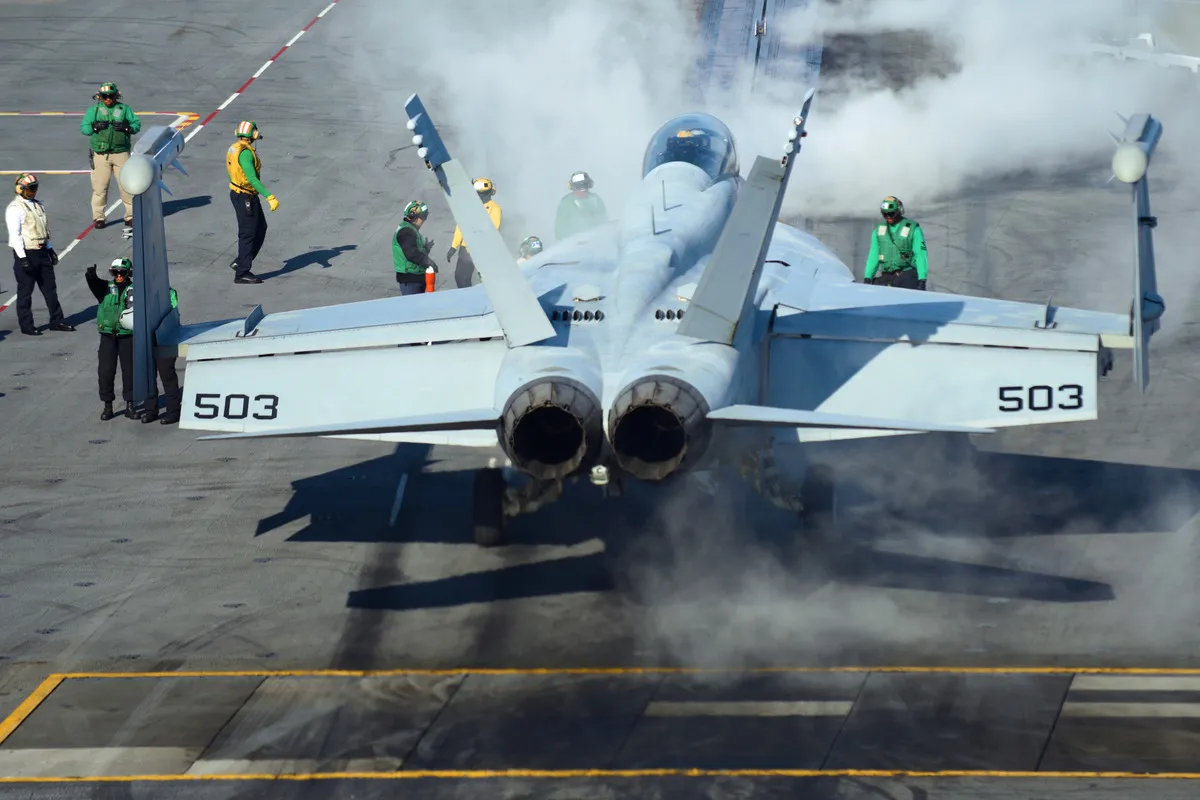
Steam Catapults Versus Electromagnets: How Ways of Launching Jets Compare
Cost and Delay Risks
General Atomics, the manufacturer of EMALS, has warned that changing course on the USS Doris Miller could have significant consequences because work on the launch system is already well underway.
The company said in a statement that catapult and arresting gear production for the vessel is roughly 50 percent complete and that abandoning the system now would create "significant cost, schedule, and integration risks." The company received a contract worth nearly $1.2 billion in 2023 related to the carrier's launch and recovery systems.
Clark warned that altering core carrier systems after a design has largely been finalized could create major disruptions because changes would affect multiple aspects of the ship's construction.
Separately, Clark told CNN that redesigning the USS Doris Miller could delay the carrier's entry into service beyond its expected 2034 timeframe. He also argued that EMALS has reduced personnel and maintenance costs on Ford-class carriers.
The concerns come as the Navy continues to struggle with shipbuilding delays and maintenance backlogs across multiple programs. Trump's memorandum itself cited cost growth, delays and cancellations linked to design complexity and changes as reasons for seeking reforms in naval procurement.
At the same time, the Navy is facing broader operational and shipbuilding challenges. Aircraft carriers have been heavily used in operations related to the Iran war, while lawmakers and military families have recently raised concerns about the lengthy deployment of the USS Abraham Lincoln and the strain placed on sailors. Trump has dismissed concerns about the deployment, while Defense Secretary Pete Hegseth has said reports about conditions aboard the carrier were "completely misrepresented."
Related Story

Navy Expansion Plans Could Cost Over $1 Trillion
Critics Push Back
Several defense analysts have questioned whether the proposed changes are worth the disruption.
Todd Harrison, a defense budget analyst at the American Enterprise Institute and former Air Force officer, told Politico that the modifications sought by Trump are "highly unusual and disruptive for the Navy," particularly because they are changes the service itself did not request.
Senator Mark Kelly, a former Navy pilot and astronaut, criticized the proposal in a Thursday post on X.
"I've launched off the front of aircraft carriers hundreds of times," Kelly wrote, adding that despite his aviation and engineering background, he would not tell Navy engineers how to design carrier systems. In a later interview with The Hill, the Arizona Democrat said redesigning ships already under construction would "probably" cost billions of dollars.
Kelly added: “Donald Trump knows nothing about this stuff. Not in any world would I suggest to the Navy to change the design of some system on a ship at this point.”
Critics counter that redesigning vessels already under construction could undermine those goals by increasing costs, extending timelines and reversing modernization efforts the Navy has spent years pursuing, including the adoption of electromagnetic launch systems and other Ford-class technologies.
Contact Newsweek editor for this story: Anthony Murray.
View 0 Comments
Submit Correction
View Editorial & AI Guidelines