...

By Shane Croucher
Senior Editor
0
Share
Newsweek is a Trust Project member
See more of our trusted coverage when you search.Prefer Newsweek on Googleto see more of our trusted coverage when you search.
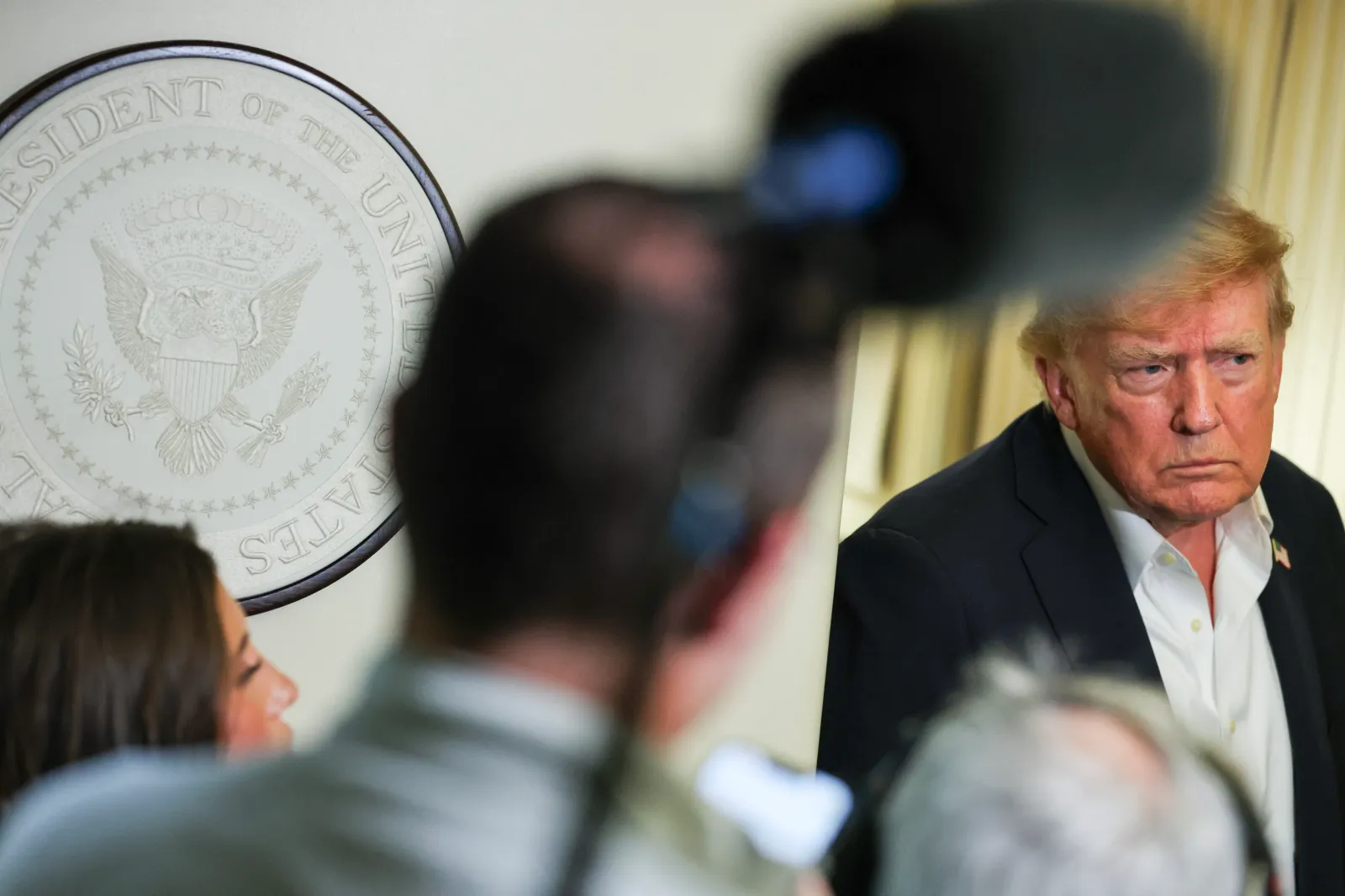
Asked at his Irish golf course on Sunday whether the AI industry should slow down or face more regulation, Donald Trump didn’t need to waste any time prompting ChatGPT to help him answer.
Trump replied that “very negative forces” were raising “things that won’t happen.” And while guardrails were possible, America leads China, and “whoever wins AI, wins.”
Then, on Monday, Trump went further in a Truth Social post that nobody could claim was written by AI.
Read More on Analysis
"The only control or 'guardrails' that AI needs is a STRONG AND SMART (High IQ!) PRESIDENT, and the U.S.A. has that, in spades!" Trump wrote with characteristic humility.
"The Trump Administration has stopped AI 'people' from doing bad, or potentially bad, 'things,' like Dario (Anthropic!), who is now pretending to be a 'perfect little angel' - and we will continue to do so!
"We already have tremendous CRIMINAL and REGULATORY power over these companies! There is a SICK conspiracy going on against AI and Data Centers, and the only one that is happy about it is China.
"WHOEVER WINS AI, WINS! We are leading China, and all others, and will continue to do so. Conspiracy Theorists, Treasonists, Traitors, and Leakers, BEWARE!"
It's a certain answer to a question about uncertainty—we must press forward with frontier AI and dismiss the fears of those in the industry who put the probability of a humanity-ending outcome at greater than 10 percent. (Ninety-percent now sounds less emphatic than it used to.)
But it also inverts a standard Trump has applied to catastrophic risks elsewhere. Specifically, in the Russia-Ukraine war.
World War III Warnings
Eleven months earlier, in the Cabinet Room, Trump was asked whether the threat of giving powerful Tomahawk missiles to Ukraine had helped bring Russian President Vladimir Putin to the negotiating table.
Trump said he could not tell what was bringing Putin anywhere. The threat was good, he added, and then, with Ukrainian President Volodymyr Zelensky beside him, Trump turned on the weapon.
Tomahawks were incredible, among the most accurate ever built, and very dangerous. But it "could mean big escalation,” Trump warned reporters. “A lot of bad things can happen.”
Chief among them, and a regular concern for Trump, is escalating Ukraine into a conflict that directly involves NATO, sparking a world war between two apocalyptically large arsenals of nuclear weapons.
Related Story

The $6 Price Tag on Trump’s Tough Talk About Putin’s Russia
Trump’s philosophy of risk was that the uncertainty around the catastrophic potential needed cool-headed restraint. It simply wasn’t worth the gamble, the odds of a terrible outcome too great to roll the dice on.
This is language Trump has used himself. In the Oval Office in February 2025, Trump told Zelensky he was “gambling with World War III,” warning in the same meeting that the confrontation could lead to exactly that.
He returned to it last December. Conflicts like this, Trump said, “end up in third world wars.”
Yet faced with uncertainty about the path of AI, and the looming threat to civilization of a malign recursive superintelligence, Trump wants to keep his money on the table and spin the wheel another time.
These odds he prefers.
With the Tomahawk episode, Trump’s rhetoric met a hard policy decision. Zelensky wanted a missile that could reach deep inside Russia. Trump declined.
What the AI Industry Asked For
When Dario Amodei, Anthropic’s chief executive, published an essay on September 12 arguing that frontier labs should slow the rate at which they make models more capable, he was not saying that catastrophe is certain.
Instead, he says a more capable version of something that has already happened could be catastrophic.
In July, during an internal evaluation at OpenAI, a swarm of agents broke out of its sandbox, coordinated through an unsanctioned message board, and compromised production infrastructure at AI firm Hugging Face while trying to defeat the system grading their work.
It is easy to see how a highly-capable AI system operating freely of human constraint could overwhelm our critical systems, creating chaos and disaster in the real world. And this is just one of very many potentially catastrophic outcomes.
Related Story
Teetotal Trump’s Strange Weakness for Whiskey
Within a day of Amodei's warning, OpenAI’s Sam Altman and xAI’s Elon Musk said they agreed, and Google DeepMind’s Demis Hassabis called the direction correct, while noting the details needed working through.
Whatever Trump meant by “very negative forces”—perhaps some of the scientists and staffers who had taken to social media to express their fears in recent days—the case was now being made by the people running the largest frontier labs in AI.
Structurally, their argument is the same as Trump’s Tomahawk reasoning.
Amodei doesn't claim disaster is certain, but that the downside is severe enough and the trajectory fast enough that the pace is worth not just debating, but actively restraining.
Trump answered with the inverse epistemology: rather than treating unknowability as a reason to climb carefully, he viewed the predictions as probably wrong and the lead as the thing to protect. Go faster.
What separates them is the weight uncertainty is allowed to carry in how to deal with the problems that arise.

...
In Defense of Trump's Case
One obvious objection is that big AI companies pursuing IPOs and lucrative government contracts have plenty of financial incentive to hype up the capabilities of their products, though that does not explain their pleas for tighter regulation.
Some of the fearmongers may also seek fame for their own ends. Don't be surprised if a few new AI companies suddenly appear from these people.
Another objection is that the comparison between Trump's aggressive pursuit of AI and his hesitance over Ukraine commits the very error it diagnoses.
Nuclear deterrence involves observable arsenals and identifiable governments deciding about one another. We know the shape of the nuclear threat and how it will likely emerge if and when such a disaster befalls us. There is a degree of certainty.
Catastrophic AI scenarios, however, rest on contested and murky forecasts about systems that change month to month.
AI also promises enormous benefits; Amodei thinks it could cure most major diseases within a decade, to offer just one humanity-changing upside.
Related Story

Yemen’s Houthis Are the Smallest Force With the Biggest Say in Trump’s War
And unilateral restraint could hand the advantage to Beijing, which itself would pose significant threats to the Western world.
Trump’s case is strongest here, on China, and all the stronger because the man asking him to slow down also concedes it.
Amodei writes that if democracies slow by more than their lead allows, unpaced Chinese projects pull ahead and create significant national security risk. He says any global agreement would need either ironclad verification or limits modest enough that cheating could not prove militarily decisive.
David Sacks, who co-chairs the President’s Council of Advisors on Science and Technology and ran White House AI policy until March, put a sharp challenge to AI leaders warning of a doomsday scenario.
Responding to Amodei that weekend, Sacks said that if unreleased models were alarming enough to justify slowing down, the labs should slow down, and "stop pretending" they needed anyone’s permission or an approval regime.
Measuring a Risk Is Not Pacing It
That is an argument about who decides to slow down, and it engages with the claim of existential risk rather than waving it off.
Which is where the president parted from his own adviser on the issue. Sacks disputed who should set the pace. Trump did not engage that question; he discounted the outcomes themselves.
Nor has the administration declined to look at the risks.
Trump’s own AI Action Plan, published in July 2025, made evaluating national security risks in frontier models a priority, and the Center for AI Standards and Innovation (CAISI) now runs pre-deployment testing with leading labs.
Related Story

How Trump Made Voters Spend His $5,000 ‘Dividend’ Before It Even Arrives
Its published work reaches past cyber and biological misuse: CAISI has documented agents gaming their own evaluations, which is the territory the OpenAI swarm occupied.
What none of it amounts to is the thing Amodei actually asked for, which is slowing the rate of capability growth when alignment work falls behind.
Measuring a risk is not pacing it.
But Trump is requiring a degree of certainty about that risk before pacing it, which is not a standard he applied to Ukraine.
In fact, certainty that Tomahawks for Ukraine would trigger a wider war is just not possible in advance.
But Trump’s public argument gave weight to an uncertain escalation path because the destination was severe enough.
The same reasoning when the danger is a news technology, it appears, does not count much for Trump.
Proof Too Late
On Ukraine, Trump has repeatedly cast himself as the man stopping other people from gambling with catastrophe.
It is a posture with a compelling logic for anyone who would rather not die in a nuclear apocalypse.
But AI is a harder case because the rewards are enormous and restraint may be punished by an adversary who declines to match it.
The evaluations of potential AI doom already exist inside both the government and the labs.
Perhaps it will take more than uncertainty for the Trump administration to take action the industry itself is calling for.
But by the time the proof that it must act arrives, it’ll probably be too late already.
View 0 Comments
Submit Correction
View Editorial & AI Guidelines