10
Loading video...


By Hannah Parry and Leonardo Feldman
0
Share
Newsweek is a Trust Project member
See more of our trusted coverage when you search.Prefer Newsweek on Googleto see more of our trusted coverage when you search.
The Trump administration on Monday refused to close the door on President Donald Trump’s push to make Canada the 51st U.S. state, instead challenging Canadian Prime Minister Mark Carney to come back to the negotiation table after trade talks collapsed last week.
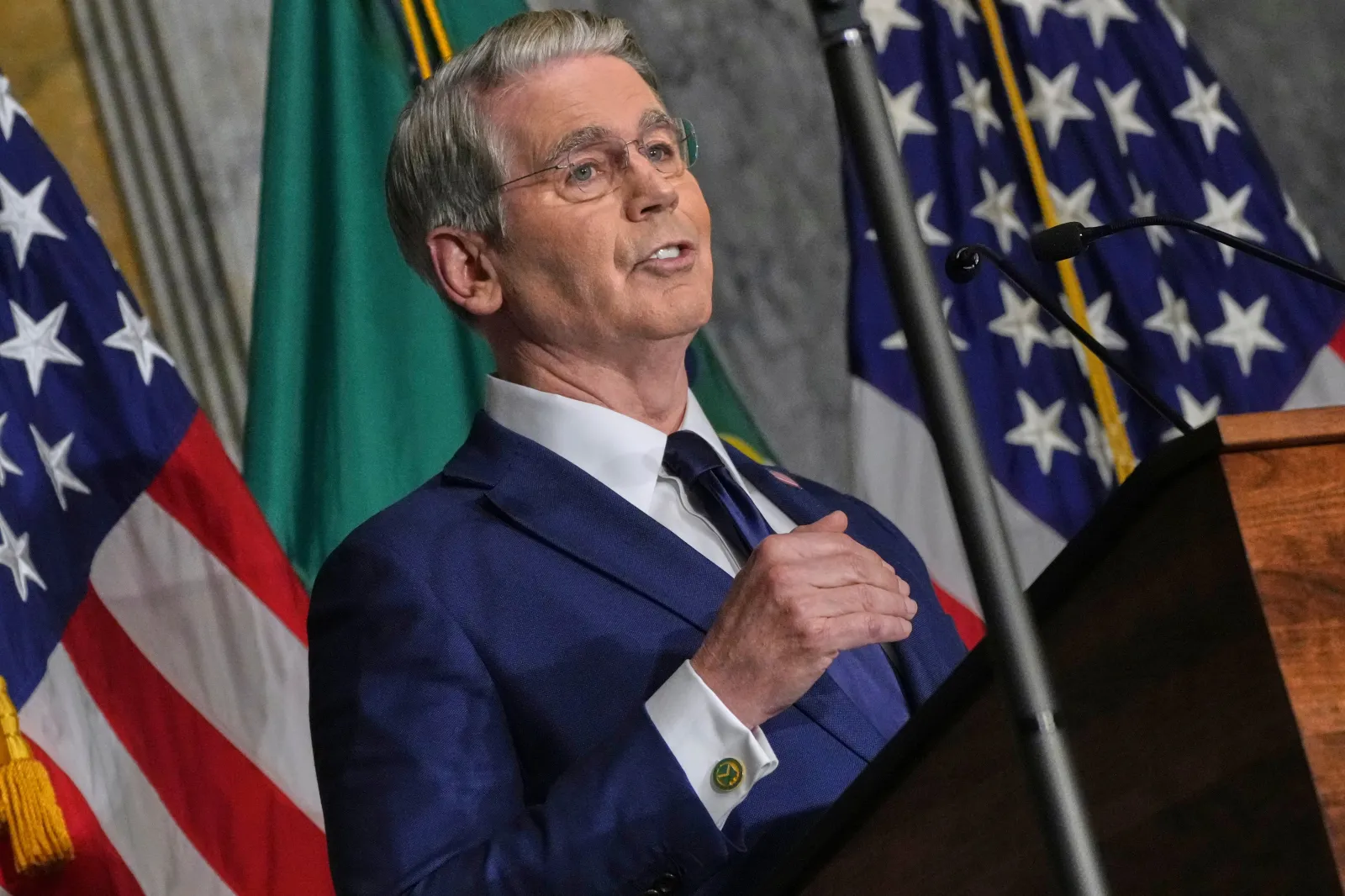
Asked whether Trump still wants Canada to become a state, Treasury Secretary Scott Bessent declined to answer directly, telling Newsweek that the president "would like Canada to come to the table and negotiate in good faith."
"They were offered quite a good deal last week. They chose to reject it," he added.
Read More on Politics
Bessent said that Carney “rose to power on an anti-American, anti-Trump platform” and questioned whether the prime minister was acting in the interests of himself, the Liberal Party or Canadian voters.
The Treasury secretary's comments come as the Trump administration imposed 50 percent tariffs on roughly $20 billion of Canadian goods. On Monday, Trump threatened to impose another 50 percent tariff on Canadian cars and auto parts.
“On Trade, and in other ways, also, they are among the worst Nations in the World to deal with. They feel entitled, and yet, WE DON’T NEED CANADA, THEY NEED US! They do 95% of their business with the U.S., with us, the exact opposite,” Trump wrote on Truth Social.
...
Trump Has Repeatedly Said He's Serious About Canada's Statehood
Trump’s comments about Canada becoming the 51st state began as a campaign-era provocation but continued well after he returned to the White House.
He has argued that Canada already receives many of the benefits associated with being part of the United States, particularly in trade and national security, without sharing the same obligations. Trump has also complained about the U.S. trade deficit with Canada, Canadian defense spending and what he views as an imbalance in the two countries’ economic relationship.
In February 2025, Trump said he would like Canada to become the 51st state, arguing that Canadians would benefit from lower taxes and greater U.S. military protection. He also linked the proposal to eliminating tariffs and other trade barriers between the two countries.
When asked later whether the statehood idea was simply a joke, Trump said no.
“I still believe that,” Trump said, while acknowledging that “it takes two to tango.”
In January 2026, Trump again called Carney “Governor” while threatening 100 percent tariffs over Canada's economic relationship with China. The term had previously been directed at former Prime Minister Justin Trudeau during Trump's campaign for Canadian statehood.
The statehood rhetoric has unfolded alongside one of the most serious economic disputes between the United States and Canada in decades.
Carney Rejects Statehood Premise
Carney has repeatedly rejected Trump's suggestion that Canada could become part of the United States and has emphasized Canadian sovereignty. The prime minister has also portrayed Trump's tariffs and threats as evidence that Canada needs to become less economically dependent on its southern neighbor.
During a May 6 Oval Office meeting, the two world leaders clashed, with Carney telling Trump, “As you know from real estate, there are some places that are not for sale.”
He later added, more explicitly, that “Having met with the owners of Canada over the course of the campaign over the last several months, it’s not for sale. It won’t be for sale, ever.”
To which Trump responded: “Never say never.”
Trump has argued that closer integration with the United States could benefit Canadians, and has said that Canada benefits enormously from access to the U.S. market and from American military protection, while Washington bears the cost.
Canada rejects that characterization and has pushed back against the idea that its sovereignty can be used as leverage in trade negotiations. Carney has repeatedly said Canada will remain independent and has sought to diversify the country's trade relationships rather than become more economically dependent on the United States.
That has put the two leaders on a collision course.
Related Story

Trump vs. Doug Ford Feud Timeline Amid US-Canada Trade Dispute
Vance Has Also Criticized Carney
Vance has made clear that the administration's frustration with Carney extends beyond Trump.
At a Republican fundraiser this month, Vance described Carney as a “very sweet guy” with whom he gets along, but mocked the prime minister for trying to “out-tough” Trump during trade negotiations.
In audio obtained by The Canadian Press, Vance said Carney “comes in and puffs his chest out” as if he can match Trump’s negotiating style.
Vance argued that the administration's pressure was already producing changes in Canada and said Trump was not going to “bend over to make Canada happy.”
Trump Says ‘We Don’t Need Canada’ as He Escalates Trade War
Trump sharply escalated the trade war Monday, threatening to raise U.S. tariffs on Canadian cars, trucks and auto parts to 50 percent starting January 1, 2027, up from the current 25 percent tariff on Canadian autos. He also said tariffs on Canadian steel would rise to 50 percent, although steel imports already face a 50 percent levy under existing U.S. measures.
Trump urged Canadian manufacturers to move production across the border to avoid the tariffs. He said companies that “Build in the U.S.” would face “ZERO TARIFFS.”
The auto threat is particularly consequential because the U.S. and Canadian auto industries are deeply integrated, with parts and vehicles crossing the border repeatedly during manufacturing. Carney warned that the proposed tariffs could dismantle Canada's auto industry, while Canadian officials have threatened retaliation.
The new threat came just two days after a separate round of 50 percent U.S. tariffs took effect on roughly $20 billion worth of Canadian goods, including products ranging from wine, honey and cement to clothing, furniture and hockey equipment. Unlike some of the administration's earlier tariffs, those new levies apply even to goods that qualify for preferential treatment under the U.S.-Mexico-Canada Agreement.
Canada has said it will respond dollar for dollar, with its next round of retaliatory tariffs scheduled to begin September 8. The measures follow the collapse of U.S.-Canada trade talks late last week, leaving the two countries deeper in a trade war as Washington demands that Ottawa return to negotiations.
Over the weekend, Carney said Canada was "at war" with the U.S. over trade.
Contact Newsweek editors on this story: Jason Lemon and Sam Wilson.
View 0 Comments
Submit Correction
View Editorial & AI Guidelines