...

By Aliss Higham
Reporter
0
Share
Newsweek is a Trust Project member
See more of our trusted coverage when you search.Prefer Newsweek on Googleto see more of our trusted coverage when you search.
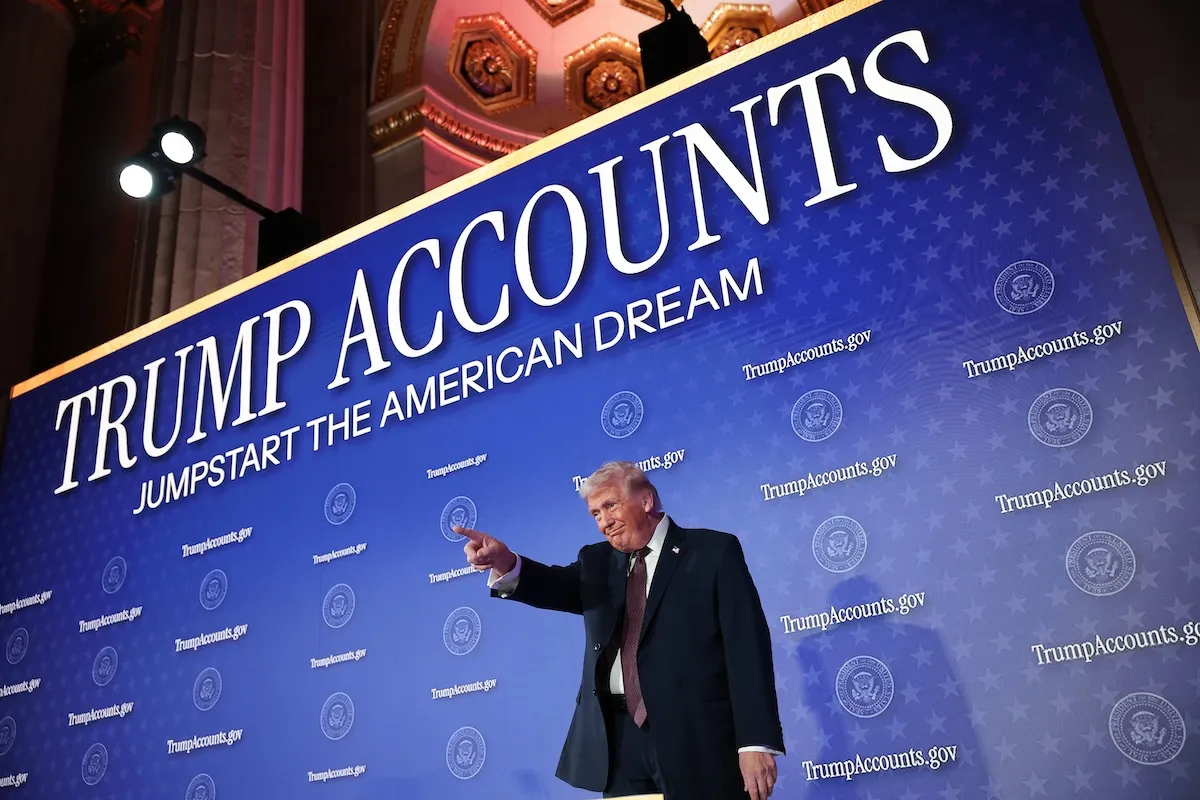
The Internal Revenue Service (IRS) said more than 4 million children have been enrolled in Trump Accounts, with over 1 million of those accounts having opted in to receive the $1,000 pilot contribution.
Why It Matters
The Trump Accounts program created a new savings vehicle for minors aimed at jump-starting long-term wealth building, with a federal seed contribution available for eligible children born between 2025 and 2028. They were established under the One, Big, Beautiful Bill enacted on July 4, 2025.
Read More on News
What To Know
The IRS said its enrollment and election figures are based on the number of Form 4547, Trump Account Election(s), submitted with individual tax returns to date. Tax season is currently in swing, with returns and payments due by April 15.
Trump accounts are a newly introduced form of individual retirement account (IRA). The account is designed for minors, meaning the child must be under 18 at the end of the year the account is set up and must have a Social Security number. Only one such account is permitted per child. To qualify for the government’s $1,000 pilot contribution, the child must also be a U.S. citizen.
Money can be added to the account by individuals, employers, and certain government or charitable organizations. Annual contributions from individuals and employers are capped at $5,000 per child. Unlike other IRAs, there is no requirement for earned income, and contribution eligibility is not limited by the contributor’s income level.
...
The funds in these accounts are limited to specific types of investments, generally low-cost index mutual funds or exchange-traded funds (ETFs) that primarily track U.S.-based companies. All investment options must comply with guidelines set by the U.S. Treasury Department.
Additional contributions from government bodies or charities may also be made and do not count toward the $5,000 annual cap. As part of a pilot initiative, the federal government will deposit $1,000 into accounts for eligible children born between January 1, 2025, and December 31, 2028, provided they are U.S. citizens. Eligibility for this payment depends on whether the child is expected to qualify as a dependent for federal tax purposes, as outlined in Form 4547 instructions.
Contributions made to a Trump account before the child turns 18 do not affect their ability to contribute to other retirement accounts. For instance, a teenager with earned income can still contribute to a traditional or Roth IRA without reducing the amount that can be placed into their Trump account in the same year.
Withdrawals are generally not permitted during the account’s "growth period," which lasts until the child reaches 18. After that point, the account transitions to operate under rules that largely mirror those of a traditional IRA, including provisions governing contributions and withdrawals.
What People Are Saying
IRS chief executive officer Frank J. Bisignano said in announcing the enrollment figures: "The IRS has been working closely with the Treasury Department to make the election process as simple and easy as possible by permitting taxpayers to fill out a one-page form when they file their tax return. Families with eligible children born between 2025 and 2028 just need to check the box on a form to stake their claim for the $1,000 contribution. It’s that simple."
Amira Boland, chief of staff at New Practice Lab and previously the first-ever lead for federal customer experience at the Office of Management and Budget (OMB), told Newsweek: "Trump Accounts represent a generational opportunity to build wealth for American families—and with the pace of contribution commitments coming in, could quietly become the largest individual cash transfer program in U.S. history.
"The program is genuinely novel with its unique combination of government seed funding, the ability to attract philanthropic and private matching contributions, allowance and flexibility of use beyond educational costs, and an investment theory anchored in the S&P 500 and building a bridge to compounding interest.
"However, implementation details will be the difference between a program that truly builds wealth for kids that typically would not have this type of asset, and one that widens the gap it has set out to close.
"The central risk is that the families who need these accounts most will be the least likely to access them. The barriers are predictable and well-documented: we have decades of evidence—from private banking services, behavioral science, retirement encouragement schemes, and both international and domestic parallel programs—that tax filing and engagement with government processes, and the financial services industry, are incredibly intimidating and hard to access for so many people."
What Happens Next
The IRS will continue processing Form 4547 elections with 2025 returns, and eligible families will be able to receive the $1,000 pilot contribution once accounts are opened and verified.
Treasury will begin sending account activation information to families starting in May 2026, the online portal is planned to open on July 5, 2026, and deposits from the pilot program will be made no earlier than July 4, 2026.
Update 4/7/26, 3:40 a.m. ET: This article has been updated with comment from Amira Boland.
View 0 Comments
Submit Correction
View Editorial & AI Guidelines