
10
Loading video...


By Dan Gooding and Amanda Castro
0
Share
Newsweek is a Trust Project member
See more of our trusted coverage when you search.Prefer Newsweek on Googleto see more of our trusted coverage when you search.
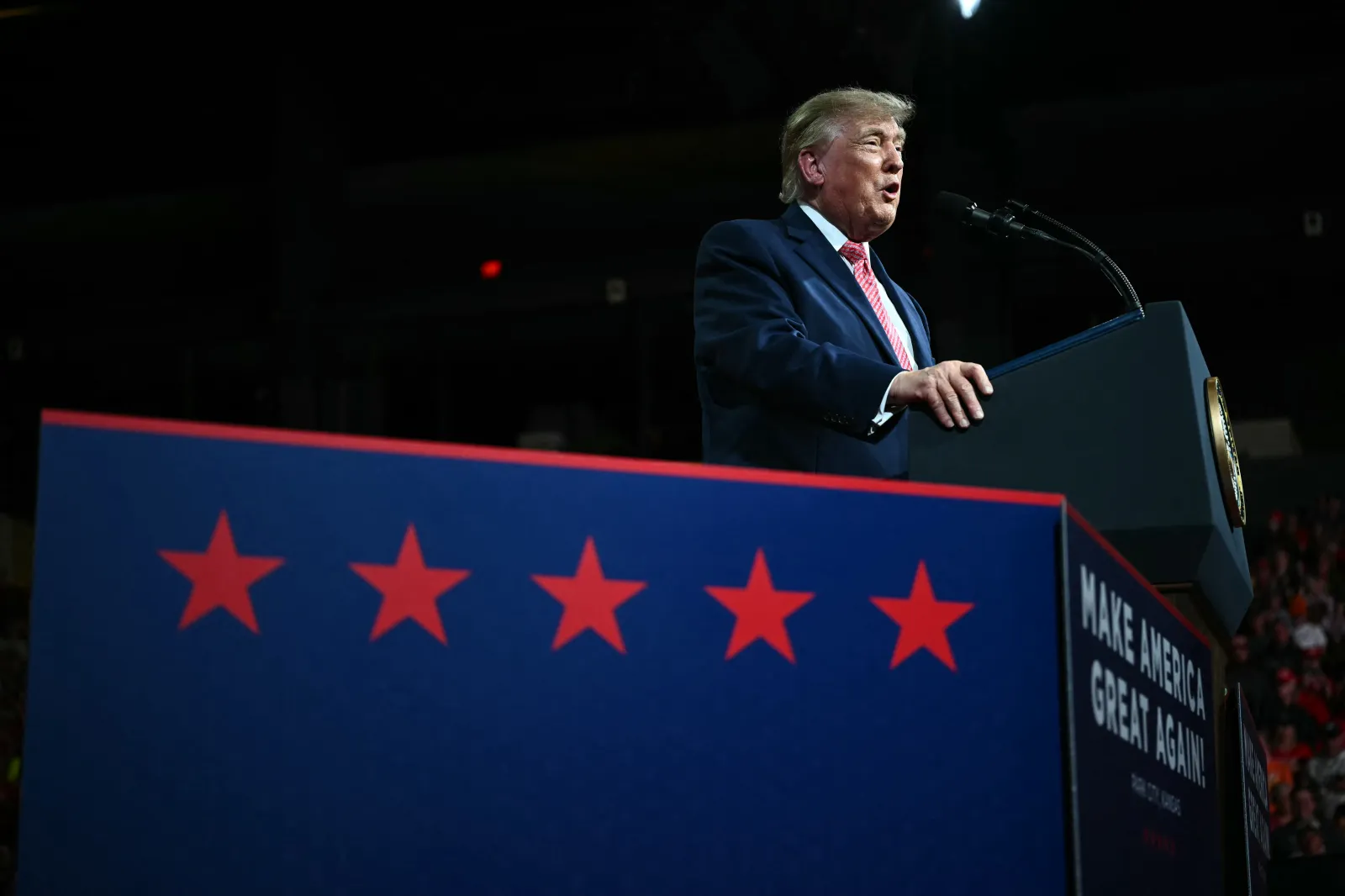
President Donald Trump said Tuesday that he has spent, or plans to spend, more than $400 million to boost Republican candidates ahead of the November 3 midterm elections.
Based on figures disclosed the same day, former New York City Mayor Michael Bloomberg is directing roughly $80 million toward Democratic candidates and allied groups, creating a stark contrast between two of the election cycle's biggest political benefactors.
The competing spending efforts could influence some of the nation's most competitive House and Senate contests as Republicans fight to maintain congressional control and Democrats seek to reclaim one or both chambers.
Read More on Politics
...
With Election Day two weeks away, both major parties are escalating voter outreach, advertising and turnout operations as control of both chambers of Congress hangs in the balance.
Trump announced in a Truth Social post that more than $300 million had already been spent on advertising, direct and indirect voter contact, rallies, tele-rallies, get-out-the-vote efforts and election integrity programs.
Reuters reported that campaign finance filings show Trump's super PAC, MAGA Inc., and an affiliated group, No Going Back PAC, have already spent at least $226 million on the midterms, although Trump's broader $400 million figure has not been independently verified.
Related Story
Newsweek Webinar: How the Politics of AI Could Shape Midterms
How Trump Says He Is Spending $400 Million on Midterms
Trump framed the spending as an investment in Republican victories and linked it to his broader political agenda.
In his Truth Social statement, he said that the money had been dedicated to a mix of political advertising, voter mobilization efforts and campaign events.
"Because of my belief in the Republican Party, and all of our Policies and Principles, and especially after witnessing what is taking place in France, and other locations throughout Europe, I am pleased to announce that, having to do with the Most Important Midterm Elections in our Country’s History, I have spent, or will be spending, over 400 Million Dollars by Election Day," the post read.
"More than 300 Million Dollars has already been spent on Advertising, Direct and Indirect Voter Contact, Rallies, Rally Arenas, Telerallies, Get Out the Vote Programs, Election Integrity, and more. It is my Great Honor to do so on behalf of the Republican Party, which has done so much to bring our Country back from the Edge of Oblivion. MAKE AMERICA GREAT AGAIN!"
Much of the money is going toward House races. Bloomberg's advisers told The New York Times that he is particularly focused on helping Democrats secure a sizable House majority.
Although he is not on the ballot, Trump has repeatedly urged supporters to treat the election as a referendum on his administration and policies—to pretend he is on the ballot. His political operation has become one of the most powerful fundraising and spending vehicles in American politics.
"This level of spending is significant and will certainly help Republicans connect with voters, but it is unlikely to determine outcomes," Costas Panagopoulos, a distinguished professor of political science at Northeastern University, told Newsweek. "Election results generally reflect more fundamental considerations, including perceptions of presidential and incumbent party performance and the economy."
Panagopoulos added that massive spending campaigns can sometimes send voters an unintended signal.
"In some ways, lavish spending can be counterproductive because it implies vulnerability," he said. "Spending huge amounts implies Republicans are worried about their prospects on Election Day."
The spending announcement comes weeks after criticism of taxpayer-funded television ads that aired on major cable networks, after Trump said he would personally cover the costs or have MAGA Inc. do so.
Michael Bloomberg's $80 Million Democratic Investment
Hours before Trump's announcement, Bloomberg's team disclosed that the billionaire philanthropist and former New York City mayor directed about $80 million to Democratic causes in September and October.
According to details provided to The New York Times, Bloomberg's donations make him one of the largest publicly known Democratic donors of the 2026 midterm cycle. His longtime adviser, Howard Wolfson, said Bloomberg views campaign resources as a key factor in competitive elections and expects the investments to have a measurable impact.
Much of the money is going to House races, where Democrats see their best chance to gain power. Bloomberg's advisers said at least $50 million is going to House contests, including $24 million for Everytown for Gun Safety, the gun-control advocacy organization he helped create, and $16 million for House Majority PAC, the leading super PAC aligned with House Democratic leadership.
House Minority Leader Hakeem Jeffries of New York credited Bloomberg with playing a significant role in the Democrats' successful 2018 midterm performance and said the latest funding could help the party flip control of the House once again.
Bloomberg's spending has also extended beyond House races. According to The New York Times, he has directed $5 million to the super PAC aligned with the League of Conservation Voters, $8 million to Democratic gubernatorial candidates in several battleground states, $2.5 million to a super PAC supporting Texas U.S. Senate candidate James Talarico, and $3.5 million to a group focused on electing Democratic scientists and doctors.
Midterm Spending War Reaches Historic Levels
The dueling announcements reflect a broader explosion in midterm election spending across the political landscape.
According to advertising data cited by the Associated Press, Republicans have spent or reserved roughly $2.2 billion on ads since September 1, while Democrats have spent about $1.8 billion. The figures encompass federal, state and local campaigns and illustrate the enormous sums being deployed to reach voters before Election Day.
Outside organizations are accounting for much of that activity. A Washington Post analysis of AdImpact data found that independent groups have spent more than $1.2 billion in competitive congressional contests alone. In more than 70 percent of those races, outside groups drove most ad spending, highlighting the growing influence of political organizations operating alongside official campaigns.
The spending surge is not limited to Trump and Bloomberg. Billionaire donors on both sides have become increasingly active as the election approaches. Republicans have benefited from major contributions from high-profile donors, including Elon Musk, while Democrats continue to rely on major benefactors such as Bloomberg to finance costly media campaigns.
Television advertising remains dominant in many battlegrounds, but digital advertising, voter-targeting operations and turnout programs are also consuming large portions of campaign budgets as parties seek marginal advantages in closely contested districts.
Trump's Polling Challenges Ahead of Election Day
Trump's spending announcement comes as signs point to a difficult political environment for Republicans in several battlegrounds.
Recent polling shows the president struggling with voters in several states with pivotal Senate and House races. A Reuters/Ipsos survey conducted October 16-19 found that 31 percent of respondents approved of Trump's job performance while 66 percent disapproved, giving him a net rating of -35 percentage points.
Republicans are defending several competitive Senate seats, while Democrats have made Trump's standing with voters a central campaign issue. In Maine, Republican Senator Susan Collins is defending her seat while the president faces substantial voter dissatisfaction. Similar challenges exist in states where Republicans are trying to hold or win critical Senate contests.
Democratic candidates and allied groups have spent more than $163 million on television ads mentioning Trump since September 1, compared with roughly $11 million by Republicans, according to AP analysis of AdImpact data.
Reports tracking political advertising show that Democratic candidates and aligned groups spending heavily on ads that mention Trump, arguing that his policies and leadership should be at the center of voters' decisions.
Contact Newsweek editors on this story: Samantha Beech and Dave Siminoff.
View 0 Comments
Submit Correction
View Editorial & AI Guidelines