10
Loading video...

By Anna Skinner
Associate News Editor
0
Share
Newsweek is a Trust Project member
See more of our trusted coverage when you search.Prefer Newsweek on Googleto see more of our trusted coverage when you search.
A hurricane warning has been issued for Hawaii's Big Island as Tropical Storm Lala moves across the central Pacific, with forecasters warning the system could bring life-threatening flooding and damaging winds this weekend.
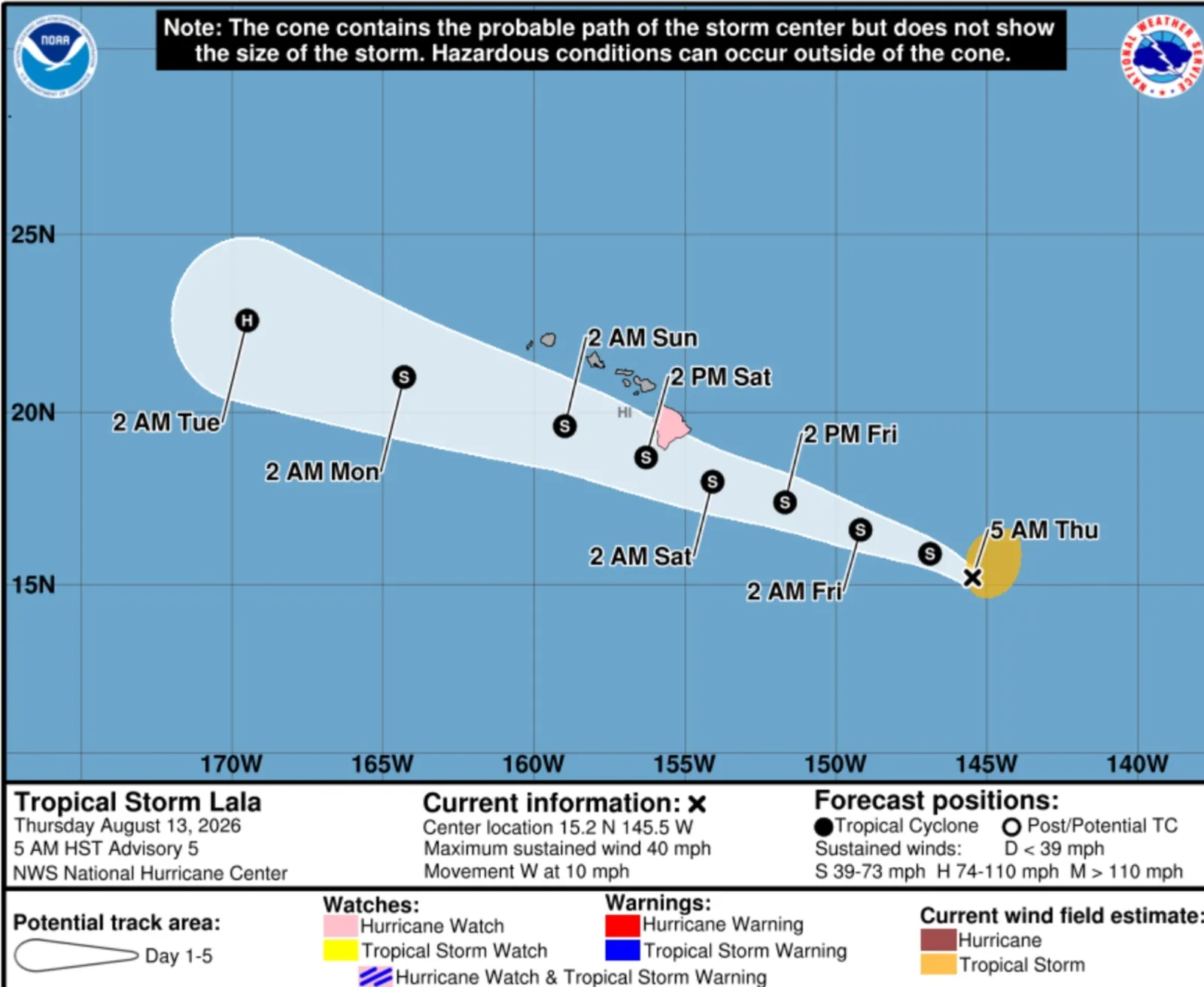
The storm is now expected to become a hurricane as it passes by the Big Island early Saturday morning, the National Hurricane Center (NHC) said in its most recent update. Previously, Lala was expected to remain a tropical storm as it passed Hawaii, but the forecast shows it will strengthen before then.
"Steady strengthening is forecast, and Lala is expected to become a hurricane as it approaches the Big Island," the NHC said in its most recent forecast on Thursday.
Read More on Weather
In a 5 p.m. HST update from the NHC Pacific, Lala has maximum sustained winds of 60 mph and is about 765 miles east- southeast of Honolulu.
Tropical Storm Lala was named on Thursday morning and is the second named storm to form in the Central Pacific and the ninth named storm to form across the broader Pacific basin this year. An update from the NHC earlier on Thursday said Lala is expected to continue strengthening, likely reaching hurricane strength by the time it nears Hawaii around 8 a.m. Saturday morning, forecasters warned.
The National Weather Service (NWS) in Honolulu early Thursday placed the Big Island South district, including Hawaiian Ocean View Estates and Naalehu and Pahala, under a hurricane watch, meaning hurricane-force winds are possible within the next 48 hours. Current forecasts call for sustained winds equivalent to a strong tropical storm, with peak winds of 45 to 60 mph and gusts up to 75 mph. Tropical-storm-force winds could begin affecting the area as early as Saturday morning.
...
While storm surge impacts are expected to remain limited, officials warned that Lala's greatest threat is likely to come from heavy rainfall. Forecasts call for an additional 5 to 10 inches of rain, with locally higher totals possible. The NWS said the storm poses a risk of rainfall capable of producing "extreme flooding," which could trigger evacuations and water rescues, overwhelm rivers and streams, and lead to dangerous mudslides and rockslides in mountainous terrain.
Tropical Storm Lala Live Tracker Maps
Animated weather footage from windy.com reveals the extent of the rainfall forecast, with heavy rainfall totals in excess of 9 inches expected over the next five days.
"Tropical Storm Lala is expected to produce rainfall totals of 5 to 10 inches across much of the Island chain, with maximum totals of 20 inches possible," the NHC said in a public advisory. "This rainfall may produce life-threatening flooding and mudslides, especially in areas of steep terrain."
Wind speeds across the island are currently low, although forecasters anticipate they will pick up as Tropical Storm Lala approaches. Windy.com footage shows stronger winds associated with the storm east of Hawaii in the Pacific, where Lala is currently churning.
As of Thursday afternoon, no rain or storm systems were impacting Hawaii.
Waves south of the Big Island were around 8 feet on Thursday afternoon, with much larger waves closer to Tropical Storm Lala southeast of the Islands.
Tropical Storm Lala comes several weeks after Hurricane Fausto, which approached Hawaii before weakening, preventing it from causing any significant impacts. Hurricane Fausto fizzled out north of Hawaii and never made direct landfall.
With Tropical Storm Lala, the NWS described potential flooding impacts as ranging from "devastating to catastrophic," warning that floodwaters could inundate homes and businesses, wash out roads and bridges, and make travel dangerous or impossible in some areas.
"Rivers and tributaries may overwhelmingly overflow their banks in many places with deep moving water," NWS Honolulu said in the alert. "Small streams, creeks, canals, arroyos, and ditches may become raging rivers. In mountain areas, deadly runoff may rage down valleys while increasing susceptibility to rockslides and mudslides. Flood control systems and barriers may become stressed."
In addition to the new hurricane warning for Hawaii County, a tropical storm watch has been issued for Maui County, including the islands of Maui, Lanai, Molokai and Kahoolawe, the NHC Pacific said in its latest update.
Forecasters also noted conditions may become somewhat favorable for isolated tornadoes as the storm approaches. Residents are being urged to complete preparations now and closely monitor forecasts and any additional watches or warnings issued in the coming days. The NHC will issue regular updates for the system as it progresses.
Tropical Storm Arthur and 2026 Hurricane Season Thus Far
Tropical Storm Arthur, which formed in mid-June, became the first named storm of the 2026 Atlantic hurricane season and brought heavy rainfall, flash flooding and severe weather to parts of the U.S. Gulf Coast. Since then, activity across the basin has remained relatively subdued compared with a typical season. As of mid-August, only a handful of named storms have developed, and no hurricanes have formed, according to NHC data.
Forecasters have noted that the season has been running below the long-term average for this point in the year, even as the climatological peak of hurricane season, which typically occurs in September, still lies ahead.
By comparison, the Pacific hurricane season has told a different story, with significantly higher storm activity, including one major hurricane and one hurricane.
Contact Newsweek editors on this story: Samantha Beech, Sam Wilson, Gray R. Thomas and Anna Commander
View 0 Comments
Submit Correction
View Editorial & AI Guidelines