...

By Anna Skinner
Associate News Editor
0
Share
Newsweek is a Trust Project member
See more of our trusted coverage when you search.Prefer Newsweek on Googleto see more of our trusted coverage when you search.
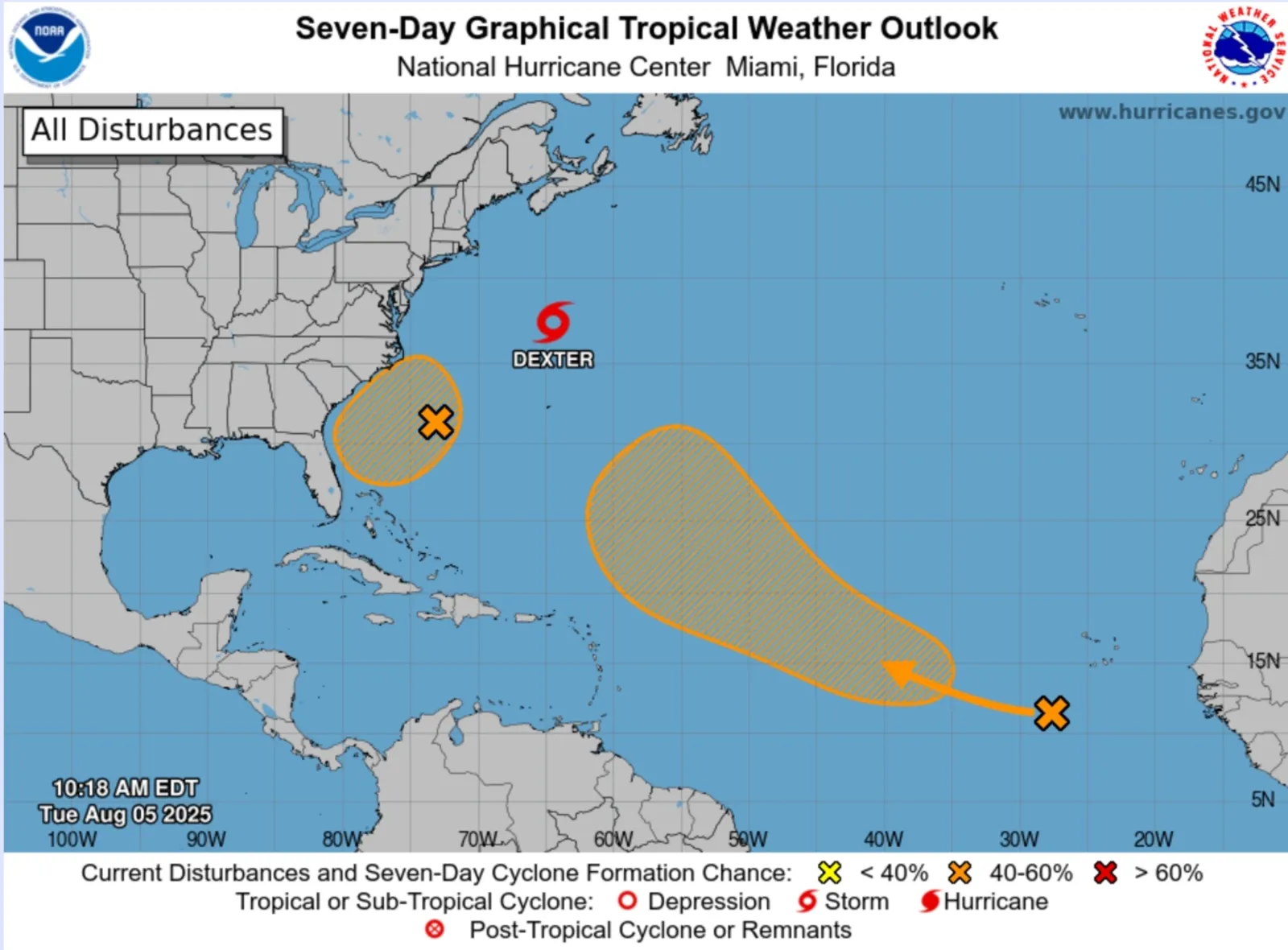
The National Hurricane Center (NHC) has increased the chances that a disturbance off the Southeast U.S. coast will form within the next seven days. Should it strengthen into a tropical storm, it will become the fifth named storm of the season and will be called Erin.
Why It Matters
The NHC is currently tracking three systems in the Atlantic Ocean. They are Tropical Storm Dexter, which is currently moving further out to sea, and two disturbances, one off the western coast of Africa and one brewing much closer to the U.S. Each of these disturbances has a moderate chance at strengthening into a tropical storm in the coming days.
Read More on U.S.
Hurricanes and tropical storms can lead to evacuation warnings and cause major damage when they hit the U.S. Tracking and predicting the movement of these storms can help with preparedness and public safety.
The Atlantic hurricane season began on June 1 and runs through November 30.
What To Know
Since Monday, chances that the disturbance nearest the U.S. will strengthen into a tropical storm have increased.
The storm had zero percent chance of strengthening within 48 hours and a 30 percent chance of doing so within the next seven days on Monday. On Tuesday, those chances for it to form within the next 48 hours have risen to 10 percent, and the chances it will do so within the next seven days have risen to 40 percent.
...
Meanwhile, the disturbance off the coast of Africa has a slightly higher chance at forming in the next seven days at 50 percent, but chances remain at near zero for the next 48 hours.
Either one of these disturbances could become Erin. Should they both strengthen into a tropical storm, one will be named Fernand.
Neither of the new systems is causing weather hazards on land, although the North Carolina coastline did see dangerous wave and current activity yesterday from Tropical Storm Dexter, National Weather Service (NWS) meteorologist Olivia Cahill told Newsweek.
It remains to be seen what, if any, impacts will be caused by the new disturbances.
Weather experts have issued repeated warnings this summer that peak Atlantic hurricane season doesn't typically hit until September, urging people to take precautionary action, such as stocking up on emergency supplies and ensuring they have proper insurance in place, before a storm forms.
The National Oceanic and Atmospheric Administration (NOAA) is predicting from 13 to 19 named storms for this year's Atlantic hurricane season, with six to 10 strengthening into hurricanes and three to five into major hurricanes.
What People Are Saying
NHC in an updated outlook about the system closest to the U.S.: "A weak surface trough currently located several hundred miles off the coast of the southeastern United States is expected to form an area of low pressure in a day or so. Thereafter, environmental conditions appear favorable for gradual development of this system, and a tropical depression could form by the latter portion of this week or weekend as the low initially moves slowly westward, but turns more northward by this weekend."
NHC in an updated outlook about the system near Africa: "A tropical wave over the far eastern tropical Atlantic is currently producing disorganized shower and thunderstorm activity, primarily to the southwest of the wave axis. Environmental conditions are forecast to be conducive for gradual development during the next few days, and a tropical depression could form late this week or over the weekend as the system moves generally west-northwestward across the central tropical or subtropical Atlantic."
What Happens Next
NHC meteorologists will continue to monitor the system as it progresses. As of the most recent forecast, there were no warnings or watches in place for the Southeast coast.
View 0 Comments
Submit Correction
View Editorial & AI Guidelines