
...

By Benjamin Lynch
US Politics and National Affairs Reporter
0
Share
Newsweek is a Trust Project member
See more of our trusted coverage when you search.Prefer Newsweek on Googleto see more of our trusted coverage when you search.
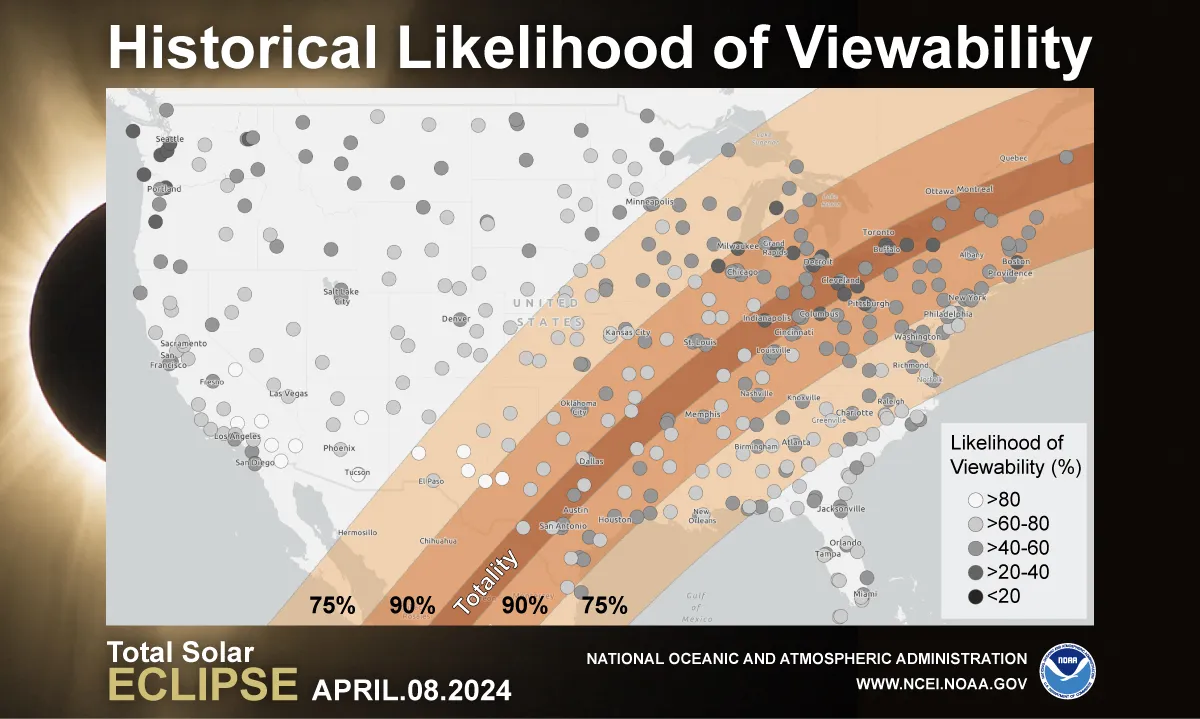
A handy map published online shows Americans the best places to view the next solar eclipse.
The online map by the National Oceanic and Atmospheric Administration (NOAA) shows areas in Texas, New Mexico, Arizona and California. Each state has at least one area listed as having a high chance of viewability of over 80 percent.
The total eclipse is due to be seen from the United States on April 8. It is the first total eclipse, when "the moon perfectly aligns with the sun," since 2017, according to NASA. There won't be another total eclipse seen on the U.S. mainland until August 2044.
Read More
Videos Show Driest Place in North America Flooded Before Atmospheric River3 min read

Last Total Solar Eclipse for Decades Expected to be Even More Jaw-Dropping5 min read

‘Breathtaking’ Video of Moon and Venus Moving Across Sky Stuns Internet4 min read

The sight will cast a "breathtaking shadow on Earth" and cause "a momentary darkening of the sky" as the moon aligns with the sun, the NOAA's National Environmental Satellite, Data, and Information Service said in a press release.
...
The areas with the best points of visibility are:
- Bishop, California
- Lancaster, California
- Barstow-Daggett Airport, California
- Jacqlyn Cochrane Airport, California
- Imperial County, California
- Blythe, California
- Winslow Municipality, Arizona
- Tucson International Airport, Arizona
- Truth or Consequences, New Mexico
- Roswell, New Mexico
- Carlsbad Cavern City, New Mexico
- Winkler County, Texas
- Midland-Odessa, Texas
Also shown on the map is the area of "totality." None of the areas listed above will see a full total eclipse, and only a thin band running northeast from Uvalde, Texas, up to Little Rock, Arkansas, Indianapolis, Indiana, Buffalo, New York, and parts of Maine will see a total eclipse.
The NOAA map, created with the National Centers for Environmental Information (NCEI) and the North Carolina Institute for Climate Studies (NCICS) can be seen here.
...
Partial eclipses will become gradually less the further away from the area of totality.
Experts warn anyone viewing a solar eclipse to do so in an area that is safe and allows them to view the event in a way that is unlikely to lead to harm or injury. Specialized equipment should also be used such as safe solar viewing glasses, also known as "eclipse glasses," or a pinhole projector.
"It is not safe to look directly at the Sun without specialized eye protection for solar viewing," NASA said.
Scott McIntosh, a solar physicist with the U.S. National Center for Atmospheric Research, told Newsweek earlier this month that the April eclipse could be "incredible" because of solar activity.
The eclipse will coincide with a "solar maximum," which is when the sun is particularly active. Coronal mass ejections (CME) are eruptions of plasma from the sun's outer atmosphere, also known as the "corona."
More frequent or intense CMEs can "generate spectacular auroras," McIntosh said.
When the eclipse occurs, a more active-looking sun is likely to appear around the shielding of the moon.
McIntosh added the April eclipse will resemble an "angry hedgehog" as the "solar maximum eclipse corona is very spiky."
View 0 Comments
Submit Correction
View Editorial & AI Guidelines