...

By John Feng
China Editor
0
Share
Newsweek is a Trust Project member
See more of our trusted coverage when you search.Prefer Newsweek on Googleto see more of our trusted coverage when you search.
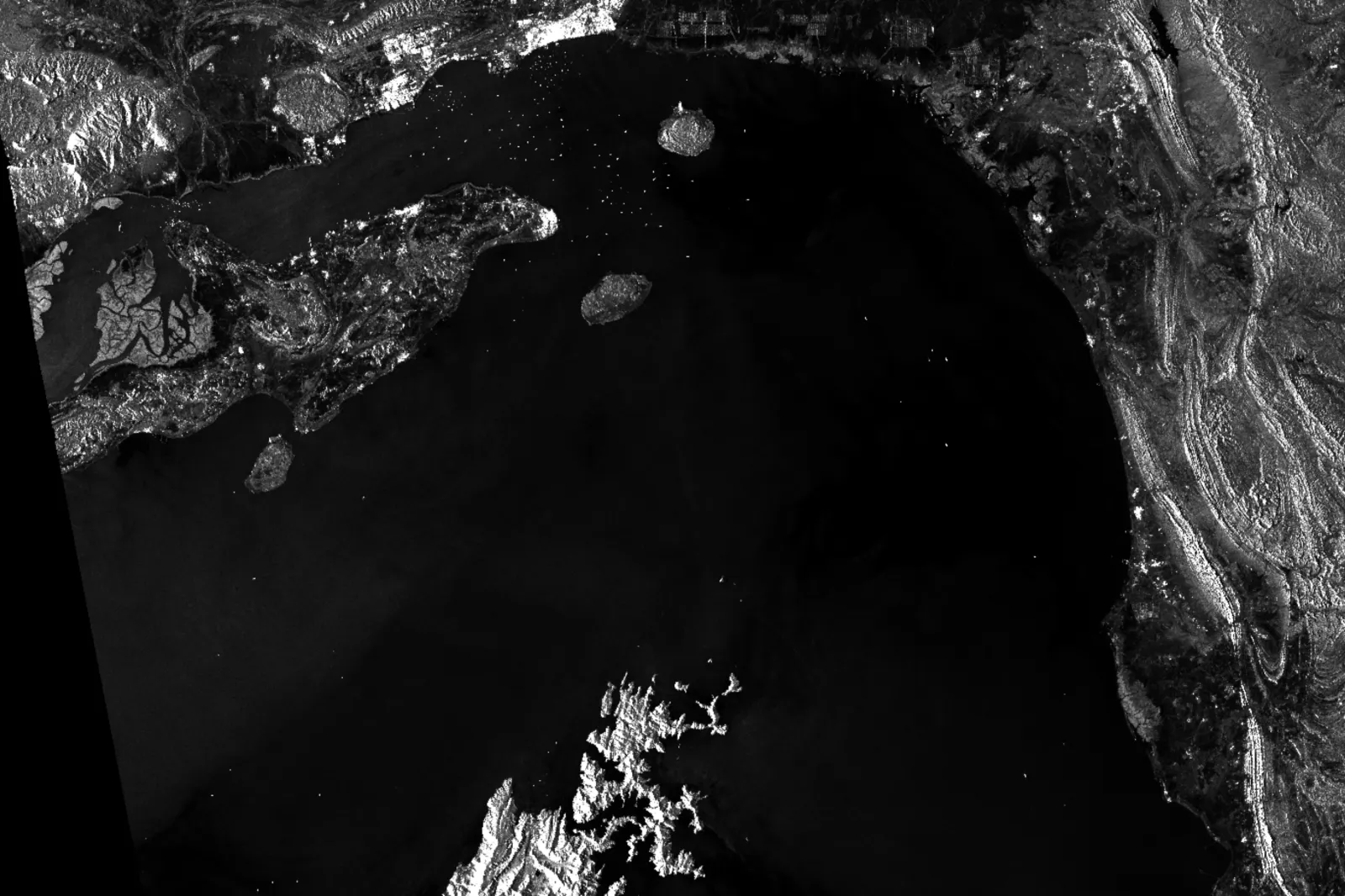
New satellite imagery taken over the Strait of Hormuz shows ships continuing to use a transit corridor managed by Iran’s military despite a ceasefire in the Middle East war.
The photograph, taken on Thursday, April 9, by the Sentinel-1 satellites of the European Space Agency’s Copernicus Earth observation program, demonstrates how Iran has successfully held the United States to ransom ahead of crucial peace talks by weaponizing one of the world’s most important energy trade routes.
"Iran is doing a very poor job, dishonorable some would say, of allowing Oil to go through the Strait of Hormuz," blasted President Donald Trump on Thursday. "That is not the agreement we have!" he wrote on Truth Social.
Read More on World
Iran's control of the waterway through which at least one-fifth of global crude oil and liquified natural gas flows likely will be a major bargaining chip as its negotiators seek maximalist concessions from U.S. interlocutors in Pakistan this weekend.
Iran, the U.S. and Israel have not traded blows since the two-week ceasefire was reached late on Tuesday, although Israel has bombarded Lebanon.
But the safe reopening of the strait—Trump’s top ask in exchange for hitting pause on “the destructive force” en route to Iran that night—has not happened.
...
Shipping experts say the trickle of commercial vessels crossing the strait has increased, but not by much. And those that have made the transit have done so with Iran’s explicit approval. Crucially, most are dry goods carriers rather than the tankers that ferry oil and gas.
Kpler, the commodities analysts, said nine ships sailed through the strait on Thursday, up from five on the first day of the ceasefire. The waterway hosted an average of 138 ships per day before the war, and Kpler expects traffic to remain at about 10 percent of that prewar norm.
A timelapse of monthly ESA imagery going back 12 months shows just how effective Tehran was at shutting the strait when hostilities began in late February, with traffic coming to an immediate standstill after Iran’s Islamic Revolutionary Guards Corps struck over a dozen ships around the Persian Gulf—seemingly at random—in a display of resolve.
On Thursday, the IRGC further demonstrated precisely why shipowners remain cautious despite American bullishness. In a post carried by state media, the Iranian military released a new map of the strait that included a “hazardous area,” which it said was “restricted for all traffic.”
The no-go zone, which covers the traditional deepwater sea lanes north of the Omani coast, may contain naval mines, the Iranian forces said, in a subtle threat that will force ships to use Tehran’s “tollbooth” around Larak Island, through Iran’s territorial waters.
Iran says the strait is open to all who follow its new transit regime, which may include multimillion-dollar payments in exchange for safe passage to and from the gulf.
The ESA photograph taken on Thursday showed at least half a dozen ships exiting the strait via Tehran’s tollbooth—proof that the strait has never been off limits to Iran-linked or -approved tankers and cargo.
“Iran is taking several steps to exert control over maritime traffic through the Strait of Hormuz, with the net effect of keeping oil prices high,” the Institute for the Study of War, a Washington think tank, said in analysis on Friday.
“Iran likely aims to use high oil prices to exert economic pressure on the United States and extract concessions from the United States during negotiations,” the ISW said.
Russia’s Tass news agency, citing an unnamed senior Iranian source, reported on Thursday that Iran intends to allow no more than 15 ships through the strait each day, a scenario that would add further pressure on shipping lines whose vessels are stuck in the gulf.
Lloyd’s List, a shipping intelligence firm, said: “Regardless of the ceasefire agreements, the threat of direct strikes against ships failing to meet Iran’s requirements remained in force on Wednesday.”
Some of the hundreds of tankers in the gulf received an English-language radio broadcast that said: “If any vessels try to transit without permission, [they] will be destroyed,” according to a broadcast seen by Lloyd’s List and verified by industry sources.
Iran’s Foreign Ministry did not immediately respond to a written request for comment.
Defense Secretary Pete Hegseth said this week that the ceasefire was the result of a “historic and overwhelming victory” for the U.S. over Iran, but the real winner so far may be the battered leaders in Tehran.
View 0 Comments
Submit Correction
View Editorial & AI Guidelines