AirNow

By Joe Edwards
Reporter
0
Share
Newsweek is a Trust Project member
See more of our trusted coverage when you search.Prefer Newsweek on Googleto see more of our trusted coverage when you search.
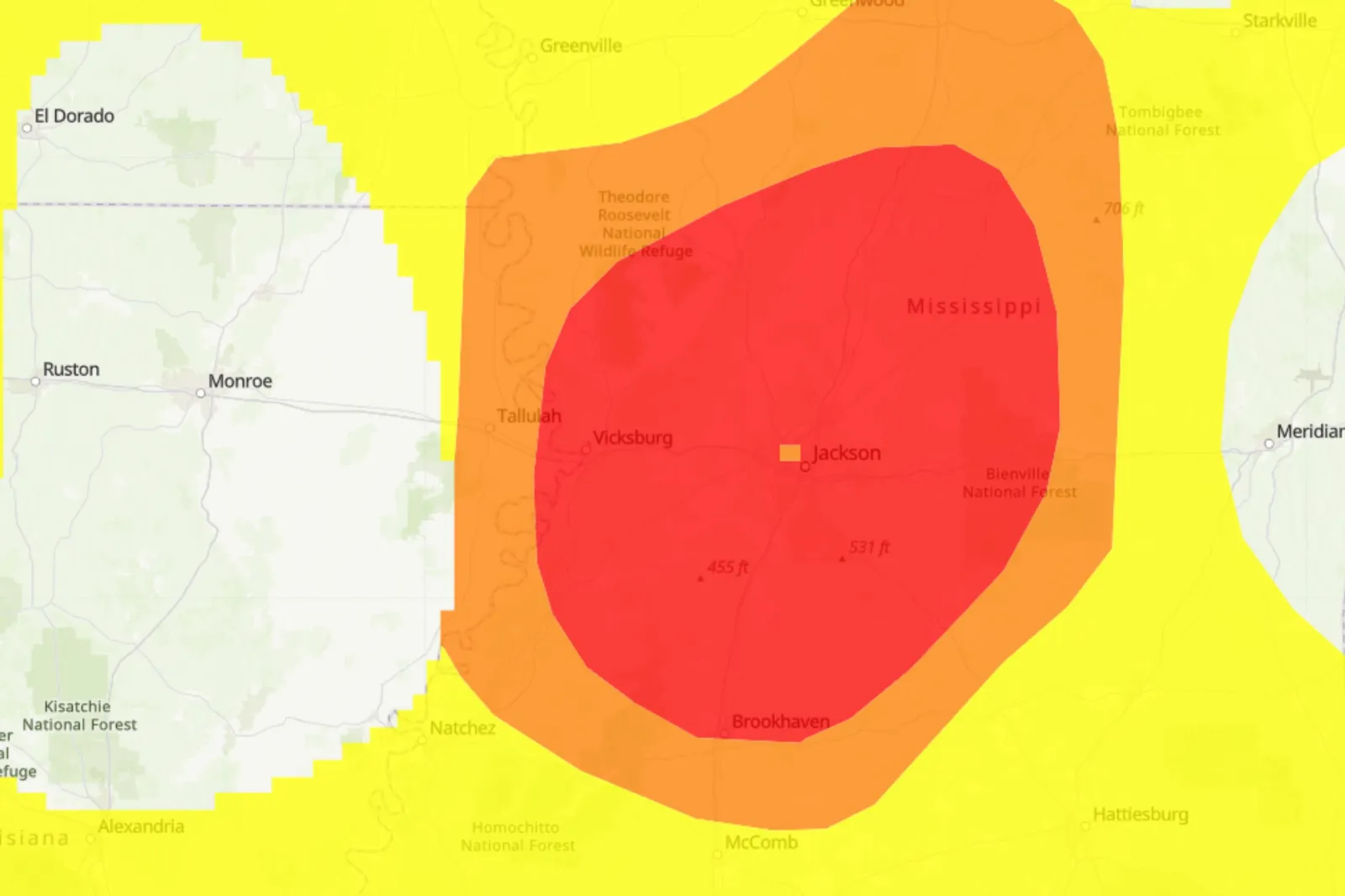
Residents in Jackson and its surrounding areas in Mississippi face potentially harmful air pollution levels as of early Sunday morning, according to monitoring resource AirNow.
As of approximately 2:20 a.m. CST, AirNow shows an area of fine particle (PM2.5) pollution in the “unhealthy” category centered over the city.
According to the AirNow map, this zone also extends west over Vicksburg, north over Durant, east over Forest, and south over Brookhaven.
Read More on News
At these levels of air pollution, the Environmental Protection Agency (EPA) recommends that sensitive groups avoid long or intense outdoor activities and consider rescheduling moving them indoors.
The agency also advises that the remainder of the population reduces long or intense activities, and to take more breaks during outdoor activities.
A Mississippi Department of Environmental Quality (MDEQ) meteorologist told Newsweek: "There have been several prescribed fires as well as wildfires in the area due to the dry conditions. Parts of central Mississippi are currently experiencing moderate to severe drought conditions.
"Additionally, the high PM2.5 levels are being exacerbated by an extremely stable air mass from strong High pressure over the region. This has been trapping pollutants near the surface overnight, with a low-level nocturnal inversion further trapping the smoke and increasing PM2.5 concentrations. As daytime heating begins, the lower atmosphere will mix, and we should start to see a decrease in PM2.5 values across the area later this morning into this afternoon."
...
AirNow is a partnership between the EPA, the National Oceanic and Atmospheric Administration, and several other agencies.
The Air Quality Index measures air pollution on a scale from 0 to 301 and above:
- 0-50 (Green): Good—air quality is satisfactory, and air pollution poses little or no risk.
- 51-100 (Yellow): Moderate—air quality is acceptable. However, there may be a risk for some people, particularly those who are unusually sensitive to air pollution.
- 101-150 (Orange): Unhealthy for sensitive groups—members of sensitive groups may experience health effects. The general public is less likely to be affected.
- 151-200 (Red): Unhealthy—some members of the general public may experience health effects; members of sensitive groups may experience more serious health effects.
- 201-300 (Purple): Very unhealthy—health alert. The risk of health effects is increased for everyone.
- 301 and higher (Maroon): Hazardous—health warning of emergency conditions. Everyone is more likely to be affected.
What Is PM2.5?
As per the EPA, PM2.5 means fine inhalable particles with diameters that are generally 2.5 micrometers and smaller. For perspective, the average human hair is approximately 70 micrometers in diameter, meaning it would be around 30 times larger than the largest fine particle.
It notes that PM pollution may originate from a variety of sources, including construction sites, unpaved roads, fields, smokestacks or fires.
"Some particles less than 10 micrometers in diameter can get deep into your lungs and some may even get into your bloodstream. Of these, particles less than 2.5 micrometers in diameter, also known as fine particles or PM2.5, pose the greatest risk to health," the agency states on its website.
Update, 3/1/26, 4:53 a.m. ET: This article has been updated with additional information.
Update, 3/1/26, 12:41 p.m. ET: This article has been updated with comment from the Mississippi Department of Environmental Quality.
View 0 Comments
Submit Correction
View Editorial & AI Guidelines