
By Joe Edwards
Reporter
0
Share
Newsweek is a Trust Project member
See more of our trusted coverage when you search.Prefer Newsweek on Googleto see more of our trusted coverage when you search.
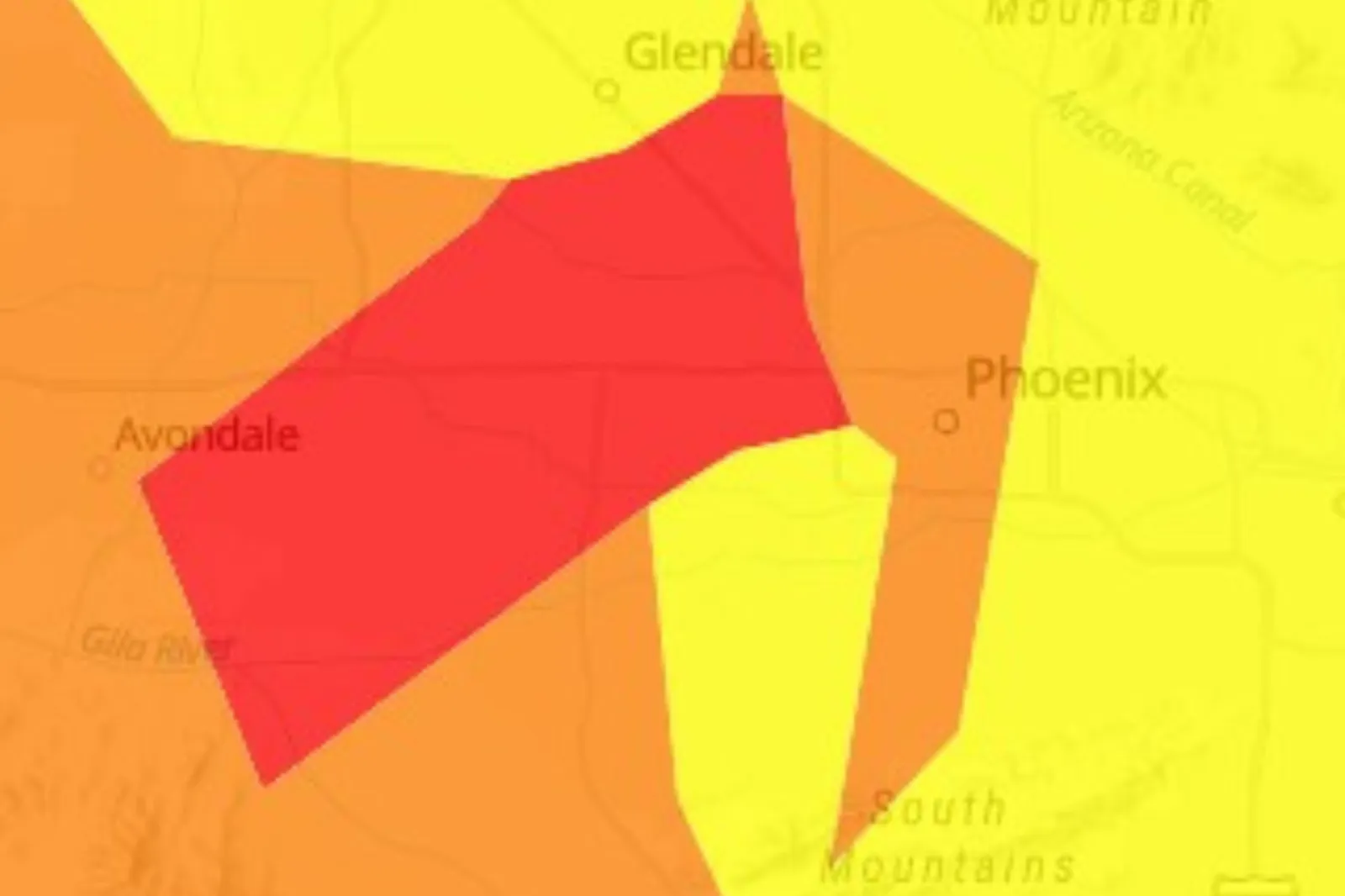
Thousands of people in Arizona face potentially unhealthy levels of air pollution early Friday, a live map from AirNow shows.
The map shows an area of fine particle (PM2.5) pollution in the "unhealthy" category covering a portion of Phoenix.
At these air pollution levels, the Environmental Protection Agency (EPA) recommends that sensitive groups avoid long or intense outdoor activities and consider rescheduling moving them indoors.
Read More on News
The EPA also advises that the remainder of the population reduces long or intense activities, and to take more breaks during outdoor activities.
Why It Matters
Officials and specialists warn that declining air quality heightens health dangers for vulnerable groups, including older adults, children, and those with respiratory conditions.
What To Know
The Air Quality Index measures air pollution on a scale from 0 to 301 and above:
- 0—50 (Green): Good—air quality is satisfactory, and air pollution poses little or no risk.
- 51—100 (Yellow): Moderate—air quality is acceptable. However, there may be a risk for some people, particularly those who are unusually sensitive to air pollution.
- 101—150 (Orange): Unhealthy for sensitive groups—members of sensitive groups may experience health effects. The general public is less likely to be affected.
- 151—200 (Red): Unhealthy—some members of the general public may experience health effects; members of sensitive groups may experience more serious health effects.
- 201—300 (Purple): Very unhealthy—health alert. The risk of health effects is increased for everyone.
- 301 and higher (Maroon): Hazardous—health warning of emergency conditions. Everyone is more likely to be affected.
Air quality data resource AirNow is a partnership between the EPA, National Oceanic and Atmospheric Administration, and other agencies.
What People Are Saying
An Arizona Department of Environmental Quality (ADEQ) spokesperson told Newsweek: "Fireplace use over the Thanksgiving holiday elevated PM2.5 (particles 2.5 micrometers in diameter or less) levels yesterday and into this morning. While no Phoenix Valley monitors exceeded the 24-hour health standard yesterday, concentrations remained elevated this morning and ADEQ issued a PM2.5 High Pollution Advisory as a result. We expect levels to return to normal by Saturday.
"We encourage the public to subscribe to ADEQ’s daily air quality forecasts, Monday through Friday, for Phoenix, Tucson, Yuma, Nogales, Douglas, Rillito, Flagstaff, Prescott, West Pinal, Miami and Hayden. These forecasts provide an hour-by-hour outlook, helping people plan for outdoor activities throughout the day to minimize the impacts of air pollution."
The ADEQ previously told Newsweek: "In Phoenix, particles 10 micrometers in diameter or less (PM10) can settle in the valley during the early morning hours, which is very typical for this time of year as temperatures drop overnight. Thankfully, this is usually short-lived and conditions improve quickly."
The EPA said on its website: "The size of particles is directly linked to their potential for causing health problems. Small particles less than 10 micrometers in diameter pose the greatest problems, because they can get deep into your lungs, and some may even get into your bloodstream.
"Exposure to such particles can affect both your lungs and your heart. Numerous scientific studies have linked particle pollution exposure to a variety of problems, including: premature death in people with heart or lung disease; nonfatal heart attacks; irregular heartbeat; aggravated asthma; decreased lung function; increased respiratory symptoms, such as irritation of the airways, coughing or difficulty breathing.
"People with heart or lung diseases, children, older adults, minority populations, and low socioeconomic status populations are the most likely to be affected by particle pollution exposure, either because they are more sensitive or may have higher exposures."
What Happens Next
AirNow's interactive map is regularly updated.
Update, 11/28/2025, 5:10 a.m. ET: This article was updated with additional information.
Update, 11/29/2025, 1:05 p.m. ET: This article was updated with comment from ADEQ.
View 0 Comments
Submit Correction
View Editorial & AI Guidelines