10
Loading video...

By Tom O'Connor
Deputy Editor, National Security and Foreign Policy
0
Share
Newsweek is a Trust Project member
See more of our trusted coverage when you search.Prefer Newsweek on Googleto see more of our trusted coverage when you search.
Twenty years after Iraq held its first election in the wake of the U.S.-led invasion that toppled Saddam Hussein and shook the Middle East, a nation home to the cradle of civilization and yet beset by decades of conflict prepares to hold another fateful vote.
The contest will mark a milestone in Iraq’s many millennia of history. This is not simply because of the more than 7,700 parliamentary candidates whose hopeful portraits line nearly every road in Baghdad, but, even more vitally, due to the unprecedented stakes associated with a highly competitive election that has the potential to determine the course of Iraq during an elusive era of stability.
At the helm—and poised to stay there only if his bloc emerges with enough seats to bargain for a second term among an array of rivals—is Prime Minister Mohammed Shia al-Sudani.
Read More on World
Propelled to the position upon political disputes that unraveled his predecessor’s short-lived premiership in 2022, the man once viewed as a temporary fix has since managed to navigate his nation through an era of major regional turbulence. He now outlines an ambitious road map to establish Iraq as a global hub for trade, investment and innovation that channels the untapped potential of a country rich with human capital, natural resources and cultural heritage.
“Iraq is a great country dating back a long time, a nation of civilizations from 7,000 years ago,” Sudani tells Newsweek.
Seated in his office at the Republican Palace within Baghdad’s still heavily guarded Green Zone, the Iraqi premier points out a representation of the ancient Code of Hammurabi across the room, calling it “the first law of humanity” and “an achievement” for all humanity.
“And this exists in the Iraqi genes, generation after generation,” he says. “And it is the reason for the steadfastness of this people and in the face of various challenges, and by virtue of the heritage it carries.”
Now, after what Sudani calls a prolonged period of “difficult circumstances, political upheavals, conditions of instability,” and during an interview symbolically coinciding with the centennial of Iraq’s first constitution adopted in 1925, he declares: “We must prepare for the next 100 years.”

...
‘Iraq First’
Many mottos accompany the parliamentary election campaign mounted by Sudani’s aptly named Reconstruction and Development Coalition. The coalition’s logo is a crane, the kind which can be found across Baghdad’s skyline as new buildings, roads and bridges rise. The widespread construction is a visible sign of the influx of foreign direct investment in recent years.
Yet one phrase appears to be gaining particular traction amid the frenetic political landscape—“Iraq First.” Sudani calls this more than a slogan; to him, it represents a pledge he believes is long overdue for the Iraqi people after so many years of strife—from the restive monarchy era to disastrous wars with Iran and the U.S. under the reign of Saddam and the deadly, sectarian insurgencies that followed.
Baghdad, at one point the virtual center of the world during the Islamic Golden Age, came to be defined for much of the 21st century by insecurity and crises that largely overshadowed the democratic process that began in 2005. Sudani aims to change this, capitalizing on the defeat of the Islamic State militant group, ISIS, to steer Iraq away from new confrontations and toward a national revival.
“It is very important that the leader of any country rank the interests of their country and people first,” Sudani says. “This is what we believe we are doing for Iraq. We believe Iraqis deserve to be first, and Iraq to be first in security, in stability, in development, in services, in better standards of living and in a future that promises opportunities for the youth.”
“All of these are goals and priorities that we established as our national priorities for our dear Iraq,” he says. “Our people have made many sacrifices, and it is time now that we do a service to them and make them first in all of our orientations and decisions.”
Sudani also acknowledges similarities between his approach and that of President Donald Trump, whose “America First” strategy at home and abroad has proven divisive to some. Sudani, for his part, considers this concept to be a “common denominator between us, to give priority to our peoples in our visions, in our goals and in our programs.”
In fact, he views the U.S. leader as an especially valuable ally in the quest to pave a new path for Iraq.
“In my estimation, under the presidency of Mr. Trump, there is a real opportunity to build an ideal relationship between Iraq and the United States,” Sudani says. “President Trump’s powerful decision-making and the vision he possesses in developing economic relations makes it possible for us to invest in this characteristic for a development renaissance in Iraq, strengthen ties between the two peoples and at the same time make Iraq a stable economic center and a hub for the region and the world, as well as a force for stability and security, combining all interests so that we may continue this stability.”
At a time when the White House was pursuing a comprehensive reshaping of foreign policy, Sudani has sought to maintain a positive relationship with Trump, making calls, penning letters and, perhaps most crucially, backing the U.S. leader’s peace plan for the war in Gaza that has rocked the Middle East.
“We believe that the peace and economic development that represents President Trump’s vision is identical to our vision as a government and as a country,” Sudani says. “We aspire to security, sustainability and stability for the region because it is linked to the Iraqi economy, and we regard the United States as an active partner in achieving this vision.”

...
Balancing Act
Yet the restiveness of the region continues to serve as a potential pitfall for Sudani’s projects. The conflict that began hundreds of miles away with an attack led by the Islamist Palestinian Hamas movement against Israel on October 7, 2023—just under a year into Sudani’s term—spread like wildfire across the Middle East, drawing Iraq in as well.
Shortly after the war in Gaza erupted, a coalition of Iraqi militias joined the battle from afar under the collective banner of the Islamic Resistance in Iraq, constituting one of several theaters opened against Israel by the Iran-led Axis of Resistance coalition. These Iraqi groups contributed to the conflict by firing rockets and drones at U.S. troops in Iraq and neighboring Syria, as well as against Israeli cities and bases.
When U.S. strikes began targeting these armed factions, Sudani was left in a precarious position. A number of these militias played a fundamental role in the fight against ISIS as part of the Popular Mobilization Forces paramilitary network and have begun formal integration into the armed forces, though many maintain ties to Iran and continue to operate independently of the government.
On the one hand, Sudani’s administration repeatedly condemned Iraqi groups operating outside of the control of the state, part of an overarching effort to rein in such unsanctioned activities. On the other, the government also took aim at Washington for conducting operations that violated Iraqi sovereignty and appealed for a timeline to begin the withdrawal of U.S. troops.
Over the past year, however, attacks claimed by the Islamic Resistance in Iraq have come to a virtual halt. The looming threat of Israeli strikes that have targeted the likes of Lebanon, Syria, Yemen and neighboring Iran also never materialized in Iraq, a turn of events that Sudani credits to his careful posturing in the face of imminent warnings delivered as recently as September.
“We confronted such threats at that time, and we have expressed an official public stance rejecting these threats,” Sudani says, “which were part of the [Israeli Prime Minister Benjamin] Netanyahu policy of expanding the scope of the war and the conflict.”
“My government is committed to not allowing any group or individuals to use the Iraqi land to commit hostilities against others,” he adds. “This position is the position of the state. This is a decision of the state. The government alone possesses the decision of peace or war, and this is not a decision that is imposed.”
Sudani refers to his nonaligned stance throughout the conflict as a “positive neutral position,” one rooted in his Iraq First mentality.
“We put our interests as Iraqis first in these events,” he says. “This equation was accurate, and it was a test for the government in overcoming these challenges and changes, and we have been successful.”
Yet the balancing act persists even amid the promises for peace outlined in the U.S. proposal that has produced a fragile ceasefire and the return of Israeli hostages and Palestinian prisoners since October. Deep-rooted tensions between Israel and Iran remain, and Trump demonstrated during the “12-Day War” between the two foes that the U.S. would be willing to take direct action when necessary.
Iraq, which credits both Washington and Tehran in helping the country emerge from the post-Saddam era and then overcome the likes of Al-Qaeda and ISIS, continues to find itself in the middle of their rivalry. But Sudani says his nation’s unique position lends itself to playing an indispensable role in defusing tensions, and he refuses to be forced to choose between them.
“The nation that has the most balanced and cordial relations with the United States and Iran is Iraq,” Sudani says. “This is a positive characteristic that we have always implemented throughout the continuous tensions between the two countries in order to deescalate the situation. In previous years, Baghdad played a role in finding convergence between the two countries, and we continue in this space.”
Beyond the U.S.-Iran feud, Sudani sees an even greater capacity for Iraq to play a supportive role for peace, noting how “Iraq, which was once a source of instability, has now become a factor of stability that can help the efforts of the regional and international efforts to create sustainability in this volatile region.”

...
Six Steps to 2050
Rather than distracting from his plan, Sudani sees geopolitical positioning as a crucial element of his long-term strategy for Iraq, termed “Vision 2050.”
“We do not want to be a party to any axis. We do not want to be an arena for conflicts, or lead any proxy wars,” Sudani says. “We want a policy based on becoming involved in the interests of everyone. Everyone wants to find in Iraq a station and a meeting point for dialogue.”
“Yes, this is the role for Iraq,” he adds. “I think this is the ideal role for the country, which can be a fundamental base for stability in the region, and also an economic hub.”
Not unlike the “Vision 2030” initiative outlined by Crown Prince Mohammed bin Salman in neighboring Saudi Arabia, Sudani’s program imagines an ambitious transformation of Iraq.
In addition to redefining Iraq’s geopolitical position, Sudani’s six-pillar Vision 2050 also aims to pioneer digital breakthroughs—including artificial intelligence—in government, provide opportunities to capitalize on the productive potential of its population, create fair and consistent governance across Iraq’s 19 provinces and many ethnic groups, emphasize independence and sovereignty in political decisions and build a new, flexible economic model that breaks with decades of oil dependence.
“This vision depends on what we possess in capabilities and in financial, natural and human resources,” Sudani says. “Our country is a rich country, but it has not invested its wealth properly. And this will enable us, according to our vision, to draw a map, a clear map for the future.”
Among the more notable steps that Sudani has already taken in this direction was the implementation last year of Iraq’s first comprehensive census since 1987. The last census held a decade later in 1997—at a time when Sudani was working at the agricultural office in the province of Maysan—excluded the northern Kurdistan region, which gained a U.S.-enforced autonomy after the first Gulf War in 1991. Many other projects are in the works. Sudani hopes to enhance Iraq’s global connectivity through the “Development Road” that would link the Grand Faw Port being built along the Persian Gulf coast in the southern province of Basra to Europe via Turkey.
Tourism is another sector where Iraq’s potential has long floundered. With international visitors beginning to come back to a nation long associated with insurgency and war, Sudani is looking to contract companies to rebrand Iraq as a destination for sightseers, students and religious pilgrims alike.
“We have a civilization that extends thousands of years. This is not just for us, this is for all of humanity,” Sudani says. “The world must witness it, study it, read and write books about it. So, our mission is to provide the environment to do so.”
“And how do we present this? This is what we are working on,” he adds. “We have historical cities, we have sacred religious cities for Muslims all over the world. We also have beautiful nature in the Kurdistan region, in the marshes, in the desert.”
Already, he argues, Baghdad has in some ways proven more secure than “some important capitals in Europe,” where today “you cannot carry a phone or a valuable bag.”
And in Iraq’s second city of Mosul, the former ISIS headquarters where Sudani recalls how “Abu Bakr al-Baghdadi announced the launch of the caliphate” in 2014, he says “today, tourists from Europe and Russia come to visit this governorate and its antiquities.”
Iraq’s revival since the collapse of Baghdadi’s self-proclaimed caliphate is more than just a political talking point. Security officials, too, affirm that the ISIS threat has been almost entirely routed.
During an intimate briefing at the Ministry of Defense headquarters, Major General Tahseen al-Khafaji, head of the Iraqi Security Media Cell, proudly proclaims that the number of militants that once swarmed the nation in the thousands has dwindled to a mere four to five hundred jihadis scattered in several remote locations.
“We have control over everything,” Khafaji says.

...
Hearts and Minds
The victory over ISIS has indeed established a new sense of security across Iraq. But in the absence of existential crises, new challenges have arisen as rival political factions prepare to fight for a chance to guide Iraq toward their own respective visions.
Among the most influential figures representing Iraq’s majority-Shiite Muslim constituency include former prime minister and head of the State of Law bloc Nouri al-Maliki, Badr Organization chief and Fatah Alliance leader Hadi al-Amiri and National Wisdom Movement founder Ammar al-Hakim. All three men are part of the same broader Coordination Framework coalition that brought Sudani to power in 2022 and has since fractured into competing cliques, with parties ultimately deciding to run separately in this year’s election.
Conspicuously absent from the ballot is influential cleric Muqtada al-Sadr, who has called on his many followers to boycott the vote in protest of what he viewed to be the repeated ineffectiveness of the state to enact key reforms.
Sadr’s National Shiite Movement emerged from the last bout in 2021 with by far the largest share of seats, nearly twice that of then-parliamentary speaker Mohammed al-Halbousi, a Sunni Muslim whose Progress Party won the second-highest share of individual spots that election and is set to once again prove a major force in the upcoming vote.
Each of these men, and many more, will prove crucial to deciding who Iraq’s next premier will be once the votes are tallied and meticulous negotiations begin based on the number of parliamentary seats won and the weight of each candidate’s political influence.
Sudani is poised to compete fiercely with all sides, but he and his allies view their coalition as having a particular advantage when it comes to young voters. And though records indicate a sizable increase of 5 million registrations since 2023, participation rates have historically proven a challenge to Iraq’s nascent democracy, with the last election in 2021 producing a record-low turnout of 41 percent.
“Our challenge, really, is turnout,” says Farhad Alaaldin, Sudani’s adviser for foreign affairs.
Speaking at a small gathering in his backyard—where masgouf, Iraq’s famous grilled carp dish, was served—he tells Newsweek that the constituencies of many major parties remain largely fixed, and most loyalties are unlikely to be swayed. Yet competition in mixed areas—such as among Shiites and Sunnis as well as Kurds and Arabs—could drive more citizens to the ballots and thus work in the incumbent’s favor, especially if the Sudani administration’s extensive efforts to motivate young people to participate bear fruit.
“In general terms, the younger generation would be his voters, because these people do not have perceived ideas of the past,” Alaaldin says. “They are not moved by sectarian ideology. They are not moved by the history of Saddam and the Baath Party and all of that.”
For “the new generation,” he says it’s “more about what they are seeing” now, and, “especially in the past three years, they’ve seen good things about Sudani.”
Also seeking to aid the coalition’s youth outreach efforts is Qusay Mahbouba, head of the allied Amarji Liberal Party, which he calls the first truly liberal party in Iraq’s history. The party is also unique in that its name derives from the ancient Sumerian word for “freedom,” and the party’s name is written in the thousands-year-old cuneiform script even before Arabic and English.
“Regardless of what ethnic groups we come from, if we are Arab, if we are Kurdish, if we are Persian, we are at the heart of the Middle East, Iraq is at the heart of the Middle East,” Mahbouba says during a discussion held at his party’s headquarters. “We cannot consider the Iraqi nation to be just one people, or one ethnic group. That’s why we say the best thing is to go back to the past. Let’s bring a word from the people who built the civilization in this land.”
Mahbouba, an entrepreneur who enjoys a personal relationship with Sudani, also subscribes to the Iraq First slogan. He views his party, even with just five young candidates running this year, as an integral part of the shared effort to instill a sense of hope among Iraq’s youth for what he calls “the most important election in Iraq since 2003.”
“We are full of hope. That’s our message, and it’s going to be the strongest,” Mahbouba says. “They have the money, they have the militias, they have, maybe, the regional influence, but we have the future. We have the new generation, and that’s what we guarantee.”

...
A Farewell to Arms
Meanwhile, Iraq’s constellation of armed groups will also have their say at the polls, where the impact of the broader conflict over Gaza is being felt in Iraq in profound ways.
The death of Lebanon’s Hezbollah Secretary-General Hassan Nasrallah at the hands of Israel in September 2024, the ousting of Syrian President Bashar al-Assad in a lightning rebel uprising just months later and the lingering impact of the 12-Day War between Iran and Israel in June this year have reshaped the regional security equation, bringing with it new uncertainties.
The events mark the most serious turmoil for Tehran and its allies since the killing of Iranian Quds Force chief Qassem Soleimani and Iraqi Popular Mobilization Forces deputy commander Abu Mahdi al-Muhandis, in an airstrike ordered by Trump just outside Baghdad International Airport in 2020.
Amid the array of campaign posters, portraits of Soleimani and Muhandis stare at passersby throughout Baghdad, still promising vengeance some five years on from their shocking demise. Nasrallah, too, is a common sight, while Assad’s fall to a former Islamist militant leader has led to Iraqi reinforcements at the Syrian border and cast ambiguity over plans to phase out the U.S. military presence, drawing the ire of some Axis of Resistance supporters. But it is Sudani’s hope that armed factions at home can be convinced to shift their focus from the battlefield to the ballot box.
Some, such as the influential Asaib Ahl al-Haq, represented by the Sadiqoun bloc, have already demonstrated a preference for political action, having largely stayed out of the clashes surrounding the war in Gaza. Others, including the powerful Kataib Hezbollah and its Harakat Huqooq bloc, played key roles in Islamic Resistance in Iraq operations and yet remain invested in the political process.
“There is a high percentage of these groups that are actually inclined to political work, and this is a good thing,” Sudani says. “We encourage them and push them toward political work and to exercise their roles in the political process and outcomes according to the voters, so that does not actually represent a hindrance, but rather we have begun a transformation in the right direction.”

...
Entering With Confidence
From militias seeking to retain their arms to rival politicians skeptical of the current government’s lofty promises and many more independents striving to upend the order altogether, there is no shortage of criticism being leveled toward Sudani as he prepares to put his leadership to the popular test for the first time.
But Sudani asserts that he and his allies “enter the elections with confidence,” owing to what he touts as accomplishments that “no previous prime minister has offered.”
His opponents, he argues, are simply unable to compete with his record.
“We are known for our tendency not to engage in political disputes and arguments,” Sudani says. “And the response from us is always on the ground with achievements, because we believe that the more we achieve, the more we annoy the others."
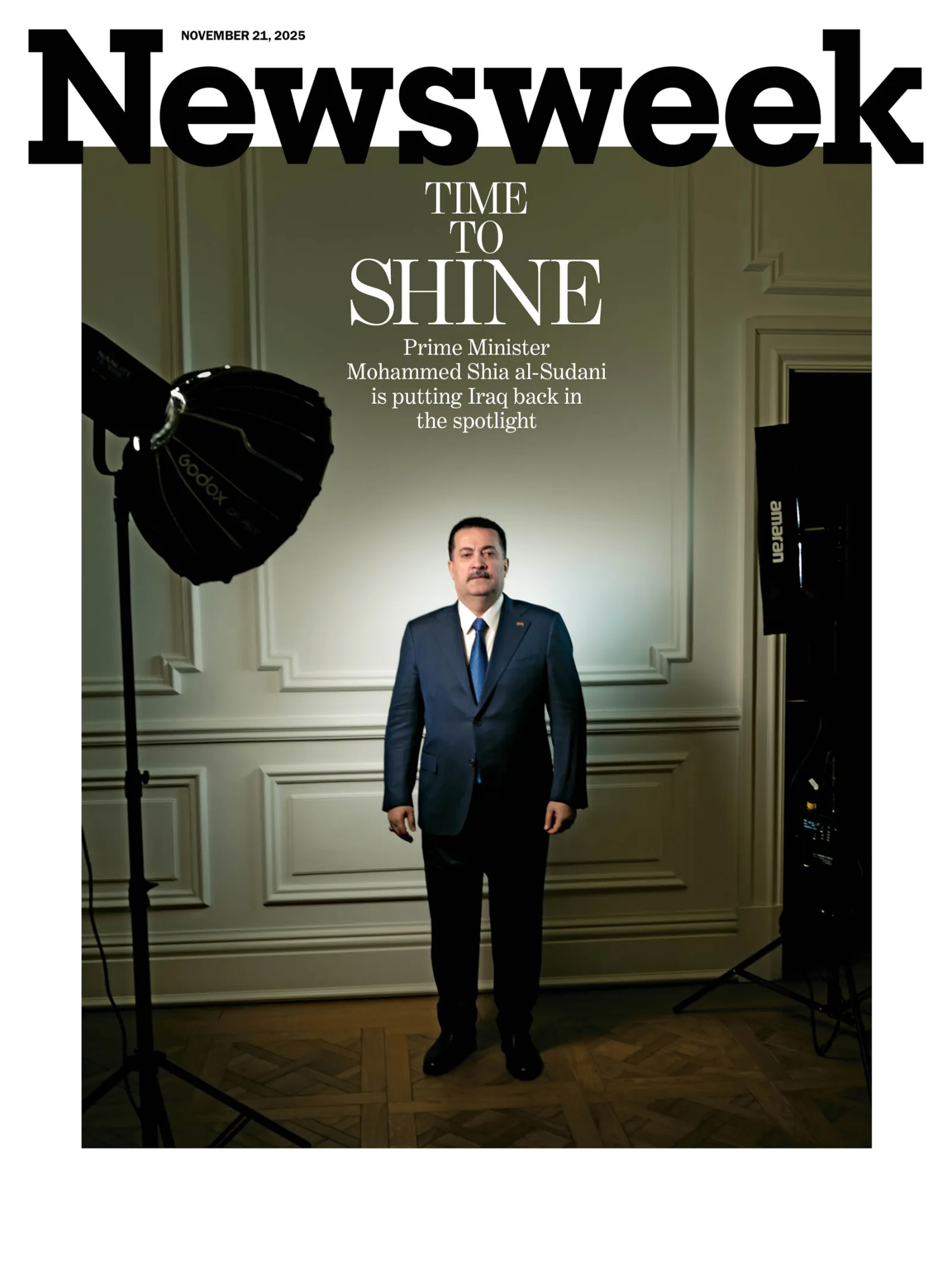
Photography by Shawn Carrie for Newsweek
View 0 Comments
Submit Correction
View Editorial & AI Guidelines