10
Loading video...

By Joe Edwards
Reporter
0
Share
Newsweek is a Trust Project member
See more of our trusted coverage when you search.Prefer Newsweek on Googleto see more of our trusted coverage when you search.
Wildfires are advancing on cities, emptying towns and sending smoke across borders, as parts of Europe and North America face another summer of fast-moving blazes.
In southwestern France, fires have threatened the outskirts of Bordeaux, forcing mass evacuations. In Spain, tens of thousands have reportedly fled as fires burned through central and eastern regions. Across the Atlantic, hundreds of fires continue to burn in Canada, with smoke again drifting into the United States.
The fires are not isolated disasters. Experts say they are part of a wider pattern in which heat, drought and vegetation dried by prolonged warm weather are creating more dangerous fire conditions across regions that once viewed extreme wildfires as an occasional or distant threat.
Read More on Weather
"Wildfires have always been a natural occurrence across the globe and will continue to be," AccuWeather meteorologist Brandon Buckingham told Newsweek. But he added that "there is evidence suggesting that the number of fires and area burned, fire behavior, and time of year at which fires are occurring are changing due to a changing climate."
...
Europe’s Fire Season
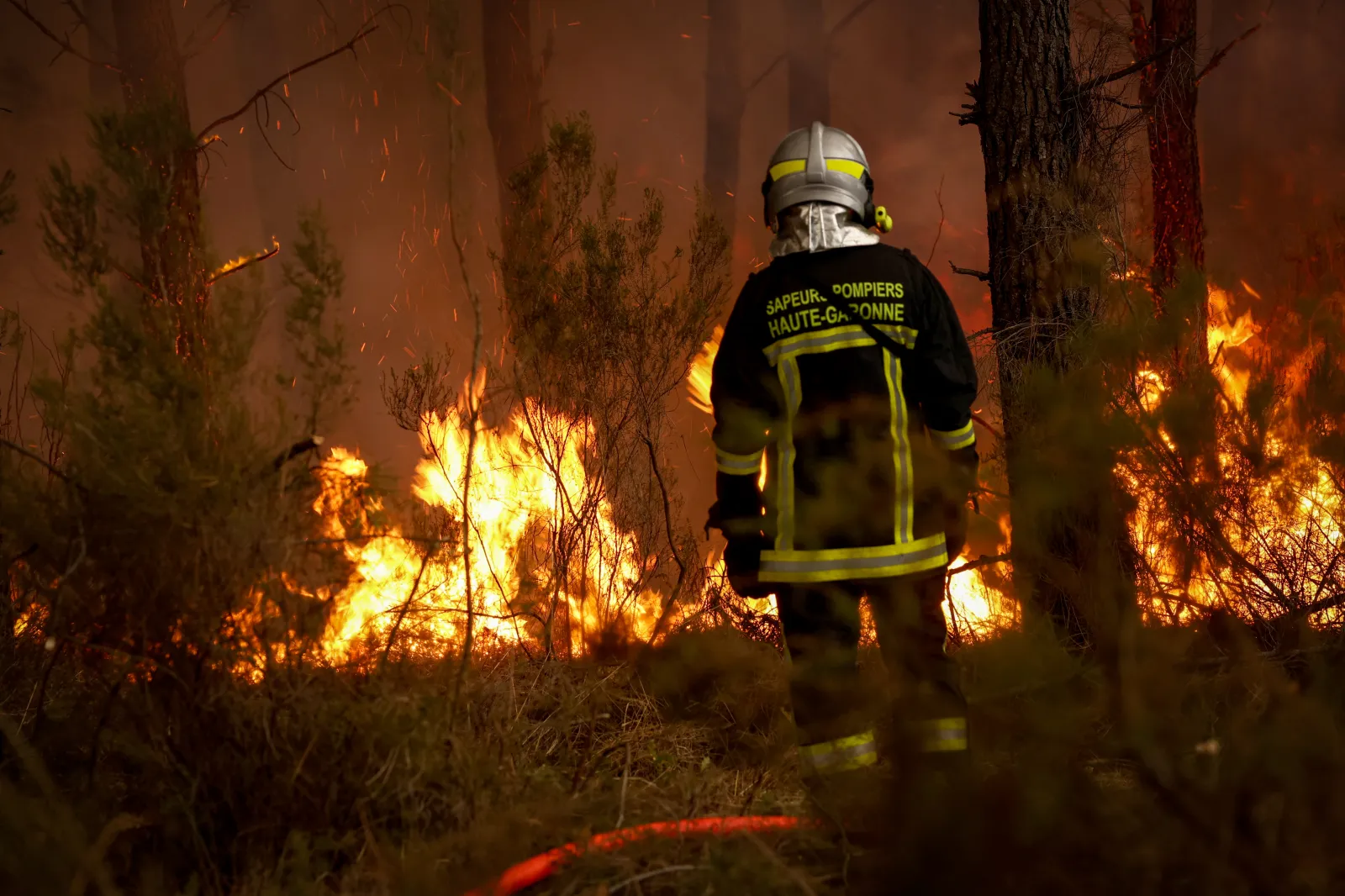
France and Spain have become the focus of Europe’s latest wildfire emergency. Reuters reported Monday that fires were burning about 15 kilometers, or 9.3 miles, from parts of the Bordeaux metropolitan area, while around 220,000 people had been evacuated in France and nearly 100,000 in Spain had been told to leave their homes.
Reuters reported that in Spain fires in Madrid, Ávila and Toledo had burned more than 111,000 acres, while a separate blaze in Castellón had ravaged more than 10,500 acres.
The scale has been startling, but scientists caution that this year is not yet Europe’s worst on record. Buckingham said 2025 was the worst year on record for wildfires in Europe, and that 2026 is still behind it for both acreage burned and number of fires. Even so, the European Commission’s Joint Research Centre reported that, as of July 22, the EU had recorded 1,254 fires this year, more than double the long-term average of 569, with 254,388 hectares burned.
Buckingham said the main drivers in Europe this year have been "multiple rounds of heat" and "severe drought in much of Western Europe and parts of central and Eastern Europe," adding that drought in France and Spain is rivaling the historic dry conditions of 2022.
Theo Keeping, a researcher at Imperial College London and World Weather Attribution, said in a statement shared with Newsweek that the fires in Spain and France are "some of the most extreme we have seen in Europe, in their size, in rapidity of spread, and in the pyrocumulonimbus storms they have created."
"Whilst wildfires are affected by people, and need vegetation, the hot and dry summer weather we have seen is the singular reason for these dangerous extremes," Keeping said. "Climate change is causing these conditions to become much more intense and more likely, which is why we are seeing much more extreme wildfires across Europe."

...
Portugal has also faced serious fires, such as in the central Vouzela area, where more than 1,200 firefighters, nearly 400 vehicles and 15 aircraft were deployed against a blaze that had burned about 12,000 hectares by July 5.
In Greece, fires have hit both the north and central regions. Reuters reported that two people died after a wildfire gutted a house near Liti, outside Thessaloniki, while more than 135 firefighters and 25 aircraft were later deployed to a central Greece blaze that prompted evacuation orders for two villages.
A fast-moving fire near Thessaloniki forced residents of three suburbs to evacuate, damaged several businesses and blanketed western parts of the city with smoke, while another major fire broke out west of Athens in the Mandra area.
The U.K. has experienced what experts have called a "firewave," with emergency services dealing with fires across England, Wales and Scotland during repeated heatwaves. The Guardian reported that fire services were dealing with 19 wildfires across Britain in mid-July, while the National Fire Chiefs Council warned that prolonged hot, dry weather makes vegetation easier to ignite and allows fires to spread faster.
North America Burns Too
North America’s fire season is also running above average.
Buckingham said the U.S. has recorded "just over 4 million acres burned this year so far," around 121 percent of the 10-year running average. The National Interagency Fire Center reported on July 26 that over 42,000 fires had burned more than 4 million acres across the country, with firefighters working to suppress 90 large fires.
Canada remains a major source of cross-border smoke. The Canadian Interagency Forest Fire Centre reports more than 900 active fires and 3.7 million hectares burned so far this year as of Monday. Buckingham said Canada had seen above-average activity, but "these are not extreme years by any means" in either Canada or the United States.
That does not make them harmless. Smoke from Canadian fires has repeatedly degraded air quality in parts of the U.S., turning wildfires into a public health issue far beyond the fire line.

...
A Global Pattern
A similar pattern is appearing elsewhere. Fires have also been reported this year in North Africa, Japan and South America. In Japan, The Japan News reported in April that fires in Ōtsuchi, Iwate Prefecture, burned more than 1,100 hectares and led to evacuation orders for thousands. In Chile, NASA said fires in Biobío and Ñuble broke out amid hot, dry conditions in January, burning more than 30,000 hectares and forcing tens of thousands of evacuations.
Al Jazeera reported on July 26 that extreme heat and strong winds were fueling significant blazes across North Africa, with Tunisia calling in international firefighting aircraft as fires threatened forests, farmland and communities.
No single wildfire can be reduced to climate change alone. Ignition sources, land management, vegetation, firefighting capacity and wind all matter. But scientists say climate change is loading the dice by making heatwaves more intense, droughts more damaging and fuels more flammable.
"As these climate extremes can occur any month of the year, wildfire seasons begin to have blurred start and end times," Buckingham said.
Contact Newsweek editors on this story: John Fitzpatrick and Tony Phillips
View 0 Comments
Submit Correction
View Editorial & AI Guidelines