10
Loading video...

By Hugh Cameron
Reporter
0
Share
Newsweek is a Trust Project member
See more of our trusted coverage when you search.Prefer Newsweek on Googleto see more of our trusted coverage when you search.
Major American companies are adopting different approaches to using the millions of dollars in refunds they are now receiving from the government, after President Donald Trump’s tariffs were struck down by the Supreme Court in February.
Amazon executives last week confirmed that the company received approximately $600 million in tariff refunds during its second financial quarter. In terms of sharing this with consumers, Chief Financial Officer Brian Olsavsky said that Amazon had absorbed the tariffs in most cases, but had identified a “limited set of circumstances” where import surcharges were passed on to customers.
“When we receive those refunds, we will proactively contact affected customers and automatically issue refunds to them,” he said, adding that refunds would also be invested “in low prices for customers.” When approached for comment, Amazon said it had nothing to add beyond Olsavsky's remarks.
Read More on U.S.
But other firms have made no such commitment, despite consumers having ultimately paid these in cases where companies raised prices to absorb the new duties. According to some estimates, the tariffs effectively amounted to a tax increase of $1,000 per household in 2025.
Companies Expecting Massive Refunds
In February, the Supreme Court ruled that the majority of Trump’s global tariffs were unlawfully imposed using an overly expansive reading of the 1977 International Emergency Economic Powers Act (IEEPA).
According to filings in the U.S. Court of International Trade, over 330,000 importers unduly paid tariffs on more than 53 million shipments thanks to Trump’s IEEPA duties. And since being ordered to do so, the government has returned around half the $166 billion customs officials estimate was paid by importers through the now-invalidated levies.
Kathleen Claussen, a leading international trade expert and professor at Georgetown Law School, told Newsweek that it was “reasonably unlikely but possible” that the government pays back the full $166 billion. This is because not every importer applied for a rebate, there was no automatic system for doing so, and a number of companies may have gone out of business during the tariff period.
"I would anticipate that 10-15 percent of the duties collected will not be refunded," said Joseph Spraragen, an international trade attorney and partner at GDLSK LLP. "In addition to the ongoing litigation regarding finally-liquidated entries...there are importers who are owed refunds, but who have not filed cases in the U.S. Court of International Trade and/or have not filed administrative claims with CBP via the CAPE portal."

...
Aside from Amazon, several companies have begun disclosing the significant amounts they are receiving or expect to receive from the government. Last week, Apple said tariff refunds—estimated at up to $2.2 billion—had boosted its earnings and propelled the iPhone maker to its “strongest June quarter ever.”
The carmakers Ford and General Motors have said they expect to receive $1.3 billion and $500 million in rebates, respectively, as a result of the Supreme Court decision.
Nike, meanwhile, has said it is awaiting nearly $1 billion this year thanks to “expected recovery of the IEEPA tariffs.”
These firms served as the importers of record—making them entitled to receive the rebates from the government—and most are treating the recovery process as strictly a settlement between importer and government, despite consumers having in some cases shouldered the burdens of Trump’s policy.
Nintendo argued last month that consumers agreed to any tariff-related price increases when they made their purchases, and are therefore “not entitled” to a portion of the rebate. Apple has said that it will use the refund to supplement its ongoing investment projects in the U.S., but has not committed to sharing any of this with its customers.
But many others, including FedEx, UPS, Walmart and Costco, have said they plan to pass along the refunds to their customers in some manner.
“As we’ve done in the past when legal challenges have recovered charges passed on in some form to our members, our commitment will be to find the best way to return this value to our members,” Costco CEO Ron Vachris said during an earnings call in March.
Related Story
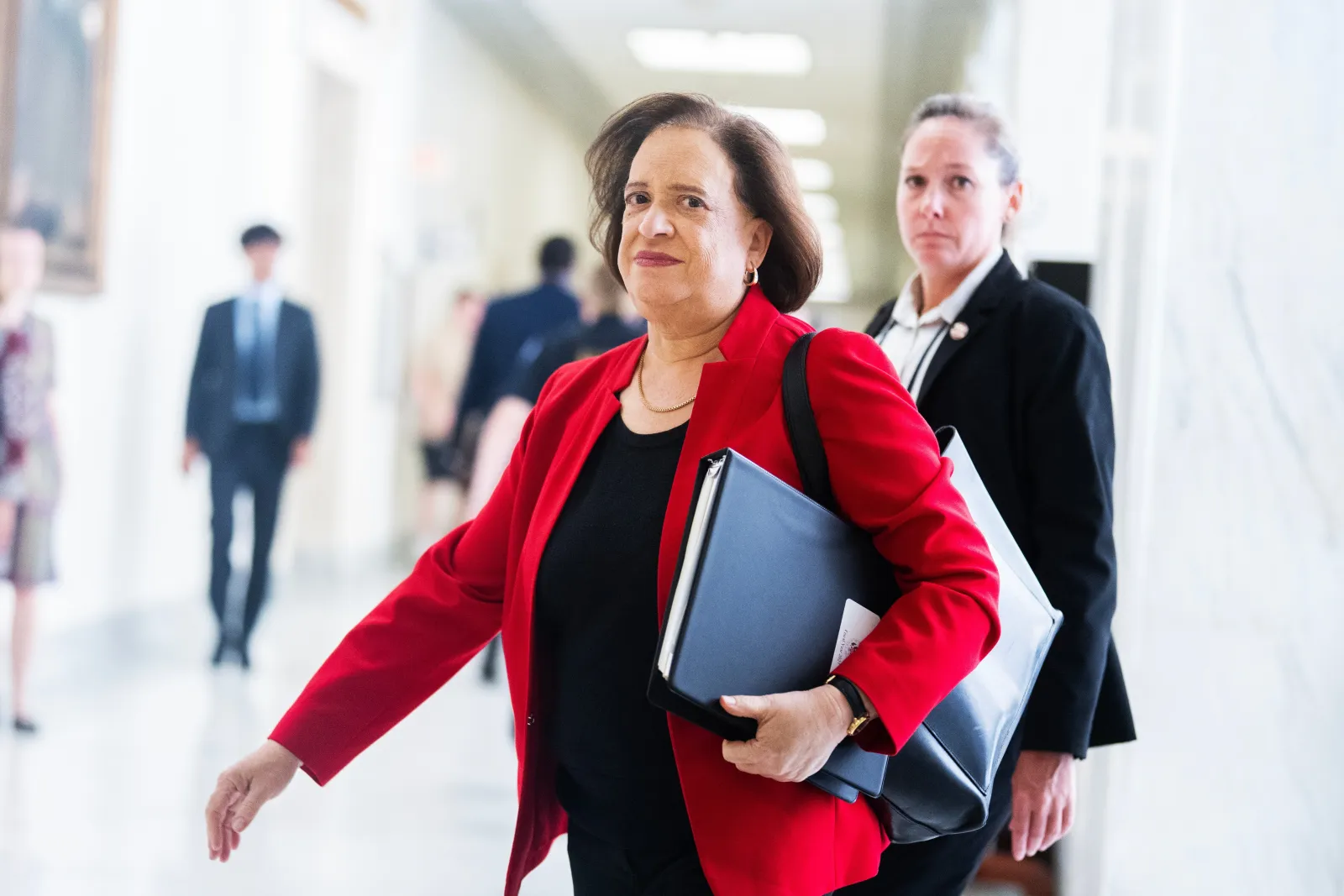
Elena Kagan Reveals How Trump at Supreme Court Hearing Impacted ‘Vibes’
Consumers Demanding Their Share
Amazon’s decision to issue automatic refunds to certain customers comes after the e-commerce giant faced significant pressure—and class action lawsuits—from consumers over prices that rise as a result of the tariffs.
And news of the refunds secured by corporations this earnings season has fueled further calls for customers to share in the rebates now being distributed by the government.
“Corporations passed on the cost of Trump’s tariffs to working people, consumers. They will pocket the refunds. More profits for corporate shareholders and we get screwed. Again,” Lorena Gonzalez Fletcher, president of the California Federation of Labor Unions, posted on X on Sunday.
Claussen told Newsweek consumer claims will in many cases be precluded by the legal and mathematical difficulties involved in calculating whether and to what extent costs are distributed, and whether these can be traced directly to the tariffs.
But some have said that consumers may be able to seek reimbursement from the firms that were transparent about imposing tariff-related price hikes in 2025 and early 2026.
"Most companies made tariffs a 'cost of doing business,' but there were some who took the step of delineating that a portion of the cost of a good was due to tariffs," Steve Wyett, chief investment strategist at the financial services firm BOK Financial, said in April. "In those cases, if consumers still have their receipts, they might have a claim against a company which gets a refund."
As well as consumers themselves, some of whom are chasing rebates in court, certain lawmakers have been pushing for firms to share their tariff refunds.
The Tariff Relief for Consumers Act, introduced by Democratic Representatives Rosa DeLauro and Frank Mrvan, would require any corporation receiving over $5 million in refunds to pass these back to consumers for purchases of household essentials.
Separately, in April, a group of House Democrats sent formal letters to the CEOs of 10 major corporations—Walmart, Home Depot, Target, Best Buy, FedEx, Amazon, Lowe’s, Costco, UPS, and DHL—demanding they “pass the refunds they get from the federal government to their customers” rather than using these to “pad their bottom line and raise costs even further.”
Contact Newsweek editors on this story: Ben Kelly and Sam Wilson.
View 0 Comments
Submit Correction
View Editorial & AI Guidelines