...

By Andrew Stanton
Reporter
0
Share
Newsweek is a Trust Project member
See more of our trusted coverage when you search.Prefer Newsweek on Googleto see more of our trusted coverage when you search.
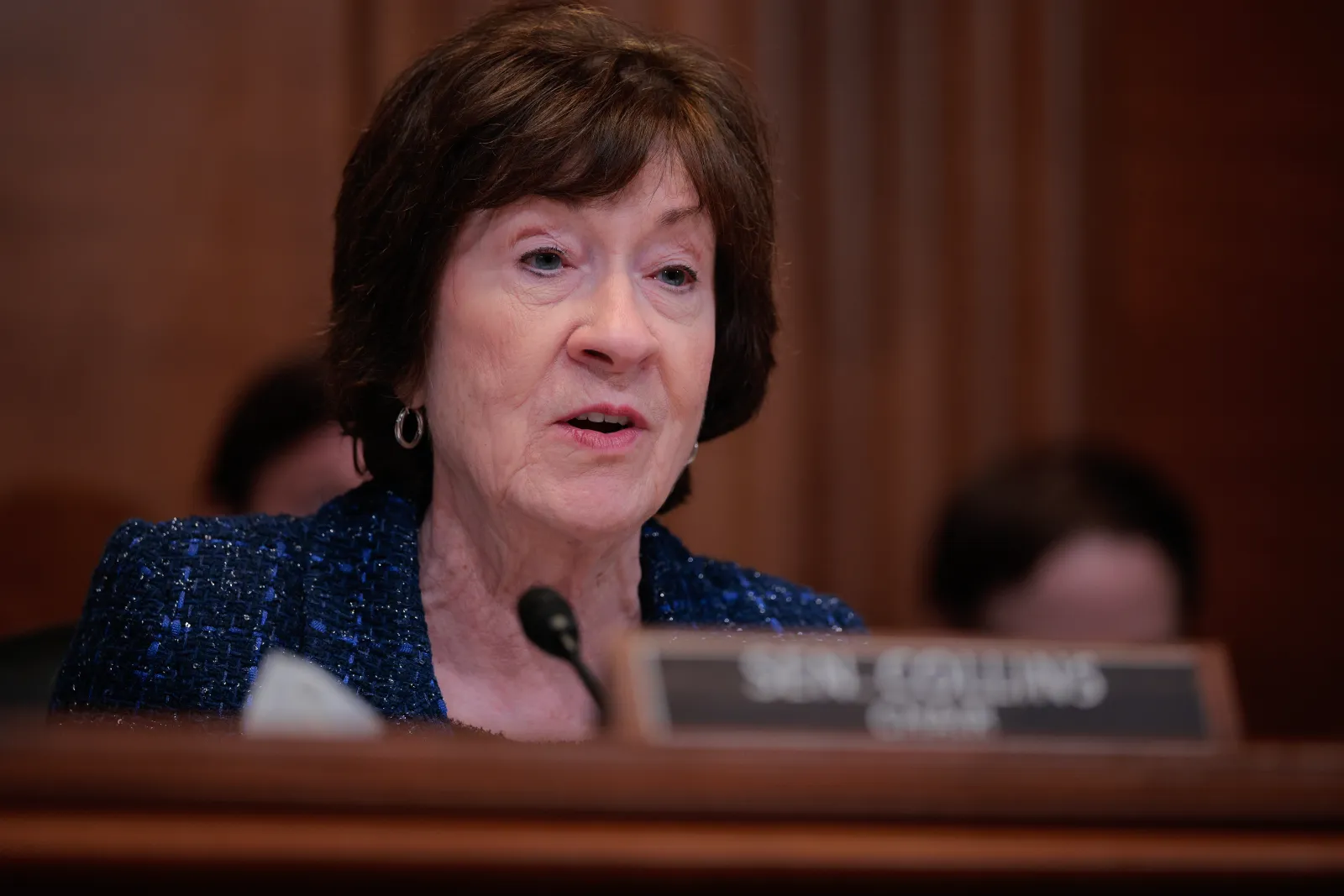
Republican Senator Susan Collins officially launched her reelection campaign in the 2026 Maine Senate race, a top target for Democrats as polls show a tight race against Democratic candidates, including Governor Janet Mills and progressive Graham Platner.
Newsweek reached out to each of the candidates' campaigns for comment via email.
Why It Matters
Collins’ decision to seek another term means that Maine's Senate race will be among the most competitive of the 2026 midterms. The Pine Tree State’s election is a top target for Democrats, as former Vice President Kamala Harris carried the state by about seven points in the 2024 presidential race; President Donald Trump has never won it. Democrats also believe a favorable national environment and increased political polarization could make Collins's reelection difficult.
Read More on Politics
But Collins, a centrist who has enjoyed historical popularity in Maine, has won in tough environments before—and forecasters view the race as a pure toss-up due to her incumbency and historical overperformances in Maine. Republicans hope she can win again due to her long tenure and bipartisan appeal.
What To Know
Collins officially announced her plans to run for reelection on Tuesday. Although she had indicated she intended to run again, she had not made her campaign official until now, fueling speculation about her intentions.
“As a proud native of Maine, I've dedicated my life to serving our state and nation. I am deeply grateful for the unwavering support Mainers have shown me over the years. It is an honor to serve you, and I'm excited to announce my run for re-election to the U.S. Senate in 2026,” she wrote on X.
In an opinion article published in The Bangor Daily News, the Maine Republican wrote that the midterms present a “choice between leaders committed to uniting Americans or further dividing us.”
“Both parties need to end the distractions and deliver for the American people. At a time when Washington seems broken and trust is low, Maine needs experienced, steady leadership and a senator committed to the hard work it takes to get things done,” she wrote.
...
Maine is generally Democratic-leaning, but it also has an independent streak that has allowed Collins to win reelection in the past. She most recently won reelection in 2020 with just over 50 percent of the vote; at the same time, former President Joe Biden carried the state by about nine points. Southern Maine is generally seen as more Democratic, while the state's rural, northern areas are more conservative.
The state also notably uses a ranked choice voting system where voters "rank" their preferred candidates. If no candidate reaches 50 percent support, the candidate with the fewest voters is eliminated, and their votes are distributed to the other candidates based on who they ranked second. This continues until a candidate reaches majority support.
James Melcher, a professor of political science at the University of Maine at Farmington, told Newsweek the race will be “extremely competitive.”
“The last race was far closer than Collins’ previous runs. She got 51 percent, and Sara Gideon got about 44 percent. Six years earlier, she beat Shenna Bellows by about 2-1. She was once the second most popular senator in their home state (Sanders was #1). Now, she is the second least popular,” he said.
Susan Collins vs. Janet Mills, Graham Platner Polling
Recent Maine Senate polls show Collins in a close race against her Democratic challengers, with no candidate holding a lead outside the margin of error.
The latest survey from Fabrizio, Lee & Associates, sponsored by GOP-aligned group Pine Tree Results, gave Collins a single-point lead over both Platner and Mills (45 percent to 44 percent), reported The New York Times. It surveyed 800 likely voters from January 20-24, 2026.
Earlier in January, Platner had presented his own poll showing him with a single-point lead over Collins (50.4 percent to 49.6 percent). Collins led Mills in that poll (51 percent to 49 percent). It surveyed 900 likely voters from December 11-16, 2025, and was conducted by Workbench Strategy.
A Pan Atlantic Group poll last year yielded similar results. Platner led by a single point (43 percent to 42 percent), while Mills and Collins were tied at 43 percent. The poll surveyed 820 likely voters from November 29 to December 7, 2025, and had a margin of error of plus or minus 3.7 percentage points.
Betting odds favor Democrats to win the seat. Kalshi gave Democrats a 69 percent chance, and Polymarket gave them a 71 percent chance of unseating Collins on Tuesday.
In the fourth quarter of 2025, Collins reported a $2.2 million fundraising haul, according to Federal Election Commission (FEC) filings reviewed by Newsweek. Meanwhile, Platner raised $4.6 million, and Mills raised $2.7 million.
Maine Senate Race Viewed as Toss-Up—Forecasters
Both the Cook Political Report and Sabato’s Crystal Ball classify the race as a toss-up.
In a January 29, 2026, update, Sabato analyst Kyle Kondik described the race as “the truest Toss-up of them all.”
“Maine may be the truest Toss-up of them all, both because of Sen. Susan Collins’s (R) unique cross-party appeal in a politically quirky state and because the primary contest between insider Gov. Janet Mills (D) and outsider veteran/oyster farmer Graham Platner (D) has become one of the premier intraparty fights of the cycle,” he wrote.
Janet Mills, Graham Platner Battle for Democratic Nomination
Mills and Platner are both vying for the Democrats’ nomination. Mills, who currently serves as the state’s governor, is viewed as the more centrist candidate in the race and has been viewed as the preferred candidate by Senate Democratic leadership. Her supporters note that she has won solid victories in her gubernatorial runs.
But some critics warn that her approval rating has not been particularly strong; the latest Morning Consult poll showed her as the least popular Democratic governor in the country. Age has also become a factor, as Mills is 78.
Platner supporters view him as someone who can turn out the party’s progressive voters. They believe his biography as an oyster farmer and position as a political newcomer may win over independents, as well.
But unearthed social media posts about women, rural white people and Black people, as well as the revelation that he had a tattoo resembling the Totenkopf, or “death’s head,” a symbol adopted by the Nazi SS, have threatened to upend his campaign. Platner has apologized for the posts and has had the tattoo covered.
He previously told Newsweek, “I absolutely would not have gone through life having this on my chest if I knew that—and to insinuate that I did is disgusting.”
Conventional wisdom suggests Mills would be the stronger candidate because Maine voters tend to support “relatively moderate candidates in statewide races,” according to Melcher.
“But this year may be different. Many young Democrats care deeply about getting younger people into government—and at 77, many of them see her as too old, and some think she should have been more supportive of tribal sovereignty and have more liberal stances on crime/corrections issues. Some of them also like Platner’s forceful criticism of Israel’s actions in Gaza,” he said.
Maine Is a Must-Win for Democrats Facing a Tough Map
Maine is viewed as a must-win state for Democrats this year.
Even if the national environment benefits Democrats, the party may still face a tough Senate map. Republicans currently hold a 53-47 majority, meaning Democrats must flip three seats for a tie and four for an outright majority.
In addition to Maine, North Carolina, where GOP Senator Thom Tillis is retiring, is the Democrats' other top target. But even if Democrats hold every seat they currently hold and flip those two seats, they would still be a 49-seat minority.
No other Republican-held seats in Harris-won or single-digit Trump states are up for grabs. This means Democrats must compete in more conservative territory. They are eyeing double-digit Trump states like Alaska, Iowa, Ohio and Texas as potential flip opportunities.
Still, Democrats believe they may be able to compete for control of the Senate. Trump's declining approval rating and concerns about the economy loom over the midterm. Analysts have said these economic factors could put the Senate in play.
What People Are Saying
Maine Governor Janet Mills responded to Collins’ announcement: “Seniority without a backbone is just tenure, and after decades in Washington, Senator Collins has failed to demonstrate the leadership required in this dangerous moment in history. As Donald Trump tramples on the Constitution, undermines the rule of law, and weaponizes the federal government against the American people, Susan Collins is refusing to stand up to his abuses and is instead rubber stamping a Republican agenda that prioritizes the wants of the wealthy over the needs of working Maine people. Maine deserves strong leadership, not someone who sticks their finger in the air and feigns concern but refuses to act with courage when it matters most, as Susan Collins has done time and time again.”
Graham Platner wrote on X: “Susan Collins pledged to only serve two terms in the Senate. That’s just one of a hundred reasons she doesn’t deserve a sixth term.”
NRSC Chairman Tim Scott wrote in a statement: “From protecting Social Security to supporting small businesses, no one works harder and is more dependable at delivering prosperity and opportunity. I’m confident Susan will defeat whoever emerges from the messy Democrat primary, because Mainers know they can always count on her.”
What Happens Next
Maine remains a toss-up race for this November. The primary is set for June 9, 2026, and the general election will be held on November 3, 2026.
Update 2/11/26, 1:21 p.m. ET: This article was updated with comment from James Melcher.
In a polarized era, the center is dismissed as bland. At Newsweek, ours is different: The Courageous Center—it's not "both sides," it's sharp, challenging and alive with ideas. We follow facts, not factions. If that sounds like the kind of journalism you want to see thrive, we need you.
When you become a Newsweek Member, you support a mission to keep the center strong and vibrant. Members enjoy: Ad-free browsing, exclusive content and editor conversations. Help keep the center courageous. Join today.


View 0 Comments
Submit Correction
View Editorial & AI Guidelines