...

By Nick Mordowanec
Staff Writer
0
Share
Newsweek is a Trust Project member
See more of our trusted coverage when you search.Prefer Newsweek on Googleto see more of our trusted coverage when you search.
U.S. Supreme Court Justice Brett Kavanaugh said he was "surprised" Tuesday during oral arguments for a case involving a school district and LGBTQ+ books in his lifelong home of Montgomery County, Maryland.
Why It Matters
Kavanaugh, his wife, Ashley, and their two daughters live in Chevy Chase Section Five, a small village within Montgomery County. The justice and former U.S. Court of Appeals judge was nominated by President Donald Trump in 2018 to replace retiring Justice Anthony Kennedy.
Read More on U.S.
What To Know
The case Mahmoud v. Taylor was brought forward May 24, 2023, to the U.S. District Court of Maryland after parents of different religious persuasions claimed that the Montgomery County Public Schools (MCPS) district in Rockville, Maryland, was forcing their pre-K and elementary-aged children to read controversial LGBTQ+ books.
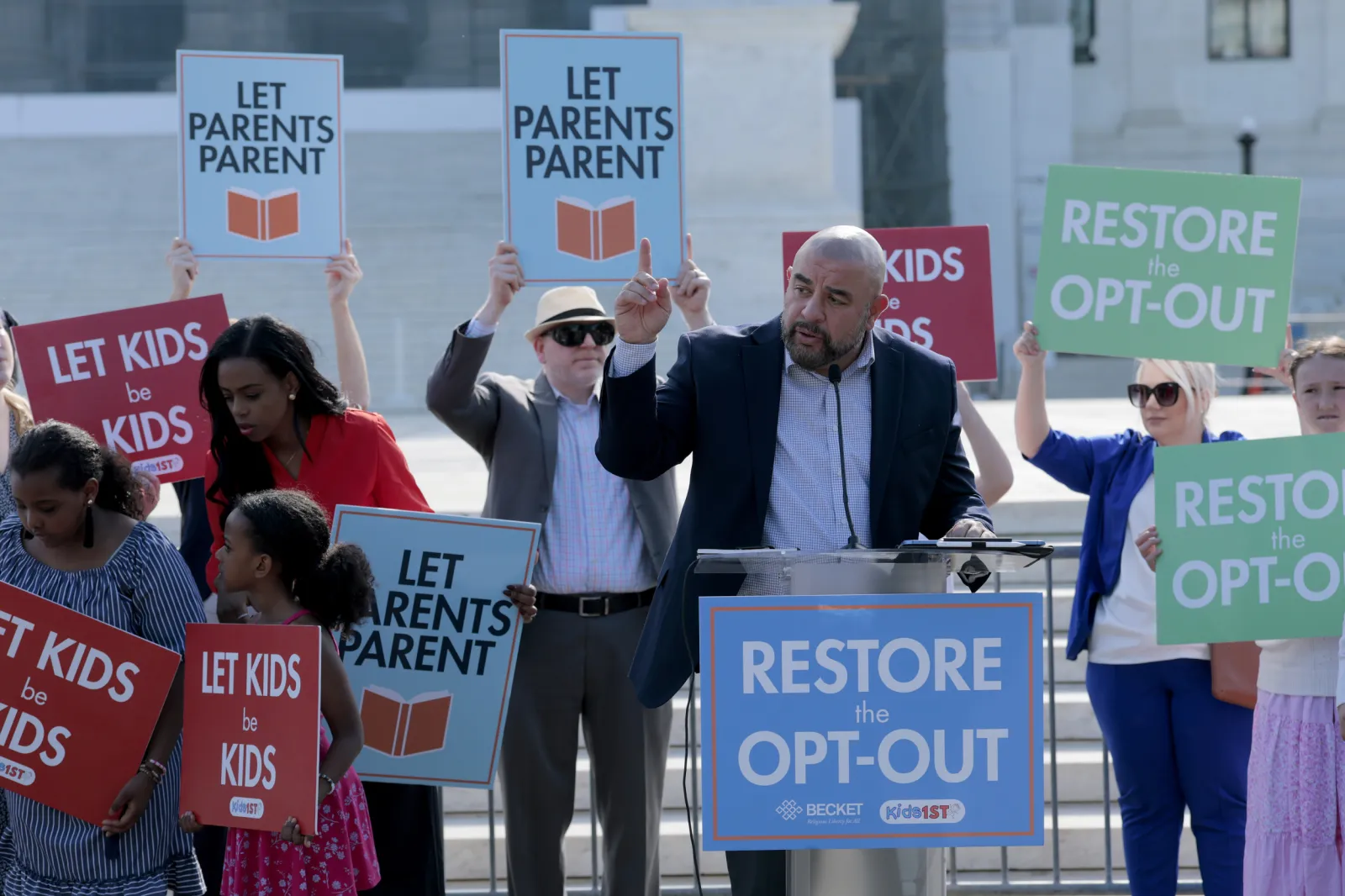
Plaintiffs, which include Christian, Jewish and Muslim parents, have argued that their right to religious expression and in turn their First Amendment rights have been violated after the school district took away an "opt-out" option for parents uncomfortable with the reading selections in their children's classrooms.
...
In fall 2022, the Montgomery County Board of Education announced over 20 new "inclusivity" books for pre-K through eighth grade students as part of "Pride Storybooks." The caveat was that parents would be informed when such books were read, providing an option for parents to opt out their children.
But concerned parents argue that the schools' informing of parents was short-lived. By 2023, the school board announced it would no longer notify parents or honor opt-out requests. The district has more than 70,000 children.
The May 2023 lawsuit ruled against the parents. That decision was appealed to the Fourth Circuit Court of Appeals, and nearly a year later, the appellate court ruled to keep the school board's policy.
Becket, a nonprofit group that fights in court to protect religious expression, appealed the ruling to the U.S. Supreme Court in September 2024. The High Court agreed in January to hear the case.
Kavanaugh, during Tuesday's proceedings, said that Montgomery County has long been a "beacon" for religious freedom.
"I guess I'm surprised that this is the hill we're going to die on, in terms of not respecting religious liberty," Kavanaugh said.
Attorney Eric Baxter, vice president and senior counsel at Becket and speaking on behalf of the Maryland parents, claimed the district's actions were "clearly targeted" at religious individuals.
The plaintiffs have argued that the books in question include some that champion pride parades, gender transitioning and pronoun preferences for children. One book, for example, reportedly tasks 3- and 4-year-olds to search for images from a word list that includes "intersex flag," "[drag] queen," "underwear" and "leather."
Another encourages fifth graders to discuss what it means to be "non-binary."
Kavanaugh said that a goal in religious precedents is a "win-win" where religious beliefs can be respected and accommodated while cities or states pursue goals.
"I guess I am a bit mystified, as a lifelong resident of the county, how it came to this," he said.
The plaintiffs are not trying to alter the general curriculum, the justice added.

...
"As our counsel told the Court, MCPS's policy is grounded in our commitment to provide an appropriate classroom environment for all of our students," a Montgomery County Board of Education spokesperson told Newsweek following oral arguments. "We believe a curriculum that fosters respect for people of different backgrounds does not burden the free exercise of religion.
"Based on established law, as discussed in our brief and by our counsel at today's argument, we believe the Supreme Court can and should affirm the lower courts' rulings. Regardless of the outcome, we are grateful for the opportunity to have our case heard by the highest court in the land. We await the Court's decision."
Attorney Alan Schoenfeld, who argued on behalf of MCPS, said the board withdrew the opt-out notice policy because it became unfeasible—adding that the district makes it "explicitly clear students do not need to accept, agree with or affirm anything they read or anything about their classmates' beliefs or lives."
Kavanaugh didn't understand how it wasn't feasible, considering that the district did at one point have an opt-out policy that it later rescinded.
"Every other school board in the country has opt-outs for all sorts of things; the county has opt-outs for all sorts of things; other Maryland counties have opt-outs for all sorts of things," Kavanaugh said. "And yet, for this one thing, they changed midyear and said, 'No more opt-outs.' I just don't understand feasibility."
A spokesperson for Becket referred Newsweek to a statement released Tuesday.
What People Are Saying
Supreme Court Justice Samuel Alito: "Why is the Montgomery County Board of Education in this argument running away from what they clearly want to say?"
Supreme Court Justice Ketanji Brown Jackson: "This is not just about books. This is about exposure to people of different sexual orientations and the objection, the sincerely held objection, that children shouldn't be exposed to this."
Baxter: "In this country, we've always trusted families to decide when their kids are ready for sensitive topics. Children shouldn't be forced into conversations about drag queens, pride parades, and gender transitions without their parents' permission. Today, we fought for common sense and parents' right to guide the upbringing of their children."
Billy Moges, director of Kids First: "Schools should be working with parents, not against us. We are our children's primary teachers, not obstacles to be avoided. Today, we asked the Court to remind Montgomery County—and the entire nation—of this fundamental truth."
What Happens Next
The court is expected to issue a ruling in the case by June, before the current term ends.
View 0 Comments
Submit Correction
View Editorial & AI Guidelines