
...

By Mandy Taheri
Reporter
0
Share
Newsweek is a Trust Project member
See more of our trusted coverage when you search.Prefer Newsweek on Googleto see more of our trusted coverage when you search.
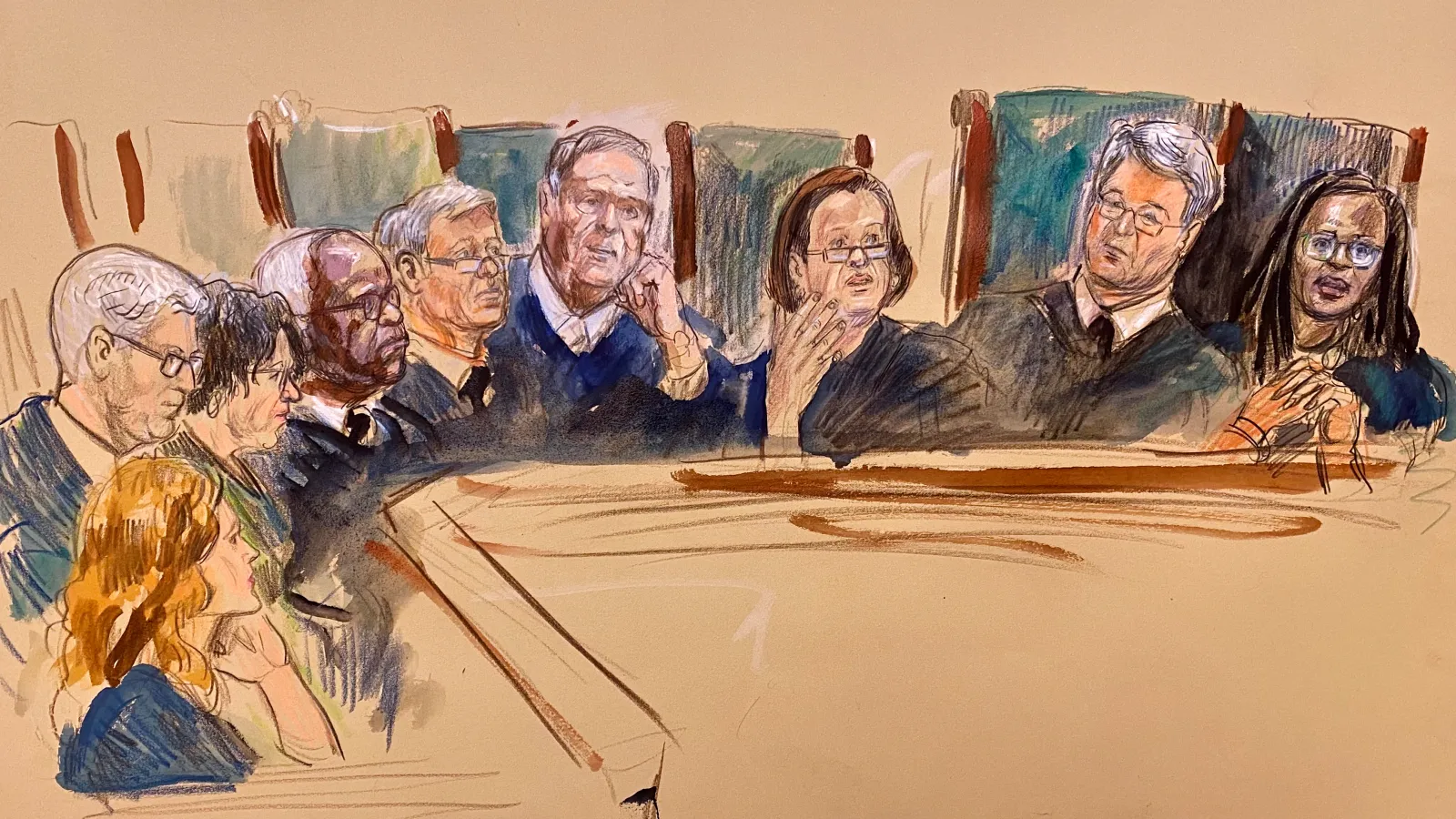
Supreme Court Justice Ketanji Brown Jackson warned that attacks on judges and the broader judicial system are “really an attack on our society,” in remarks Tuesday, as she urged Americans to defend the independence of the courts against mounting political pressure.
Her comments arrive as President Donald Trump has publicly criticized several judges and court rulings—including decisions tied to legal challenges over his sweeping tariff policies—and his calls for impeachment of district court judges who ruled against him—raising broader concerns on judicial independence.
Why It Matters
Confidence in the Supreme Court recently fell to a quarter-century low, according to NBC polling in March, which found just 22 percent of registered voters expressing a great deal or quite a bit of confidence in the highest court in the land.
Read More on News
The Supreme Court’s authority ultimately depends on public acceptance of its rulings and legitimacy, and confidence levels can shape how elected officials and the public respond to consequential decisions on issues like abortion, voting, presidential power and immigration. However, justices serve lifetime appointments and are not directly accountable to voters, which insulates them from electoral pressure.
...
What To Know
The Court has a 6-3 conservative majority, including the three justices appointed by Trump. It has ruled in favor of the Trump administration on a number of key issues, including immigration enforcement and cuts at federal government agencies, but has also drawn the president's ire, including when it struck down his tariffs earlier this year.
While speaking to students at Southern Methodist University (SMU) in Dallas, Texas, Jackson said, “Equal justice under law is a key tenet to freedom in our society, and in order to have that, you have to have an independent judiciary—one that is not beholden to the political branches or beholden to people.”
She continued, “I just wish that people really focused on that and, therefore, stood up in some ways for the judiciary, when people—judges are being attacked and undermined, that is really an attack on our society.”
In addition to escalating political attacks against judges, members of the judiciary have also faced physical threats, including a 2022 assassination attempt against Supreme Court Justice Brett Kavanaugh.
Last year, Sophie Roske, formerly known as Nicholas Roske, pleaded guilty to attempting to assassinate Kavanaugh after traveling to the justice’s home in Chevy Chase, Maryland, in June 2022. Roske, who was 26 at the time of the incident, was arrested near the residence while armed with a gun and knife and carrying zip ties and burglary tools, according to federal authorities.
Americans' Perception of the Court
An October 2025 Gallup poll found that an all-time high of Americans, 43 percent, say the Supreme Court is “too conservative.” Thirty-six percent of participants believe it is “about right,” and 17 percent said it’s “too liberal.” The poll of 1,000 Americans was conducted from September 2 to September 16, and has a margin of error of plus or minus 4 percentage points.
Overall approval of the Supreme Court dipped to 42 percent in October 2025, with 57 percent disapproval, a significant drop from March 2025, when the court's approval rating was 54 percent, with 46 percent disapproval.
...
A Marquette Law School survey of 982 adults on perception of the High Court found that Democrats' approval rating increased from 17 percent to 19 percent, while 70 percent of Republicans approved and 30 percent disapproved. The poll was conducted from April 8 to April 16, and has a margin of error of plus or minus 3.4 percentage points.
A survey conducted by the Public Religion Research Institute (PRRI) in 2025 showed that two-thirds of Republicans, 67 percent, support the idea of term-limiting Supreme Court justices, along with 85 percent of Democrats and 76 percent of independents.
In addition, a poll by NBC News released in March found that 22 percent of registered voters nationally said they have a "great deal" or "quite a bit" of confidence in the Supreme Court, 40 percent said they had "some" confidence and 38 percent said they had "very little" or "no" confidence. The poll surveyed 1,000 registered voters from February 27 to March 3 and has a margin of error of plus or minus 3.1 percentage points.
Opposing Opinions, Yet Cordial Relations
While the justices often write sharp dissents and publicly disagree over major rulings, several members of the High Court, including Jackson, have said they maintain cordial relationships off the bench.
She told the Dallas crowd, “We are very good at compartmentalizing. It’s part of the job." Justices Samuel Alito, Neil Gorsuch and Clarence Thomas recently described one of Jackson’s criticisms of a Voting Rights Act-related ruling as “baseless and insulting."
Jackson told the SMU crowd, “In the world of law and the world of writing your opinions, you’re going to disagree, and you have the opportunity to express your views in the context of your opinions, but in our day-to-day interactions, none of us takes it personally, and we get along just fine."
Justice Sonia Sotomayor has echoed similar sentiments, saying in the fall, "We are a family," about all the justices, including those with whom she does not share the same legal viewpoints.
When speaking about conservative Justice Thomas, she said he "knows the name of practically every employee in the building. And not infrequently, we're walking out of a conference or the dining room and he'll say, 'Did you know somebody in the building has lost a parent, a sick son?' Something about them personally. He cares deeply about people," Sotomayor said.
View 0 Comments
Submit Correction
View Editorial & AI Guidelines