...

By Jenni Fink
Senior Editor
0
Share
Newsweek is a Trust Project member
See more of our trusted coverage when you search.Prefer Newsweek on Googleto see more of our trusted coverage when you search.
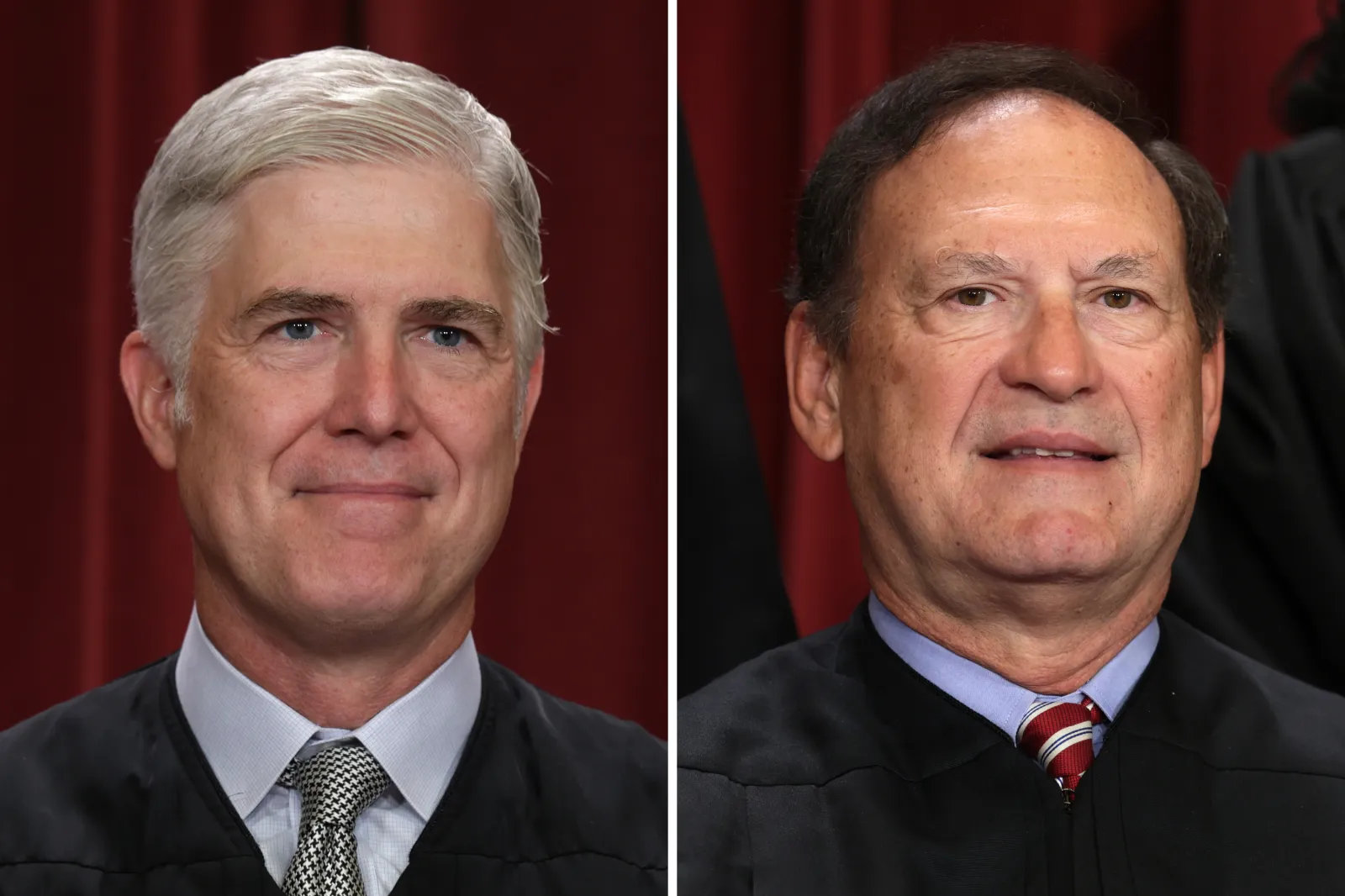
Supreme Court Justices Neil Gorsuch and Samuel Alito did not participate in the decision making of two different cases and while it may be known why Alito decided to recuse himself, it's less clear the reasoning behind Gorsuch's decision.
Supreme Court justices, who aren't required to explain why they're sitting out of a case, tend to sit them out when there's a conflict of interest. That could be because of a financial stake in the case through stocks they own, a personal relationship or that they were involved in the case as a judge before they joined the court.
Which Supreme Court Case Did Samuel Alito Sit Out On?
In Coleman v. Chevron Phillips Chemical Co., the court declined to hear an employment‑discrimination case brought by a former Chevron Phillips employee after the Fifth Circuit ruled against him. Alito took no part in the decision, according to the order list. Alito didn't explain why, but it fits a well-established pattern.
Read More on News
Alito continues to hold individual stocks, including in major energy companies. As a result, he has frequently recused himself from cases involving oil, gas, and petrochemical firms, particularly those connected to Chevron and its corporate affiliates. In multiple high‑profile cases this term involving Chevron‑related litigation, Alito has stepped aside due to financial conflicts tied to his stock ownership, sometimes confirmed explicitly by the court clerk in letters to the parties.
In the Chevron U.S.A. Inc. v. Plaquemines Parish, Louisiana case, Alito initially participated in it, but later formally recused himself. A court clerk said it was because of his financial interest in ConocoPhillips, the parent company of Burlington Resources, which was involved in the lower-court litigation. He also recused himself from several petitions involving Boulder's climate damage lawsuits that would impact oil and gas companies.
Chevron Phillips Chemical, the respondent in Coleman, is a joint venture involving Chevron. While the court did not publicly confirm a conflict in this specific case, Alito’s nonparticipation is consistent with a longstanding, documented recusal practice grounded in federal ethics law, which requires judges to disqualify themselves when they have a financial interest in a party before the court.
...
Which Supreme Court Case Did Neil Gorsuch Sit Out On?
In Glynn Environmental Coalition v. Sea Island Acquisition, environmental groups asked the court to review an 11th Circuit decision that applied the court’s 2023 ruling in Sackett v. EPA to dismiss a Clean Water Act citizen suit. The case involved wetlands on St. Simons Island, Georgia, and raised questions about the scope of federal jurisdiction over waters of the U.S. The court denied certiorari and Gorsuch did not participate in the decision making, according to the order list.
It's unclear why Gorsuch didn't take part in the case and there is no publicly documented financial conflict, clear personal connection or prior judicial involvement. Gorsuch also doesn't have a clear pattern of sitting out other Sackett or Clean Water Act cases, indicating there was something else about this case that caused him to not participate.
Why the Supreme Court Rarely Explains Recusals
The court is not bound by the same enforcement mechanisms that apply to lower federal judges, and justices decide for themselves whether to recuse. While federal law requires disqualification in cases involving financial interests or other conflicts, it does not require justices to explain their decisions publicly.
As a result, order lists frequently include unexplained notations that a justice “took no part” in a case. Ethics watchdogs and legal scholars have long criticized this opacity, arguing it forces the public and press to speculate—particularly in high‑profile or politically sensitive cases.
There have been exceptions. In a handful of instances in recent years, individual justices—most notably Justice Elena Kagan and Justice Ketanji Brown Jackson—have cited statutory provisions explaining that they recused due to prior government or judicial service. But those explanations remain the exception, not the rule.
In most cases, including Coleman and Glynn Environmental Coalition, the court offers no explanation at all. From 2018-2023, justices recused themselves in roughly 3 percent of appeals, according to Bloomberg Law. The analysis found nearly all of the over 750 recusals didn't include an explanation as to why the justices decided not to participate.
Supreme Court justices have come under fire in recent years for the lack of ethical oversight, prompting the court to put into place a new way to assist potential conflict of interests. In February, the court announced it would be using a new software to identify times when justices should recuse themselves, but the decision as to whether participate or not will still be left up to the justices.
In a polarized era, the center is dismissed as bland. At Newsweek, ours is different: The Courageous Center—it's not "both sides," it's sharp, challenging and alive with ideas. We follow facts, not factions. If that sounds like the kind of journalism you want to see thrive, we need you.
When you become a Newsweek Member, you support a mission to keep the center strong and vibrant. Members enjoy: Ad-free browsing, exclusive content and editor conversations. Help keep the center courageous. Join today.


View 0 Comments
Submit Correction
View Editorial & AI Guidelines