...

By Gabe Whisnant
News Editor
0
Share
Newsweek is a Trust Project member
See more of our trusted coverage when you search.Prefer Newsweek on Googleto see more of our trusted coverage when you search.
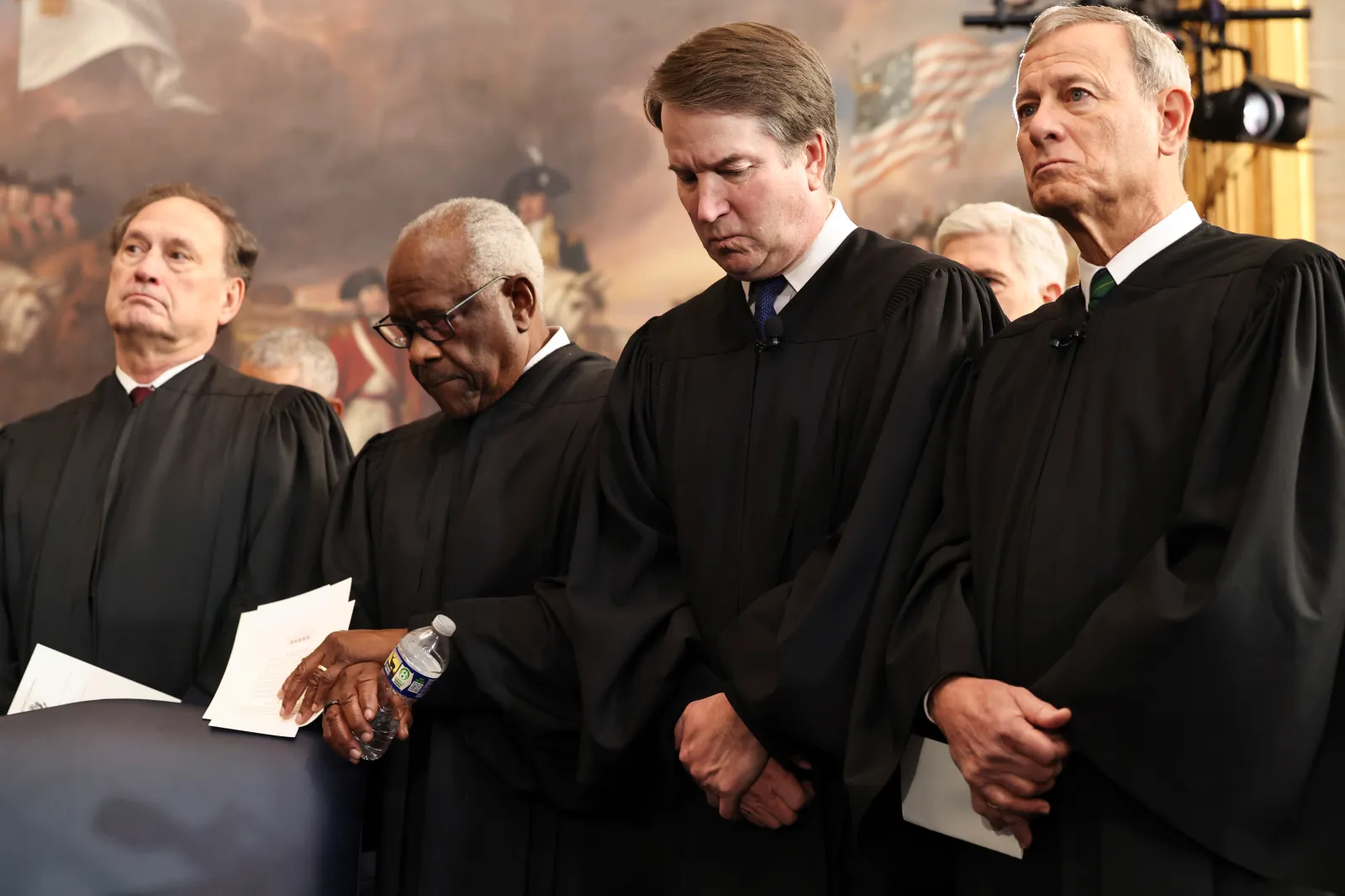
The Supreme Court on Monday signaled it may be ready to overturn a 90-year-old precedent that limits a president’s power to fire members of independent federal agencies, as the conservative justices pressed lawyers on why officials such as Federal Trade Commission members should be shielded from removal without cause.
Why It Matters
The case stems from President Donald Trump’s firing of Democratic FTC commissioner Rebecca Slaughter, whom he dismissed in March even though her term was not set to expire until 2029. A lower court ruled Trump exceeded his authority, but the Justice Department appealed, and the Supreme Court agreed to hear the case — a move that could reshape the balance of power among the branches of government.
Read More on News
...
What To Know
During more than two hours of arguments, several conservative justices openly questioned the durability of the landmark 1935 precedent Humphrey’s Executor v. United States, which held that presidents cannot remove independent-agency heads for policy disagreements. Chief Justice John Roberts suggested the ruling may no longer fit the realities of the modern administrative state.
“Humphrey’s Executor is just a dried husk of whatever people used to think it was,” Roberts said, arguing that the FTC of 1935 wielded “very little, if any, executive power” compared to the muscular agency that exists today. He pressed Amit Agarwal, a lawyer for Slaughter, on how much authority Congress could give independent commissions while still restricting a president’s power to remove their members.
Agarwal acknowledged “competing dangers” but argued the current system has served the nation effectively for nearly a century. Expanding Trump’s firing power, he said, would put “everything on the chopping block.”
Justice Samuel Alito challenged that assertion, suggesting the court may need to revisit how much authority Congress can strip from the presidency.
“What’s to stop Congress from taking more and more power from the president?” Alito asked.
Justice Amy Coney Barrett, a conservative sometimes seen as a potential swing vote, also sounded skeptical. Even if independent agencies have functioned reasonably well, she said, “it’s impossible to tell what might happen 20 years in the future,” hinting that the precedent may be too rigid for a changing government.
Solicitor General John Sauer, arguing on behalf of the Trump administration, urged the justices to overturn Humphrey’s Executor entirely. He called the decision an “indefensible outlier” that has “not withstood the test of time,” arguing it has encouraged Congress to erect “a headless fourth branch insulated from political accountability.”
The court’s conservative supermajority appeared broadly sympathetic to Sauer’s argument that presidents must retain sweeping authority over the executive branch, including independent agencies.
But the court’s three liberal justices pushed back sharply.
Justice Sonia Sotomayor accused the administration of asking the court to “destroy the structure of government” by eliminating Congress’ authority to create independent bodies. “You’re asking us to take away Congress’ ability to protect its idea that the government is better structured with some agencies that are independent,” she said.
Justice Elena Kagan warned that the administration’s position would give presidents “massive, unchecked, uncontrolled power,” enabling them not only to oversee executive functions but to dominate policymaking and adjudication. Concentrating so much authority in the White House, she said, would let a president sweep aside nonpartisan experts.
“Having a president come in and fire all the scientists, and the doctors, and the economists and the PhDs, and replacing them with loyalists … is not in the best interest of the citizens of the United States,” she said.
Justice Ketanji Brown Jackson likewise questioned whether greater presidential control truly advanced democratic accountability, noting Congress specifically designed independent agencies to operate outside of direct political pressure.
The arguments also turned repeatedly to the question of the Federal Reserve, whose independence is considered central to U.S. economic stability. Justice Brett Kavanaugh, a conservative often receptive to the administration’s views, said he was troubled by the implications for the central bank.
“How would you distinguish the Federal Reserve from agencies such as the FTC?” he asked Sauer.
Sauer responded by pointing to an earlier court order describing the Fed as “quasi-private” and uniquely structured, suggesting it raised different issues. Kavanaugh, however, did not appear convinced.
The court has allowed many of Trump’s disputed firings to proceed, but one exception stands out: Federal Reserve Governor Lisa Cook, whom Trump attempted to remove. The court will hear arguments in that case in January, underscoring the broader stakes of Monday’s challenge.
Who is Rebecca Slaughter?
Slaughter is a Democratic member of the FTC known for her work on consumer protection, antitrust policy and tech regulation. She has earned a reputation as a forceful advocate for tougher enforcement and greater accountability for powerful corporations.
Who appointed Rebecca Slaughter?
Slaughter was appointed to the FTC in 2018 by President Barack Obama and later reappointed by President Joe Biden. Her term runs through 2029, making Trump’s attempt to remove her central to the Supreme Court fight over presidential firing authority.
What Happens Next
With the justices sharply divided, the ruling — expected by June — could redefine presidential authority and the fate of dozens of independent agencies that for decades have operated with insulation from the White House.
This article includes reporting by the Associated Press.
Updates: 12/8/25, 6:47 p.m. ET: This article was updated with new information.
View 0 Comments
Submit Correction
View Editorial & AI Guidelines