...


By Dan Gooding and Gabe Whisnant
0
Share
Newsweek is a Trust Project member
See more of our trusted coverage when you search.Prefer Newsweek on Googleto see more of our trusted coverage when you search.
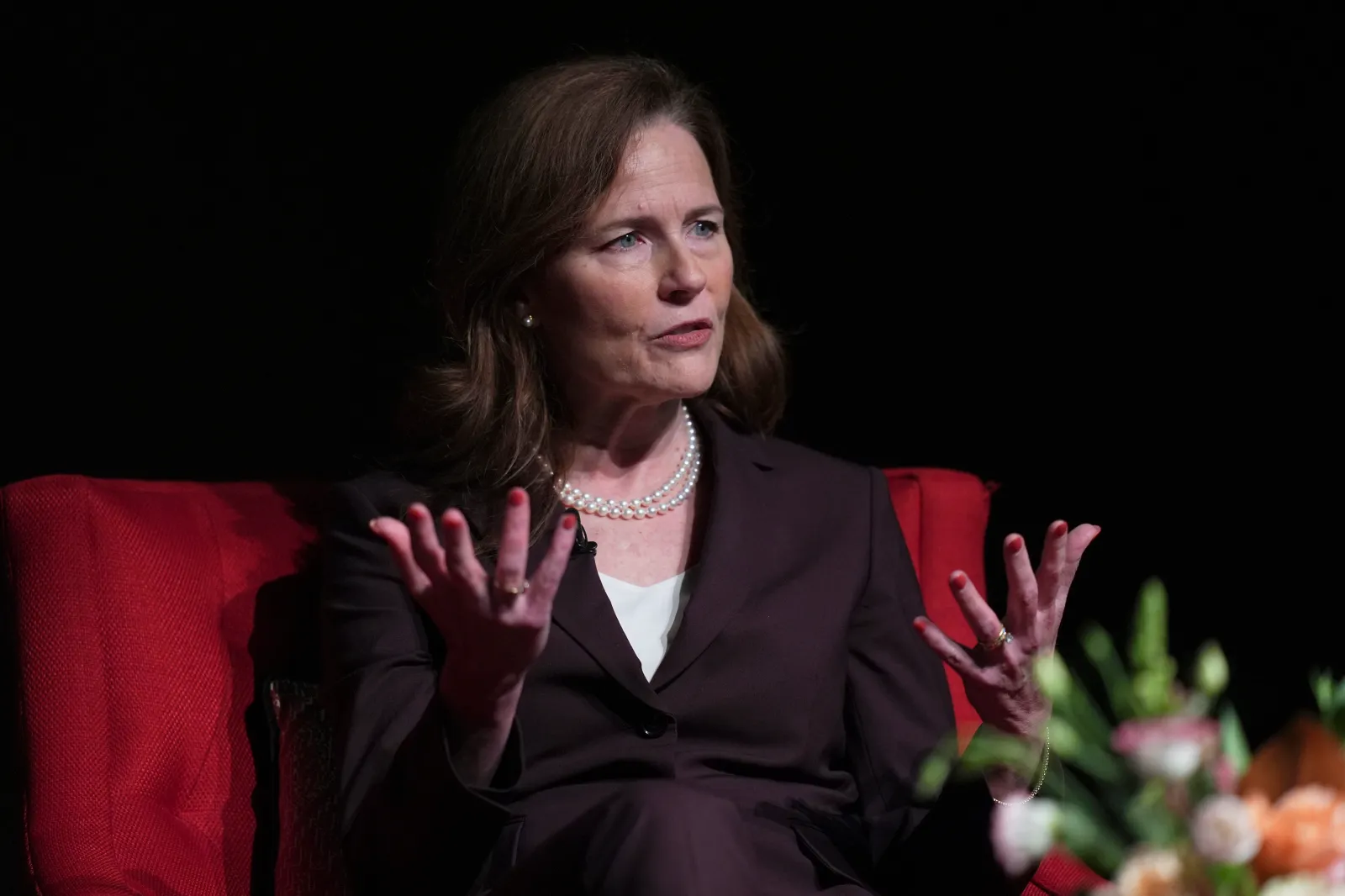
Supreme Court Justice Amy Coney Barrett pressed a Trump administration lawyer on the potential economic fallout of its bid to block Federal Reserve Governor Lisa Cook from serving, citing warnings from economists that the move could risk a recession.
During Wednesday's arguments, Barrett questioned how the court should weigh the public interest after amicus briefs warned that granting the administration’s request could destabilize the economy.
Barrett asked Solicitor General D. John Sauer, "We have amicus briefs from economists who tell us that if Governor Cook is if we grant you your stay, that it could trigger a recession. How should we think about the public interest in a case like this?"
Read More on News
Why It Matters
Trump attempted to oust Cook before the September 2025 meeting of the Federal Reserve's interest rate-setting committee, but a judge ruled that the firing was illegal, and a divided appeals court denied the Trump administration's emergency appeal. Barrett, a Trump appointee during his first term, has at times spoken out against his administration's policies and actions, or at least expressed skepticism about them.
The case before the Supreme Court on Wednesday is seen as one of the most important for the conservative-majority court this year, with potential implications for presidential power and the independence of the Federal Reserve.
Cook, who was appointed by former President Joe Biden, has been allowed to stay in her position ahead of oral arguments, after the court agreed to hear the case back in October.
...
What To Know
Representing the Trump administration, Solicitor General D. John Sauer faced tough questions from the bench. Barrett's query about fears of a recession if Cook was removed from her post received pushback from Sauer.
“If you look at what actually happened … she was removed on August 25 and the stock market went up for the next three days,” Sauer told the court Wednesday. “So, we’ve already had a kind of natural experiment, so to speak, about whether or not the predictions of doom will really be implemented.”
In the debate over economic impacts, Sauer had to confront elements of an argument he made to the court last year on Trump's tariffs, saying that shooting down the policy could have “ruinous economic and national security consequences.”
As with tariffs, Trump's efforts to make changes at the Fed show the divide over his economic policies, with the Trump administration and its supporters arguing the Fed has purposefully blocked U.S. growth by not bowing to the president's wishes, and that removing both Cook and Chair Jerome Powell is within the president's powers. On the other side of the debate are those who staunchly defend the bank's independence in making decisions about the U.S. economy.
Liberal Justice Sonia Sotomayor argued that the lower courts should make the decision over Cook's firing, rather than her colleagues and her, and pressed Sauer on why he saw greater harm for Trump if Cook remained in office than the potential harm to the American people if she were removed and returned to her post.
Her colleague, conservative Justice Samuel Alito, appeared frustrated at the case being brought on an emergency basis, asking Sauer why it had been handled in "such a hurried manner," while Brett Kavanaugh shared his skepticism of the arguments relating to Trump's belief that he has the unilateral power to fire federal employees.
What People Are Saying
The Supreme Court justices, writing in a separate case last year: “The Federal Reserve is a uniquely structured, quasi-private entity that follows in the distinct historical tradition of the First and Second Banks of the United States."
Justice Sonia Sotomayor, speaking Wednesday: "This whole case is irregular, starting with the Truth Social notice... But that's where we are."
White House spokesman Kush Desai previously told the Associated Press: "President Trump lawfully removed Lisa Cook for cause from the Federal Reserve Board of Governors. We look forward to ultimate victory after presenting our oral arguments before the Supreme Court in January."
What Happens Next
Oral arguments continued on Wednesday, with a decision expected at a later date.
The news cycle is loud. Algorithms push us to extremes. In the middle—where facts, ideas and progress live—there's a void. At Newsweek, we fill it with fearless, fair and fiercely independent journalism.
Common ground isn't just possible—it's essential. Our readers reflect America's diversity, united by a desire for thoughtful, unbiased news. Independent ratings confirm our approach: NewsGuard gives us 100/100 for reliability, and AllSides places us firmly in the political center.
In a polarized era, the center is dismissed as bland. Ours is different: The Courageous Center—it's not "both sides," it's sharp, challenging and alive with ideas. We follow facts, not factions. If that sounds like the kind of journalism you want to see thrive, we need you.
When you become a Newsweek Member, you support a mission to keep the center strong and vibrant. Members enjoy:
Help keep the center courageous. Join today.


View 0 Comments
Submit Correction
View Editorial & AI Guidelines