10
Loading video...

By Robyn White
Nature Reporter
0
Share
Newsweek is a Trust Project member
See more of our trusted coverage when you search.Prefer Newsweek on Googleto see more of our trusted coverage when you search.
The most distant active supermassive black hole ever discovered to date has been found by the James Webb Telescope.
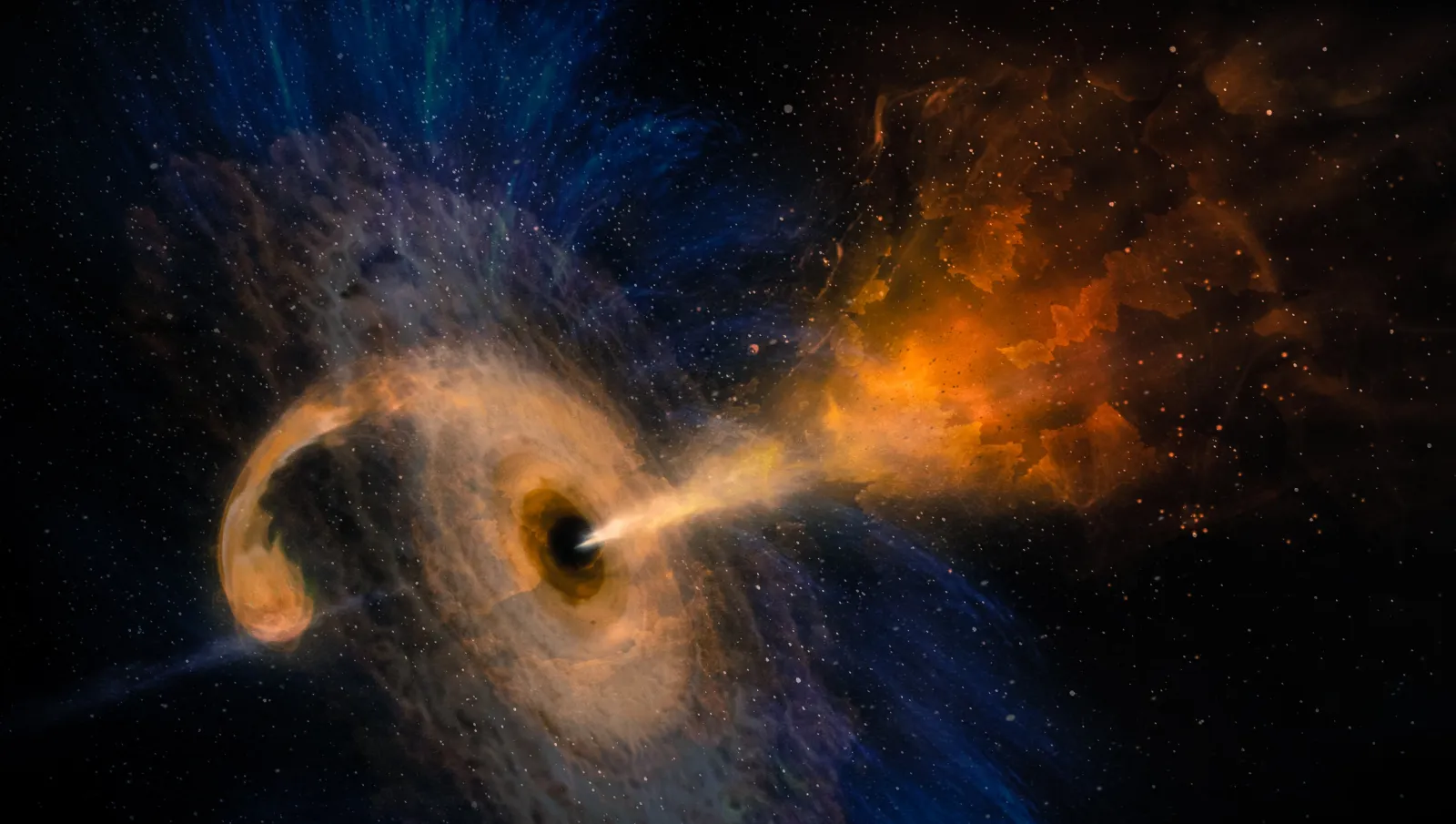
The supermassive black hole resides in a galaxy known as CEERS 1019, which existed 570 million years after the big bang. Just how the black hole existed so soon after the universe came to be remains a mystery.
Findings published by the University of Texas at Austin in The Astrophysical Journal Letters say that it is around 9 million solar masses. While "supermassive" means that the black hole has a mass many times that of the sun, this one is far smaller than other black holes detected from the beginning of the universe.
Read More
Symphony of Most Powerful Gravitational Waves Ever Discovered By Scientists5 min read

Star Betelgeuse’s Spectacular Supernova Will Be Visible With the Naked Eye5 min read

Explosion 10 Times As Bright as Supernova Discovered in Space4 min read

Ancient black holes are typically 1 billion times the mass of the sun. These are generally easier to find with the telescope, as they shine far brighter. The study found that this supermassive black hole is not dissimilar in size to the one in the Milky Way, which is 4.6 million times the mass of the sun.
...
Scientists also found two more black holes that were even smaller, which formed 1 billion and 1.1 billion years after the universe formed.
Although relatively small, the most distant black hole is notable as it formed soon after the universe came to be. Scientists already knew that smaller black holes must have formed when the universe was young.
Only by using the James Webb Telescope, are they able to study this further.
The James Webb Space Telescope launched in 2021, and is a NASA space telescope that conducts infrared astronomy. It's the largest optical telescope in space and is able to detect extremely old, distant objects and is equipped to pick up things that the Hubble Space Telescope—which launched in 1990 into low Earth orbit—cannot decipher.
During this research, the telescope also detected 11 other galaxies that formed when the universe was 470 million to 675 million years old.

...
"Looking at this distant object with this telescope is a lot like looking at data from black holes that exist in galaxies near our own," Rebecca Larson, a recent Ph.D. graduate at UT Austin who led the study said in a press release. "There are so many spectral lines to analyze!"
This is just the beginning of the team's research.
Later, it is hoped that they could measure the emissions created by the black hole and its host galaxy, as well as the galaxy's star formation rate.
"We're not used to seeing so much structure in images at these distances," CEERS team member Jeyhan Kartaltepe, an associate professor of astronomy at the Rochester Institute of Technology in New York said in a press release. "A galaxy merger could be partly responsible for fueling the activity in this galaxy's black hole, and that could also lead to increased star formation."
It is possible further data from the telescope may be able to explain just how these black holes form.
"Until now, research about objects in the early universe was largely theoretical," Steven Finkelstein, a professor of astronomy at UT Austin said in a press release. "With Webb, not only can we see black holes and galaxies at extreme distances, we can now start to accurately measure them. That's the tremendous power of this telescope."
View 0 Comments
Submit Correction
View Editorial & AI Guidelines