10
Loading video...

By Aristos Georgiou
Science and Health Reporter
0
Share
Newsweek is a Trust Project member
See more of our trusted coverage when you search.Prefer Newsweek on Googleto see more of our trusted coverage when you search.
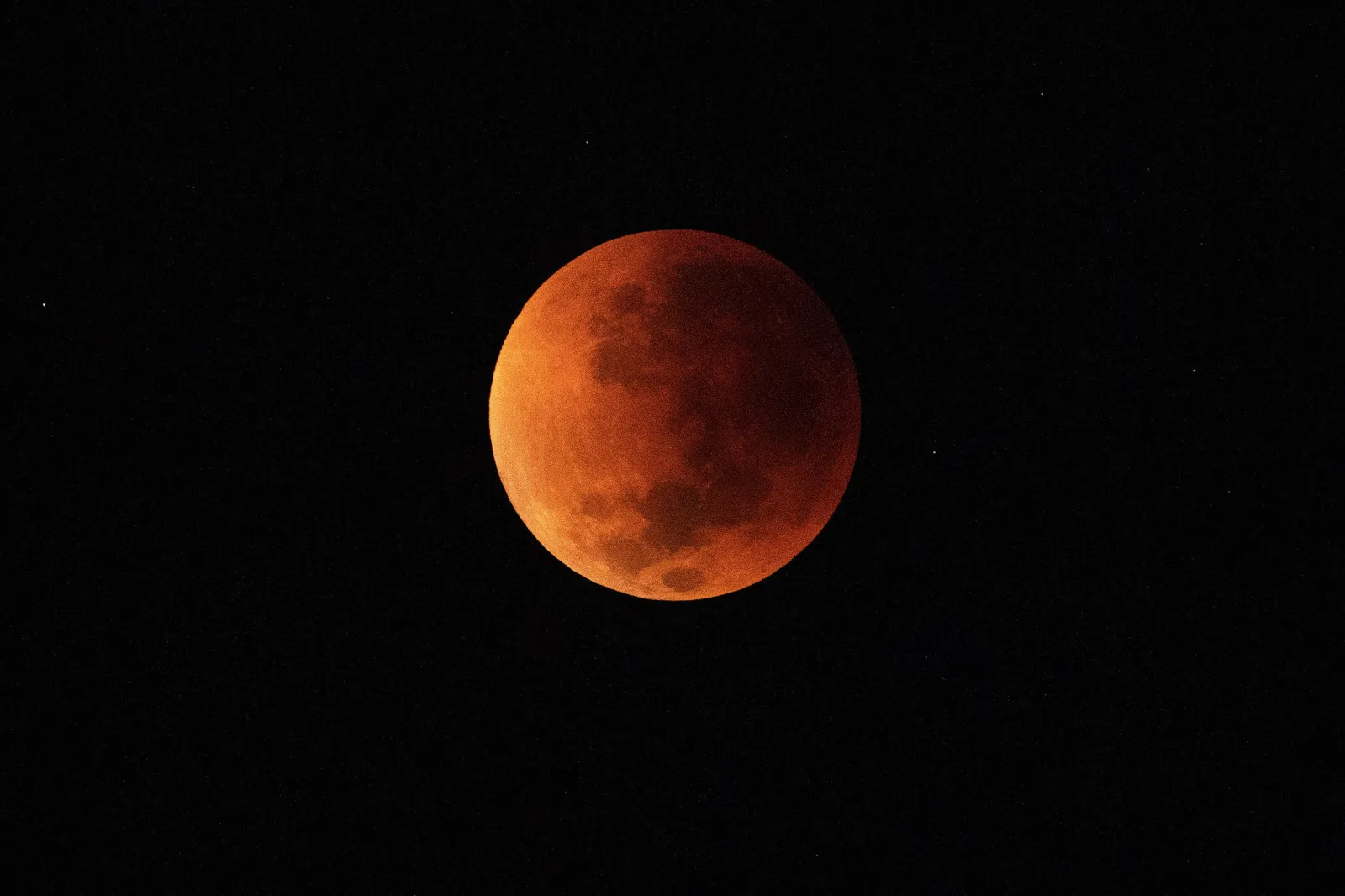
A total lunar eclipse appeared in the night sky, with people across the globe enjoying a spectacular phenomenon—and photographers took the opportunity to capture the dazzling celestial event.
A total lunar eclipse happens when the sun, Earth and moon form a near-perfect line-up in space. During these moments, which only occur during a full moon, the Earth casts a shadow on our natural satellite, changing its color and brightness.
...
Read More
Flower Moon Meaning As Lunar Eclipse Sets the Blood Supermoon Red5 min read

Lunar Eclipse of the May Full Moon to Light Night Sky in Stunning Display4 min read

What Is a Blood Supermoon Lunar Eclipse and When Can I See It?4 min read

Total lunar eclipses progress in three stages. The first stage is a penumbral eclipse during which the moon enters the lighter shadow of the Earth, called the penumbra. At this point, the face of the full moon that we can see dims very slightly.

...
The next stage is a partial eclipse, which begins when the moon starts to enter the Earth's central, darker shadow, known as the umbra, and it dims noticeably, while some parts are almost obscured entirely as the shadow moves across its face.

...
The final stage is the total eclipse phase, where the whole of the moon is within the Earth's umbra, causing it to turn a reddish color. This is why the moon at total lunar eclipse is popularly referred to by the name Blood Moon, although this is not a scientific term.

...
When the moon passes through the Earth's umbra, direct sunlight is blocked from illuminating its surface. But the moon doesn't fully disappear during a total lunar eclipse because the shadow isn't completely dark.
In fact, some light reaches the moon during the total eclipse phase, but this light gets refracted as it passes through the Earth's atmosphere. This is why the moon turns red.

...
"As light passes through the Earth's atmosphere, the blue wavelengths get more scattered than red wavelengths, so the only light reaching the moon is red light," Tania de Sales Marques, a planetarium astronomer from the U.K.'s Royal Observatory, Greenwich, previously told Newsweek. "We see the same effect occur when the sky reddens at sunrise and sunset."

...
The total phase of last night's eclipse was visible from most of the Americas—except the northwesternmost part of the continent—as well as western regions of Europe and Africa, depending on the weather in any given location, of course.

...
The full moon in May, which is often referred to as the Flower Moon, was also described as a supermoon. This is another non-scientific term with several definitions, although the most common one refers to any full moon that occurs when the moon is at least 90 percent of the way to its perigee, according to The Old Farmer's Almanac.
Perigee is the point in the moon's orbit when it is closest to the Earth. The moon actually has an elliptical orbit around the Earth, meaning the distance between it and our planet varies over time.

...

...
View 0 Comments
Submit Correction
View Editorial & AI Guidelines