
By Adam Mills
AI Editor
0
Share
Newsweek is a Trust Project member
See more of our trusted coverage when you search.Prefer Newsweek on Googleto see more of our trusted coverage when you search.

Newsweek
Editor's note: This is AI Impact, Newsweek's weekly newsletter where each week, we will explore how business leaders are unlocking real value through artificial intelligence.
Read More on AI
Tap or click here to get this newsletter delivered to your inbox.
Signal Capture
Signals from the frontlines of AI adoption
Alice CEO: Companies Can’t Outsource AI Safety

...
By Adam Mills
By the time many companies ask how an AI system could fail, its design is already set. The pilot has worked, executives are enthusiastic and security teams are left to add filters, checklists and policies before launch.
“The assumption that safety is someone else’s problem” is where many companies go wrong, Noam Schwartz, CEO and co-founder of Alice, told Newsweek. Alice is an AI safety and security company that develops tools to test and protect AI systems.
Companies that build the underlying AI models and partners that help businesses deploy them may test for catastrophic risks or problems affecting many users, Schwartz explained. They do not guarantee how a system will behave with one company’s data, rules and operations. Responsibility for securing the deployed system remains with the business using it.
The weakness often appears after a promising pilot. A team sees a working demo, then brings in security shortly before launch to add a filter, complete a checklist or write a policy around a system whose design is already set. Schwartz urged executives to ask who tried to break the tool, which languages they used and when the testing occurred.
“A guardrail that was tested once, in one language, against polite users is like a seatbelt made of paper,” he said.
AI guardrails, the filters and rules meant to block unsafe prompts and responses, need to reflect what the system is built to do. A legal or medical assistant may need to handle sensitive requests that a general chatbot would restrict. An internal banking tool may be allowed to discuss financial matters that a public chatbot should avoid. The controls should check both what users ask and what the AI returns.
In testing described by Alice, researchers ran 28,000 prompts in 13 languages through leading guardrails and found that attacks in other languages passed through filters that performed well in English. That leaves companies without evidence that the same protections work for users who speak other languages.
Connecting an AI model to other software raises the consequences of failure. An AI agent—a system that can take actions through other software—may send email, move money or change records, causing a manipulated instruction or unsafe output to trigger a real action.
“A chatbot’s worst case is a bad answer. But an agent’s worst case is a bad action,” Schwartz said.
Agents also read emails, web pages, documents and information returned by other tools. Any of that content can contain text the system interprets as a command, and one manipulated step can influence the next.
“Anything it reads can carry instructions. The content becomes the attacker,” he added.
Containing that risk requires limiting an agent’s access to the task it is performing, giving it a unique account and keeping a record of every action. Schwartz said most current deployments lack all three.
Agent “skills”—software add-ons that give agents new capabilities—need similar scrutiny. Alice reported that it analyzed 50 popular agent add-ons listed on skills.sh and identified 12 serious security problems requiring immediate attention. Schwartz advised businesses to keep a list of what their agents can run, verify where each add-on came from, test what it actually does, restrict its access and continue monitoring it after installation.
In regulated or high-risk settings, a one-time safety review is not enough. Schwartz described the necessary standard as “rigorously, individually, and continuously,” with testing tailored to a system’s purpose, the data it handles and the consequences of failure. Models update, add-ons change and attackers develop new methods after launch.
“Companies freeze when they can’t tell what their AI might do,” Schwartz said. “The organizations that can answer that question with evidence will move faster than everyone else.”
Core Intelligence
India’s AI Opportunity Begins After the Model

...
By Adam Mills
The economics of AI could change once capable models become cheaper, smaller and easier to adapt.
A lower-cost model market could reward companies and countries that can connect AI to real work. India enters that contest with millions of employees inside technology services firms and global capability centers, many already familiar with the processes, systems and client problems AI is beginning to reshape.
“You don’t have to be inventing something to be the best users,” Ashishkumar Chauhan, CEO of the National Stock Exchange of India, said during Newsweek’s July 27 “AI Impact Forum” webinar hosted by Dr. Ranjit Tinaikar.
Chauhan’s argument reaches beyond a familiar comparison between model builders and model buyers. Open models and specialized systems can widen the field of developers able to create products for phones, vehicles, appliances, factories and business operations. A company’s advantage would come from knowing where AI belongs, how to adapt it and how to deploy it at a cost the customer can absorb.
“The battle of LLMs is over,” Chauhan said, recalling a view he shared publicly in 2025. “Mostly open source will win.”
The claim is sweeping, and the largest proprietary models will remain important for demanding work. Yet even a market led by a few frontier systems can support a much broader economy of applications, local adaptations and industry-specific tools. Model access is only one input. Process knowledge, distribution and disciplined implementation determine whether the technology actually improves a business.
India’s services history gives the argument some weight. The country built a global technology industry by learning to apply inventions developed elsewhere. AI gives those firms a chance to turn their familiarity with finance, health care, manufacturing and other sectors into products and workflows designed around specific business needs.
“AI will allow you to solve even larger problems at a lower cost,” Chauhan said.
Of course, the analogy has limits. Agents can automate parts of the coding and back-office work that powered India’s earlier outsourcing growth. Capturing the next layer of value will require companies to package their domain knowledge into products, workflows and specialized AI systems. Work priced mainly by the number of people assigned to it will face growing pressure.
If capable models become widely available, the advantage may belong to whoever can make them useful across thousands of specific contexts. Chauhan’s case for India rests on that combination: technical talent close to the work, a culture of frugal engineering and a wide range of businesses and devices where lower-cost AI can be applied.
You can read the full article and watch the discussion here: India’s NSE CEO: Winning in AI Doesn’t Require the Biggest Models.
Upcoming Webinars
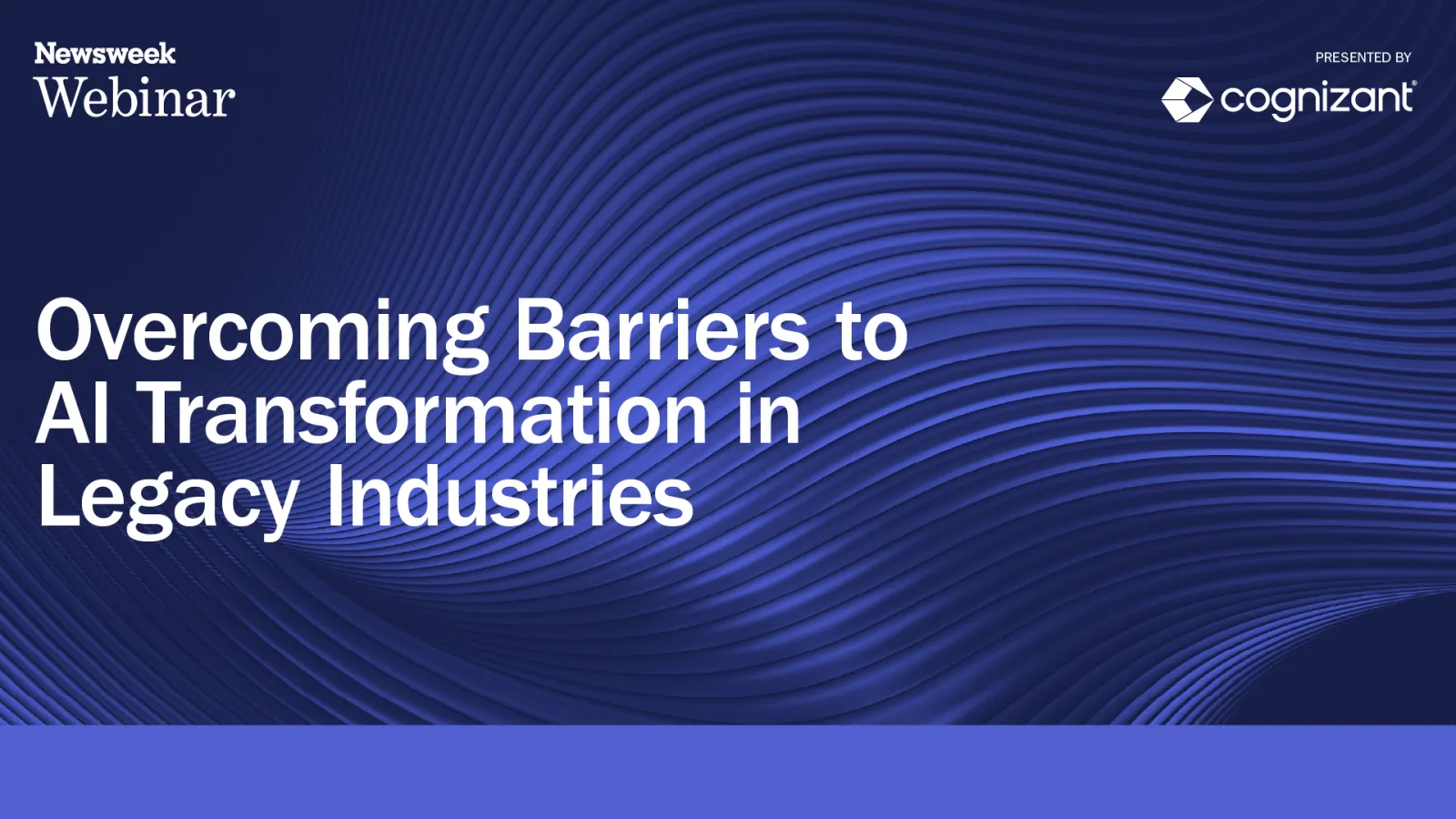
Overcoming Barriers to AI Transformation in Legacy Industries
Newsweek
AI investment is accelerating, and long-established companies are finding ways to bring the technology into organizations shaped by years of customer relationships, complex operations, critical systems and regulatory responsibilities. The challenge is turning promising pilots into lasting business results without disrupting the strengths that have made those companies successful.
In an upcoming Newsweek AI webinar presented by Cognizant, Gabriel Snyder, Newsweek’s executive editor, enterprise, will moderate a discussion titled “Overcoming Barriers to AI Transformation in Legacy Industries.” The conversation will delve into how established organizations are connecting AI to existing systems and workflows, clarifying ownership and governance and aligning technology investments with people, processes and measurable business outcomes.
Speakers to be announced.
Join the live discussion on October 21. Register for free.
Prompt Injection
What’s one recent insight you’ve learned about AI?

...
“AI is pushing entire industries to operate more like startups, not just in tech, but in healthcare too. Teams are implementing, testing, recalibrating, and iterating at a pace we honestly weren’t trained for a few years ago.
What’s become clear to me is that while AI dramatically accelerates execution, it doesn’t reduce the responsibility to apply judgment, context, and care. If anything, it raises the stakes. I’ve been reading Co-Intelligence: Living and Working with AI by Ethan Mollick, and his idea of AI as a ‘co-worker’ really resonated with me. The best outcomes come from intentionally pairing AI with human insight.
That’s especially important in healthcare. Healthcare leaders use AI to move faster, but clinical expertise is what ensures we’re moving in the right direction and designing systems that actually support patient-centered outcomes.”
Have your own lesson to share? Email us at: a.mills@newsweek.com
Run Log
AI use case of the week
HeadFirst Global Maps Work Across People and AI

...
By Adam Mills
Counting every employee, contractor and supplier still does not show how work should be divided when AI can complete part of it.
HeadFirst Global, a workforce and talent solutions company, used AI to analyze what organizations needed done, which skills were available and where technology could assist or automate specific tasks.
Thomas Jajeh, chief product and technology officer at HeadFirst Global, said the analysis looked beneath job titles and headcount. It broke business needs into the skills and tasks required to meet them, including where human judgment remained essential and where AI could assist or complete part of the work.
The analysis changed the questions workforce leaders asked, Jajeh said. They wanted visibility into how responsibilities should be allocated across employees, contractors, suppliers and AI. The same business need could call for one of those sources or a combination of them, making an open position just one option within a larger decision about how to deliver the outcome.
“AI should be considered a new labor category,” Jajeh said.
Here, “labor category” refers to workforce planning: companies would account for AI capabilities alongside the skills supplied by employees, contractors and suppliers. An AI system may handle one part of a workflow, while a specialist provides the judgment or expertise that remains.
HeadFirst’s analysis works backward from the desired outcome: define the required tasks, identify the skills and judgment involved, then decide how people and AI should carry them out.
Have an interesting AI use case to share with us? Email us at: a.mills@newsweek.com
Context Window
■ A G2 survey of 1,038 B2B software buyers found that AI is accelerating software discovery but pushing more friction into evaluation, with 40 percent calling it the longest stage and 49 percent saying a CFO reversed an already-approved purchase in the past year. [G2]
■ A new SUNY labor contract gives professors and other staff a grievance process if AI threatens or replaces their work, adding protections around classroom and evaluation uses while leaving room for AI in research and health care. [WGRZ]
■ OpenAI CEO Sam Altman previewed a new model for senators as the Hugging Face cyber breach intensified calls for federal testing standards and new authority to slow or shut down advanced AI systems. [Politico]
■ Sharp declines in Asian chip stocks and renewed scrutiny of Big Tech’s AI spending have raised investor concerns about whether AI infrastructure investments can generate sufficient returns, even as many AI-linked shares remain far above year-ago levels. [BBC]
■ NIST launched the Artificial Intelligence Technology Evaluation, a voluntary sequestered testbed that will assess AI models on blind datasets to reduce train-test contamination, beginning with vision-language tasks in quantum science, genomics and public safety. [NIST]
Transfer Protocol
Tracking executive moves across the AI landscape
Sanjeev Singh Sahni, previously president of Xometry, has moved into the chief executive officer role, taking the helm of the AI-native manufacturing marketplace as it pursues product-led growth.
Andrea Carcano, co-founder and original chief executive officer of Nozomi Networks, has resumed the CEO role, leading the OT, IoT and cyber-physical systems security company into a new phase centered on AI-driven innovation and technical leadership.
Jacob Parsons, previously chief executive officer of Mesh-AI and leader of Indicium AI’s European business, has been appointed global chief executive officer at Indicium AI, with an initial focus on expanding the company’s U.S. business and helping enterprises move frontier AI into production.
Ryan Manning, previously chief product officer at BMC Helix, will join Freshworks as chief product and technology officer on Aug. 10, setting strategy across AI, IT and customer experience products while overseeing the global product roadmap and engineering organization.
Venkat Iyer, previously vice president of products at Talkdesk, has joined Zingtree as chief technology officer, overseeing engineering and product development as the company builds agentic capabilities for complex products and highly regulated industries.
Wei Sun, previously chief digital officer at SF Supply Chain, has been named chief AI business growth officer at BTC Digital, where he will lead AI computing business development, customer acquisition and commercial ecosystem building as the company expands its AI infrastructure business.
Know someone on the move in AI? Send job change info to a.mills@newsweek.com
Magic Moment
What’s the most fun or unexpected way you’ve used AI lately?

...
“I used AI recently to plan my night out while traveling for work. I've gotten into the habit of just telling it what kind of evening I'm in the mood for. It accounts for my taste in a way that no app or review platform ever has, because it actually knows me rather than just showing me what's trending or what has the most five-star reviews from people who may like different things.”
Experience some AI magic? Tell us about it at a.mills@newsweek.com
Tap or click here to get this newsletter delivered to your inbox.
View 0 Comments
Submit Correction
View Editorial & AI Guidelines