
...

By Amanda Castro
Associate News Editor
0
Share
Newsweek is a Trust Project member
See more of our trusted coverage when you search.Prefer Newsweek on Googleto see more of our trusted coverage when you search.
The Malta‑flagged VLCC Agios Fanourios I has become the first crude carrier to sail west through the Strait of Hormuz since the U.S. blockade targeting traffic to and from Iran’s ports took effect, ship‑tracking data shows.
After nearly two days at anchor in the Gulf of Oman, the vessel got underway late on April 14 and completed its transit overnight, entering the Persian Gulf in the early hours of April 15. At roughly 13.6 knots, the tanker is bound for Basrah, Iraq, with an expected arrival on April 16.
Why It Matters
The U.S. blockade that went into effect on April 13 effectively froze most commercial traffic through the Strait of Hormuz, the narrow chokepoint that normally carries roughly one-fifth of the world’s crude and liquefied natural gas. Washington ordered the shutdown after negotiations with Iran failed, directing U.S. naval forces to stop vessels linked to Iranian ports or paying Iranian transit fees.
Read More on News
Within hours, traffic patterns shifted sharply. Hundreds of ships remained stranded inside the Persian Gulf, and most foreign‑flagged tankers avoided the strait. Only vessels with Iranian ties continued moving with any regularity, while Western and Asian operators largely halted transits because of the risk of confrontation and the U.S. warning that violators could be “eliminated.”
Did Trump Open the Strait of Hormuz?
U.S. President Donald Trump announced that he is “permanently opening” the Strait of Hormuz, claiming that China is “very happy” with the decision and has agreed not to supply weapons to Iran, according to multiple statements he posted on Truth Social.
Trump framed the move as part of a broader understanding with Chinese President Xi Jinping, saying the two countries are “working smartly and very well” and suggesting their cooperation is preferable to continued conflict—while also emphasizing U.S. military strength.
The announcement comes just days after Trump ordered a U.S. naval blockade on Iranian ports following the collapse of peace talks between Washington and Tehran. The blockade, which began on April 13, aimed to halt maritime traffic linked to Iran, and Trump claimed that violators approaching the restricted zone would be “eliminated.” He also boasted that Iran’s navy had been devastated during the conflict.
Despite U.S. enforcement efforts, at least one sanctioned Chinese tanker, the Rich Starry, reportedly transited the strait on April 14, highlighting the challenges of maintaining a full maritime lockdown.
The blockade has raised strategic and political risks. U.S. vessels operating in the narrow waterway face potential exposure to missiles and drones with minimal reaction time, while prolonged disruption threatens to keep gasoline prices high—an unwelcome pressure point for Trump and Republicans ahead of the midterm elections.
What Was the Purpose of the Blockade?
U.S. officials say the blockade is intended to stop Iran from using the strait as leverage in the conflict. Tehran had sharply restricted passage through the waterway following U.S.-Israeli strikes on February 28, prompting Washington to assert control over access to Iran’s coastline. Under the new rules, ships bound for or departing Iranian ports are subject to interception, while other international traffic is allowed to continue through the strait.
The decision followed the breakdown of peace talks and came during a fragile two‑week ceasefire. U.S. leaders argue that tightening economic pressure could push Iran back to the negotiating table. Iran, in turn, has condemned the blockade as unlawful and warned that it may retaliate against ports in neighboring Gulf states.
The strategy carries significant risks. The Strait of Hormuz is one of the world’s most important energy corridors, and any disruption can quickly drive up global oil and gas prices. Analysts also warn that the blockade could strain the ceasefire and widen the conflict, with U.S. naval forces operating in a narrow, heavily militarized environment where missile and drone attacks are a constant threat.
Despite the pressure campaign, Iran has continued exporting oil, benefiting from higher global prices. Meanwhile, countries that rely on shipments through the strait—particularly in Asia—face mounting economic uncertainty as the standoff continues.
...
Is the Strait of Hormuz Closed?
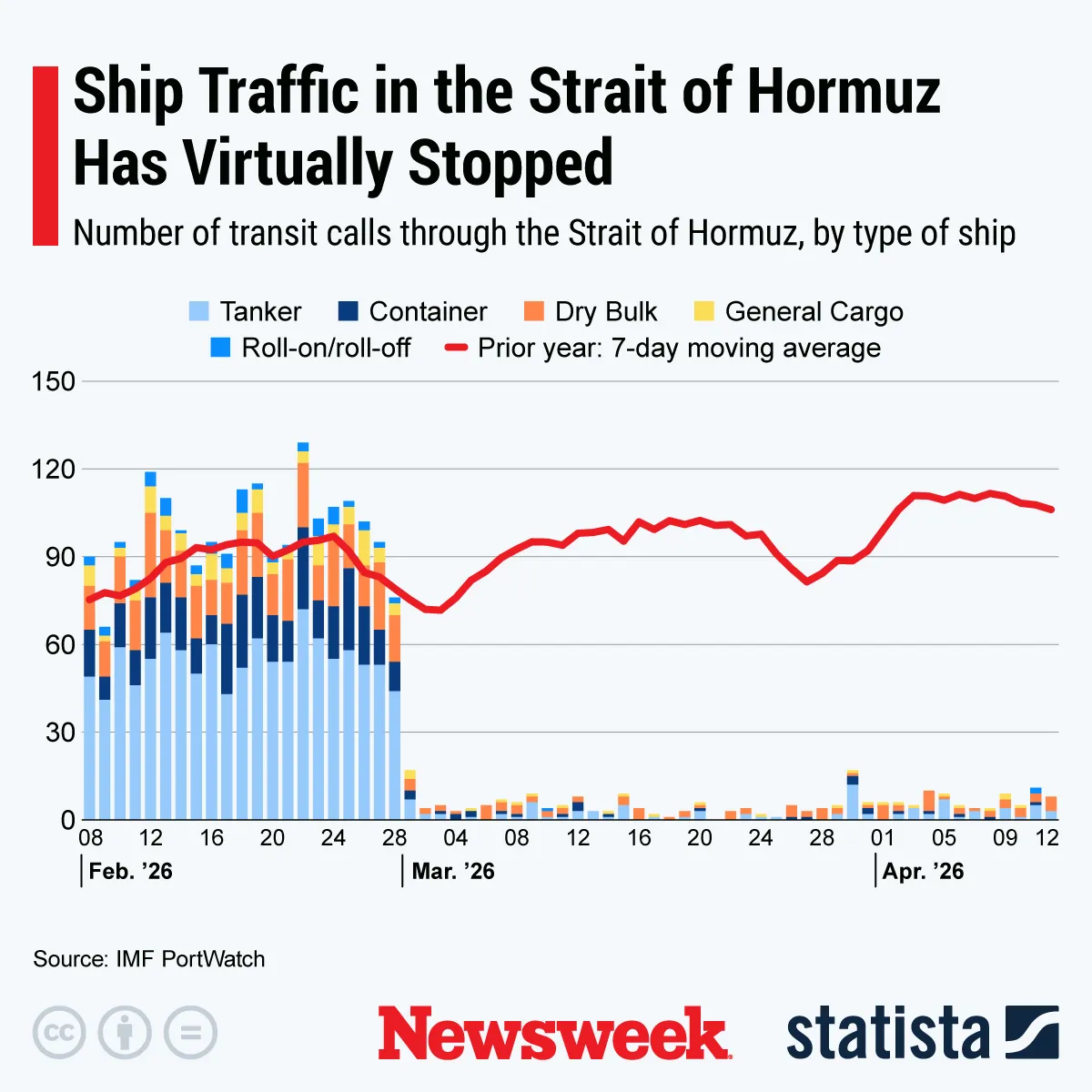
As of Wednesday, the Strait of Hormuz is effectively shut to most commercial traffic. Ship‑tracking data shows only a fraction of normal movements, with operators avoiding the strait amid U.S. naval restrictions, Iranian threats and widespread reports of sea mines.
The slowdown began after the February 28 U.S. and Israeli strikes prompted Iran to retaliate against shipping and assert control over the narrow channel. Washington responded with a blockade of Iranian ports, saying it would stop vessels linked to Iran while allowing other international traffic to pass. In practice, the combination of military risk, soaring insurance premiums and uncertainty over enforcement has left the strait largely unused.
Energy analysts say traffic has fallen by more than 90 percent, halting the flow of crude and liquefied natural gas that normally moves from the Gulf to global markets. Even after a temporary ceasefire was announced, major exporters and insurers warned that conditions remained too dangerous for routine transit.
Who Controls the Strait of Hormuz?
The Strait of Hormuz is not legally controlled by Iran, and under international maritime law, ships of all nations are entitled to pass. But geography gives Tehran an outsized ability to influence what happens there. The strait hugs Iran’s southern coastline, placing commercial vessels within range of Iranian bases, missile sites and patrol craft for much of the transit.
That proximity has allowed Iran to shape access to the waterway far more than most coastal states. Over decades, the country has built a dense network of weapons and surveillance systems designed to threaten or slow traffic if tensions rise. Analysts note that Iran’s arsenal includes anti‑ship missiles, naval mines, fast‑attack boats, submarines, drones and air‑defense systems—tools that together create a powerful “area‑denial” environment.
That leverage has been on full display during the current conflict, when Iran sharply restricted movement through the strait and demonstrated its ability to disrupt global shipping. As part of ceasefire discussions, Tehran even floated the idea of formalizing its authority over the passage—an idea the United States and Gulf states are almost certain to reject.
View 0 Comments
Submit Correction
View Editorial & AI Guidelines