...

By Kate Plummer
Senior US News Reporter
0
Share
Newsweek is a Trust Project member
See more of our trusted coverage when you search.Prefer Newsweek on Googleto see more of our trusted coverage when you search.
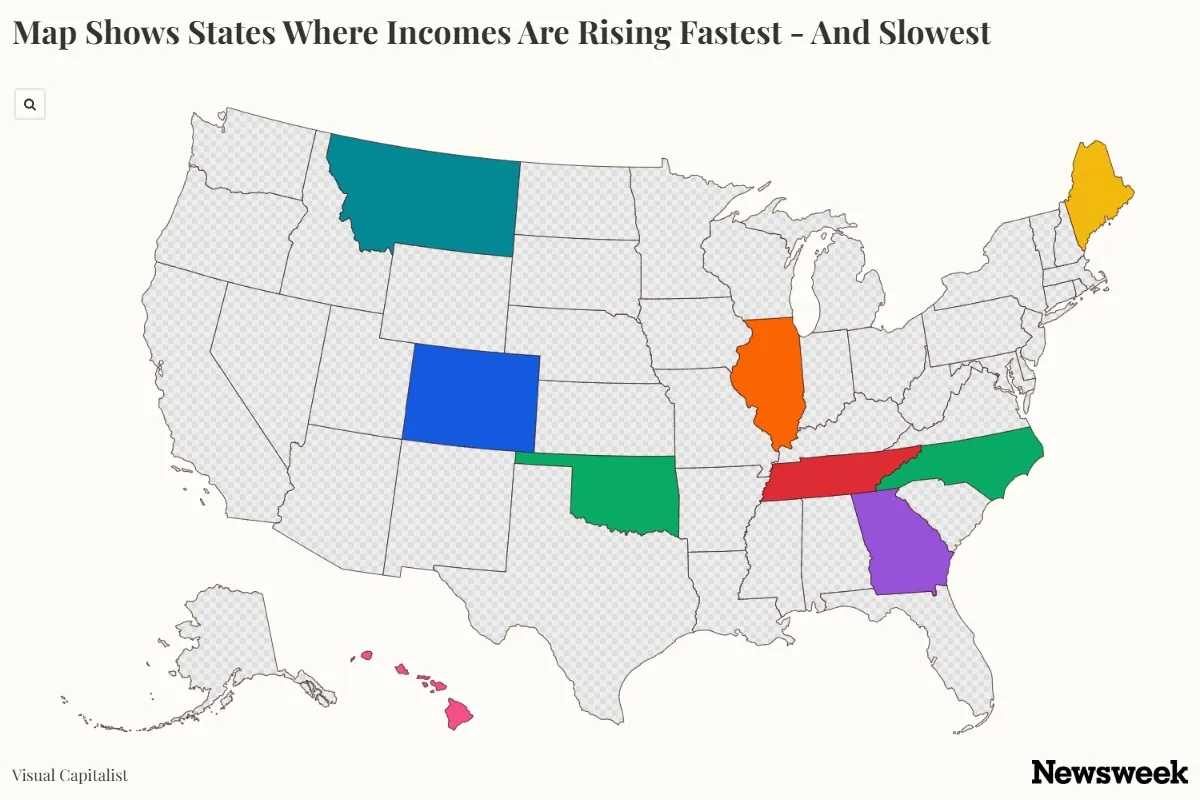
Colorado, Georgia and Maine are the three states where incomes are rising the fastest, according to new data analysis, while North Carolina, Oklahoma and Hawaii are the states which have seen the slowest income growth.
According to a study by Visual Capitalist, which used data from the U.S. Census Bureau, median household income in Colorado increased by 46.9 percent from 2019 to 2024, the fastest income growth in the U.S.
In the same time period, they found that incomes in North Carolina and Oklahoma increased the slowest, by 9.9 percent.
Read More on News
Household incomes, on average, rose 21.9 percent nationally during the period Visual Capitalist analyzed.
Below, Newsweek has created a map showing states where incomes are rising the fastest and slowest.
...
Why It Matters
The economy, the cost of living and other related themes like incomes are important to American voters, with a Gallup poll showing that they overwhelmingly cited economic pressures as the main reason they voted for President Donald Trump in the 2024 presidential election.
Incomes can determine where people choose to live and affect people's housing and other standard-of-living indicators.
Rising incomes can also bolster support for local and federal government while, in turn, stagnating economic conditions can foster discontent among voters, something that will be important when voters vote in the midterm elections in November.
What To Know
The analysis found that Colorado's average income increased from $72,500 to $106,500—an increase of 46.9 percent. The study attributed this to the state's "thriving tech industry."
Georgia had the second-biggest increase in income growth, with the median household income increasing by 43.4 percent—from $56,630 to $81,210. The study said this was because of job creating in the electric vehicle and aerospace sectors.
In Maine, incomes increased by 36.3 percent and Montana came a close fourth, with an average increase of 36.1 percent.
Tennessee was the state with the fifth-fastest income growth, with a 34 percent change in median household income.
North Carolina and Oklahoma, on the other hand, topped the list in terms of states with the slowest income growth. They both saw a 9.9 percent change in median household income, from $61,160 to $67,220 and $59,400 to $65,310, respectively.
Hawaii did not fare much better, and saw an 11.6 percent increase in median household income. There was a 12.6 percent income increase in the District of Columbia, and a 13.2 percent increase in Illinois.
It comes after recent analysis by MyPerfectResume found that Americans are making more money than they did a few years ago, but rising prices have quietly erased most of those gains, leaving many with less real spending power than before the pandemic.
Meanwhile, a recent WalletHub analysis of TransUnion and Federal Reserve Bank data found that average household debt increased by $275 to $975 from the second to the third quarter of 2025.
What People Are Saying
The Visual Capitalist study said: ""Where you live matters a lot. While some states tracked close to the national average, others saw incomes climb at nearly double the pace, driven by booming local industries and major investment."
Hannah Jones, a senior economic research analyst at Realtor.com said: "Rising incomes increase purchasing power, allowing buyers to qualify for larger mortgages, compete more aggressively, and absorb higher monthly payments. For sellers, stronger incomes can translate into firmer demand, fewer price cuts, and improved leverage in markets where inventory remains tight."
What Happens Next
Economists are predicting robust economic growth and strong gains for U.S. equities in 2026 as in 2025, but they have warned that less affluent consumers will continue to grapple with rising prices and a slowdown in the labor market.
View 0 Comments
Submit Correction
View Editorial & AI Guidelines