...

By Maren Angus-Coombs
Contributing Sports Writer
0
Share
Newsweek is a Trust Project member
See more of our trusted coverage when you search.Prefer Newsweek on Googleto see more of our trusted coverage when you search.
Ambar Roman has been to her fair share of Los Angeles Dodgers games in her lifetime. She attends about five or six games per year. Sometimes she sits in the right-field pavilion.
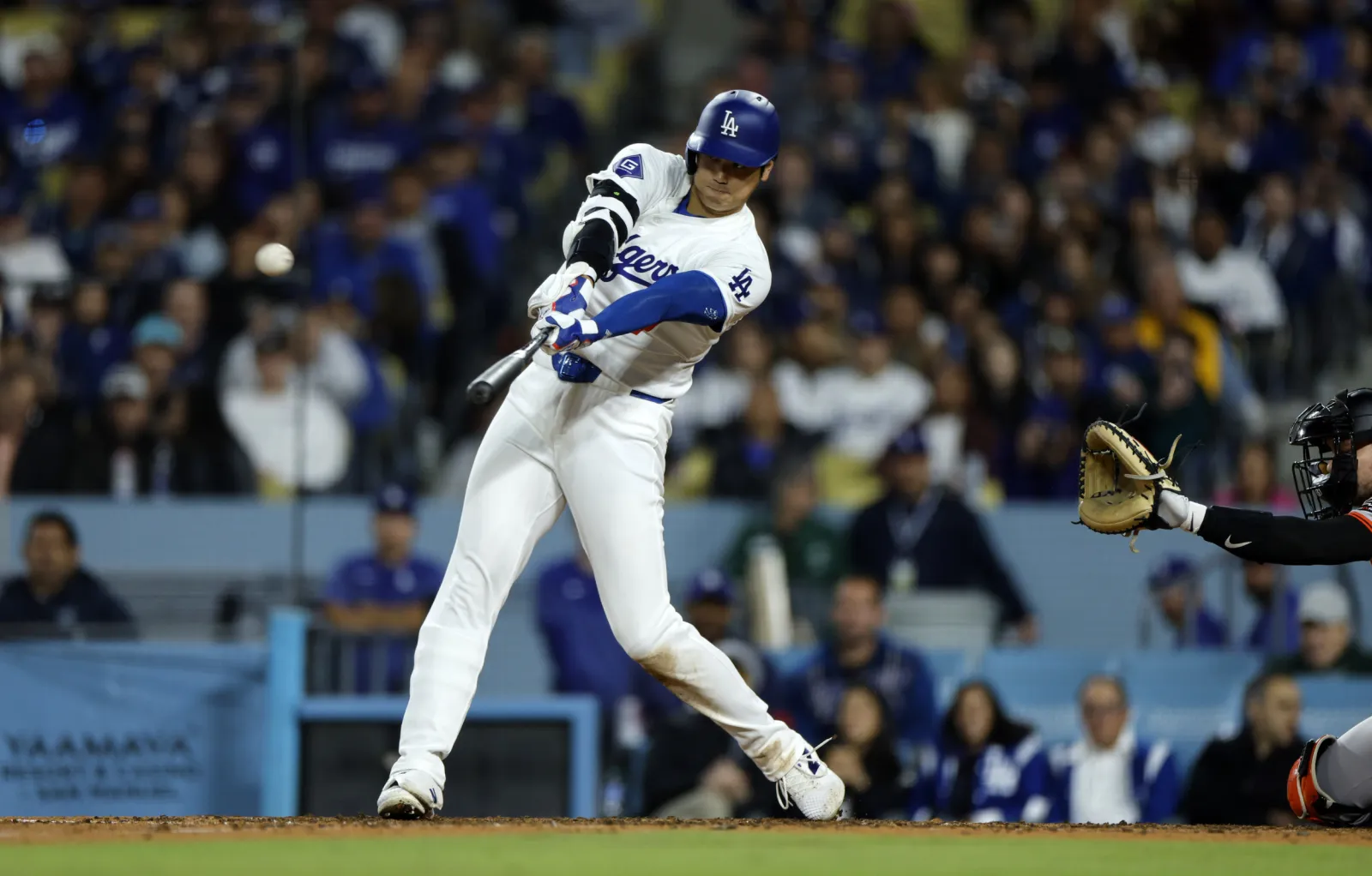
Her life turned upside-down as a home run off the bat of Shohei Ohtani landed right at her feet Wednesday night — Ohtani's first as a member of his new team.
In an exclusive interview with Dodgers Nation's Doug McKain, Roman discussed the moment and the chaos.
Read More on MLB
"Security came up and hand-signaled me to go to them. At first, I'm thinking I did something wrong," Roman said. "They said 'No, we want to reward you for catching the ball.' ... They took us down to right next to the bullpen, the gate, to go in there. That's where they had us. At that point, they didn't allow my husband or the friend that we were with to go with me. They said they had to stay back."
Roman initially asked security if she could have Ohtani sign the ball so she could keep it. "And they were like no, if you're going to keep it, he's not willing to sign for it and we won't authenticate it for you," Roman said.
Major League Baseball typically employs at least two authenticators at every game. "That's when I asked, 'what is he willing to trade me for it?' At first, what they offered was two signed baseball caps," Roman said. "I asked, 'what else can I get?' That's when they threw in a bat and another ball."
Finally, she asked to meet Ohtani and was told that wasn't possible. She settled for two signed hats, a signed bat, and a signed ball.
...
Roman's experience at Dodger Stadium isn't the first time fans have been intimidated to give up milestone balls. It has become a league-wide problem and has been well-documented over the last few years.
Bryant Junco, a Milwaukee Brewers fan, has Aaron Judge's 59th home run ball. He spoke with "The Chase," a podcast produced by Dave & Adam's Card World in Amherst, N.Y. Junco told the hosts he was sitting in right field and walked over to left field once Judge hit the home run to see what all the commotion was about.
"Yankees personnel came over along with Brewers personnel and they were trying to make the guy an offer of four signed balls and four signed hats from Judge presumably," Junco said. "For whatever reason the guy wasn't interested in that and I heard one guy offer $1,000 cash."
Junco bought the ball for $15,000 and both clubs refused to authenticate the ball in Milwaukee. He exchanged emails with the New York Yankees Museum curator and Major League Baseball. Junco said MLB did offer to turn the ball over to its authentication team, but that it "would become property of Major League Baseball" and wouldn't be returned to him.
The New York Times published a story in 2022 and interviewed Dean Pecorale, an authenticator for MLB, who detailed two special markings on every ball used for Judge after he hit No. 59. One was a coded stencil visible to the naked eye. The other is a covert marking that requires special technology to see.
Junco shared a photo of his ball under a blacklight with Outkick, revealing the special markings.
The Yankees have the balls from Aaron Judge's 56th, 57th, 58th, and 60th home runs. MLB told Outkick the 60th and 61st home run balls have a third covert marking that can only be seen with MLB proprietary technology. None of the balls Judge hit before swatting No. 60 have the covert marking, and therefore cannot be authenticated.
Mike Hutcheson is a St. Louis Cardinals fan who traveled to Pittsburgh and caught Albert Pujols' 703rd career home run. He was offered an autographed ball in exchange for the homer, but turned the offer down. Then he tried to authenticate the ball at the game but neither team would.
"I'm actually a little disappointed in both the Pirates and the Cardinals because they've made absolutely no acknowledgment (of the catch)," he said in an interview with WTAE.
MLB's authentication process was described by Sports Illustrated in a 2021 story. Their job is to take notes and track each ball — whether a foul ball or a home run — waiting for the moment when it is discarded, swapped out, or hit out of play. Once the ball leaves the game, authenticators collect it themselves, either through a ball boy, ball girl, or team personnel. They'll affix a tiny silver sticker—a hologram bearing a unique string of letters and numbers — to its surface. And they'll log their record of the ball's life in a unique MLB system.
The process of authenticating baseball memorabilia has evolved over the years to prevent counterfeits. One element of the process seems to be bothersome: the denial of authenticating milestone balls when fans want to keep them. In Roman's case, a simple silver sticker and photo opportunity with Ohtani would have prevented all the negative attention surrounding a player who is already in hot water.
View 0 Comments
Submit Correction
View Editorial & AI Guidelines