
...

By Alice Gibbs
Senior Reporter
0
Share
Newsweek is a Trust Project member
See more of our trusted coverage when you search.Prefer Newsweek on Googleto see more of our trusted coverage when you search.
International soccer teams arriving in the United States ahead of the 2026 FIFA World Cup are encountering a series of detentions, intensive border checks and visa complications.
Particular incidents involving players from countries including Iraq, Iran and Senegal have gained attention online and among soccer officials, raising questions about how teams are being received ahead of the tournament.
Iraq Star Detained
One incident involves Iraq’s national team, where forward Aymen Hussein was detained for several hours after arriving at Chicago O’Hare Airport and subjected to questioning before being allowed into the country. Reports indicate his phone was also examined during the process, highlighting the extensive authority U.S. border officials have when screening arrivals.
Read More
Somalian Referee Can’t Officiate In World Cup Despite Canadian Welcome5 min read

German World Cup Tourist on Road Trip Through America Is Taking US by Storm5 min read

Man Paid $1,400 for World Cup Tickets—Then FIFA ‘Killed the Dream’3 min read


...
The team’s photographer, Talal Salah, was detained for more than 10 hours before being denied entry altogether. A Customs and Border Protection (CBP) spokesperson told Newsweek the Iraqi team arrived in Chicago on June 5, where “two travelers underwent additional inspection,” described as a routine part of the process. One was admitted, while the second—a photographer and not a player—“was determined to be inadmissible and was denied entry due to vetting concerns.”
The case is not isolated. Somali referee Omar Abdulkadir Artan—selected by FIFA for World Cup duties—was also denied entry to the United States in the lead-up to the tournament. The CBP spokesperson added that on June 6, a Somali referee arriving in Miami also underwent “additional inspection” before being “determined to be inadmissible due to vetting concerns” and denied entry.
Videos of Team Searches
Alongside confirmed incidents, footage circulating widely on social media and shared by sports outlets including ESPN, appears to show players from Uzbekistan undergoing extensive searches after landing in the United States. In footage the players appear to be lined up with sniffer dogs and staff using handheld metal detector wands on players and coaching staff.
Newsweek reached out to the Uzbekistan Football Association (UFA) via email for comment.
While in another clip which Newsweek has not been able to independently verify, what is described as footage of Uzbekistan’s squad, including staff linked to former Italy captain Fabio Cannavaro, appears to show players undergoing bag checks and screening shortly after arrival.
Separate footage circulate on social media appeared to show Senegal’s players lined up on the airport tarmac during inspections, with individuals appearing to be screened.
In a statement on social media, the Senegal national football team clarified that the footage was taken during boarding at Raleigh airport on Sunday, June 7, before departure.
They added: “As part of the logistical organization of the trip, the bus transporting the national team left the hotel in Raleigh to go directly onto the airport tarmac. This procedure allowed players and staff members to complete all security and police checks directly at the foot of the aircraft, without passing through the usual terminal areas and boarding gates.
“We emphasize that this procedure was carried out in full compliance with airport security regulations in force, and no specific incident was reported.”
Micky Jnr, a football journalist, told Newsweek he took the photos of the team that were later shared online.
Newsweek has contacted the Senegalese Football Federation (FSF) via email for comment.
...
Restrictions on Iran’s Team
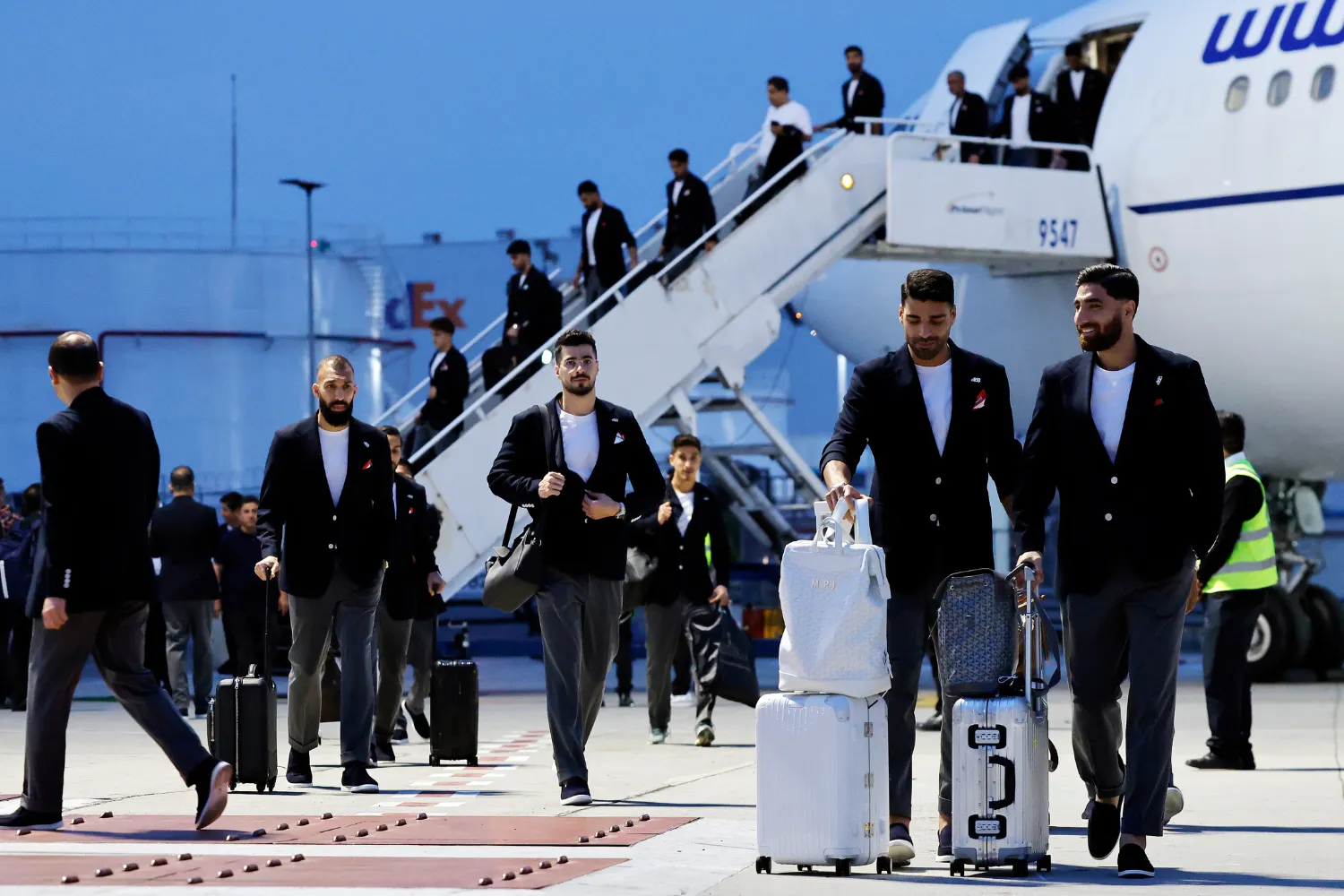
Iran’s experience points to a different—but related—set of challenges, rooted in visa policy and wider geopolitical tensions.
Members of the national team have faced strict travel constraints, with reporting indicating that players may be required in some cases to enter the United States only for matches and leave shortly afterwards, rather than remain in the country between fixtures.
...
While the players themselves were ultimately granted visas, Iranian state media have said that several members of the team’s support staff were denied entry. This has led the squad to base itself in Mexico, commuting into the U.S. for games rather than staying within the host country.
The situation has been further complicated by disputes over fan access. In a statement reported by Reuters, Iran’s soccer federation said its allocation of World Cup tickets had been withdrawn just days before their first game on June 15 against New Zealand. Iran state media called the move “contrary to the principles” of fairness and equal treatment in international competition.
A Wider Pattern
The incidents come amid a broader backdrop of stricter U.S. immigration rules and enforcement that is already affecting soccer.
In recent months, players in international competitions have struggled to obtain visas for matches in the United States, while officials and governing bodies have raised concerns about how policies could affect participation in the World Cup.
Travel complications have not been limited to the United States. South Africa’s preparations were also disrupted when visa issues delayed the team’s departure for North America from Mexico.
At the same time, border agencies retain wide discretion to carry out searches and questioning on arrival, meaning players can still be subject to checks even after securing visas.
"All travelers seeking entry into the United States, including athletes, coaches and staff, are subject to Customs and Border Protection inspection and vetting," a CBP spokesperson told Newsweek. "Admissibility determinations are made on a case-by-case basis using law enforcement, national security and immigration information available at the time of inspection. CBP officers have the authority to question travelers, conduct inspections and determine admissibility consistent with U.S. law."
A Tournament Framed by Security Questions
With the United States set to host the majority of matches in the 2026 tournament, the issue of how teams are treated at the border is likely to remain under scrutiny.
The concerns come as officials prepare for one of the most heavily secured sporting events in history, with plans that include AI-powered surveillance systems, advanced biometric screening and even robotic security technologies designed to monitor crowds and detect threats in real time. That wider security posture is intended to protect millions of visitors across host cities—but it also underscores the intensity of the environment teams are entering.
Taken together, confirmed incidents such as the detention of Iraq’s leading player and reported cases of intensive screening and travel limits point to a more complex—and, for some teams, more difficult—arrival experience than expected.
Some details remain unclear, particularly where footage circulating online has yet to be verified. But the combination of high-tech security measures, strict immigration controls and geopolitical tensions is already shaping how the 2026 World Cup begins for many of its participants—long before a ball is kicked.
Update 06/10/26, 03:00 a.m. ET: This story was updated with comment from U.S. Customs and Border Protection.
Update 06/10/26, 06:55 a.m. ET: This story was updated with additional information on the Senegal team.
View 0 Comments
Submit Correction
View Editorial & AI Guidelines