- U.S.
- World
- Science
- Health
- Life
- Rankings
- Opinion
- Entertainment
- Fact Check
- My Turn
- Education
- EventsSportsPodcastsBetter PlanetBetter WorkplacesMightierAutosNewslettersUnconventionalVantageExpertsLeadershipDev Pragad
- Subscribe

- Login
×
Subscribe Login
- U.S.
- World
- Science
- Health
- Life
- Rankings
- Opinion
- Entertainment
- Fact Check
- My Turn
- Education
- Events
- Sports
- Podcasts
- Better Planet
- Better Workplaces
- Mightier
- Autos
- Newsletters
- Unconventional
- Vantage
- Experts
- Leadership
- Dev Pragad

An AI-generated rendering of a hospital operating room, where functioning supply chains are vital to success. An AI-generated rendering of a hospital operating room, where functioning supply chains are vital to success. MidJourney AI
From Back Office to Bedside: Why Patient‑Centric Supply Chains Are the Future of Health Care
By Kylie McCoy
VP, Brand Partnerships
 Newsweek Is A Trust Project Member
Advertiser Content
Supplied by an entity that has paid the news provider for its placement; not impartial journalism.
Share
Copy Link
✓ Link copied to clipboard!
Listen
Translate
- English (Original)
- Español
- 中国人
- Français
- Deutsch
- Portuguese
- हिन्दी
Newsweek AI is in beta. Translations may contain inaccuracies—please refer to the original content.
Read original
Speed: 0.5xSpeed: 1xSpeed: 1.5xSpeed: 2x
🎙️ Voice is AI-generated. Inconsistencies may occur.
✖
The operating room was ready. The team stood scrubbed, waiting for the first incision. But one critical item was missing from the surgical cart. Minutes ticked by as staff scrambled to track it down, costs mounting while the patient lay in limbo.
Scenarios like this unfold every day in American hospitals. Emergency Care Research Institute (ECRI) reports that nearly half of clinicians face delays because supplies are unavailable, while Premier Inc. estimates those inefficiencies drain more than $25 billion annually from health systems. The consequences ripple outward: patients wait longer or see their procedures canceled, technicians hunt through storerooms instead of preparing carts, and clinicians lose time at the bedside.
However, change is possible and is already underway. At Newsweek's Digital Health Forum, Tecsys CEO Peter Brereton shared the story of an orthopedic surgeon who, after decades of working behind schedule, was suddenly finishing procedures on time. The breakthrough wasn't faster surgery. It was supply reliability.
"For the first time in his career, the right product was always there," Brereton said.
That kind of reliability doesn't happen by accident. It starts with solving one of health care's most persistent and fixable challenges: fragmentation.
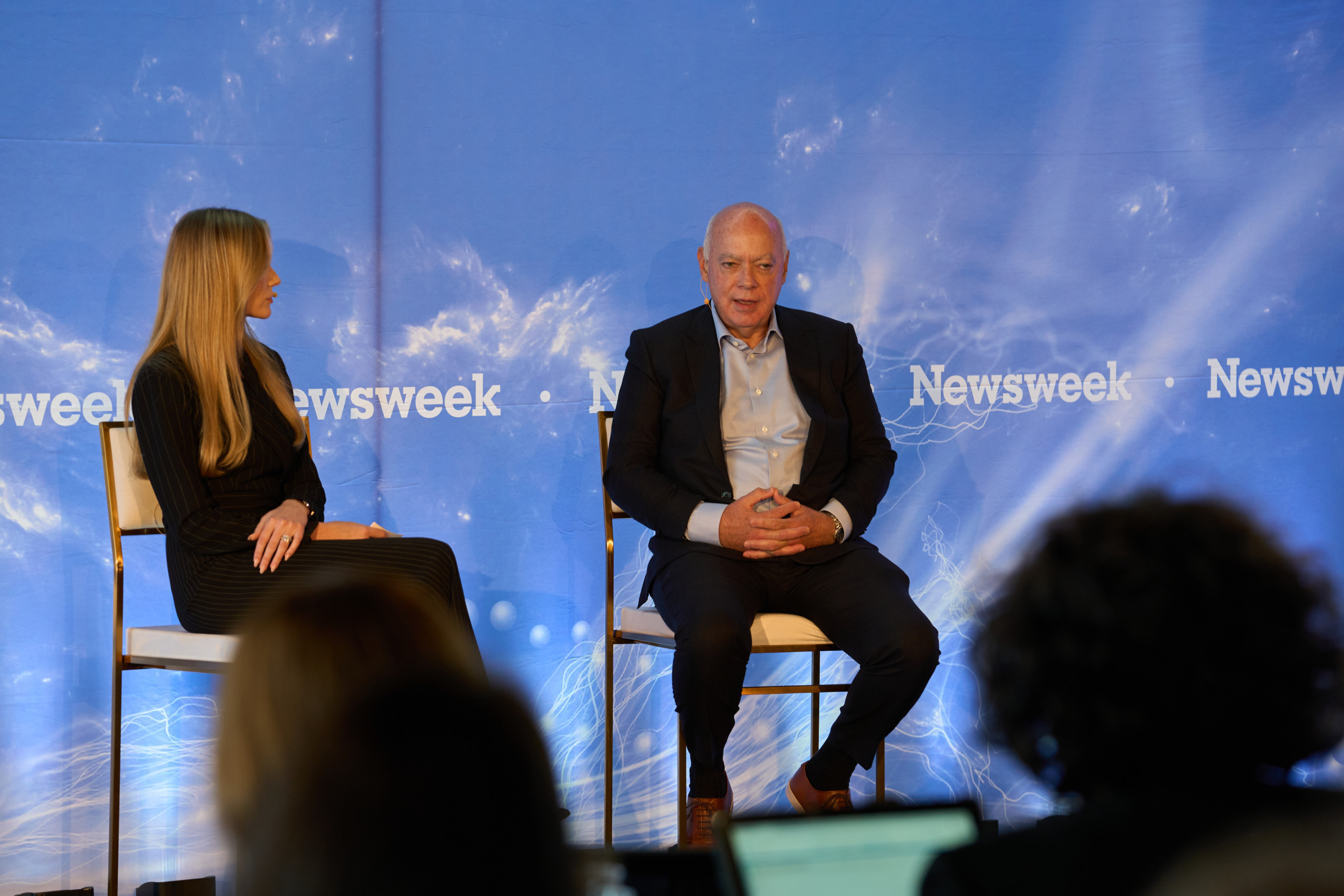
Tecsys CEO Peter Brereton spoke with Newsweek's Kylie McCoy during the publications Digital Health Care Forum. Tecsys CEO Peter Brereton spoke with Newsweek's Kylie McCoy during the publications Digital Health Care Forum. Yekaterina Gyadu for Newsweek
The Hidden Cost of Fragmentation
In many health systems, supply chain breakdowns aren't the result of a lack of technology. They're the result of disconnected systems and inconsistent data. Brereton explained that hospitals expanding through mergers or acquisitions often inherit a maze of inventory tools, duplicative SKUs and mismatched product records.
"You have different hospitals within the same network calling the same product by different identifiers," he said. "Without data standards, the rest becomes nearly impossible."
The same fragmentation that disrupts supply chains also undermines the IT systems designed to keep them running. Indiana University Health confronted this issue head-on when leaders discovered they were managing more than 1,500 applications across the organization. Many were redundant, some outdated, and altogether they created a confusing sprawl. Through a disciplined review, the system identified 600 applications for retirement. The goal wasn't only cost savings — it was clarity. As executives there explained, they began to weigh not just financial ROI but also "return on opportunity," asking whether each system advanced patient experience, staff efficiency or quality of care.
Other organizations are approaching fragmentation differently. City of Hope developed its own large language model, HOPE LLM, to merge decades of oncology data into a single longitudinal record. That innovation cut down on late-night "pajama time" for physicians and gave care teams faster access to patient histories. It also improved clinical trial matching, enabling the introduction of new therapies to patients more quickly. But whether through data science or governance, the principle is the same: Fragmented systems cost time, money and lives.
Sean Griffin, CEO of Utilization Review Accreditation Commission (URAC) and a former CMIO, summed up the cultural barrier bluntly. In health care, he said, silos aren't passive bins. "They're kingdoms, with moats and boiling oil." Breaking them down requires not only new technology but also new structures of trust and accountability. When hospitals put those structures in place, they gain the visibility needed to recover revenue that would otherwise slip through the cracks.
Visibility That Drives Revenue
With fragmentation addressed, hospitals gain a real-time picture of what's being used, where and by whom. That clarity has measurable financial consequences. Premier's 2024 Resiliency Survey found that medium-sized systems absorb about $3.5 million in added costs each year from shortages, while lost income from delayed or canceled procedures averages another $350,000 annually.
Hospitals that have tackled this challenge point to the payoff. At Parkview Health, working with Tecsys helped the system enhance its ability to capture supply usage at the point of care, resulting in more accurate billing and charge capture. The result: $17 million in revenue recovered annually, simply by connecting usage data to reimbursement systems, according to Brereton.
In the pharmacy, where compliance and expiration tracking add complexity, the impact was just as significant. Texas Children's Hospital, another Tecsys customer, implemented real-time inventory visibility and automated replenishment. The outcome: a 10:1 return on investment, with dramatic reductions in expired stock and improved 340B compliance.
The story is similar at Fairview Health Services, where a $600 million turnaround over two years wasn't driven by cuts alone—it was powered by operational focus and process optimization, backed by technology.
"The processes of health care haven't necessarily had the same attention to detail and discipline that the content of healthcare often has," said James Hereford, CEO of Fairview. "So we really focused a lot on that, and obviously, technology plays a critical part in it."
A Roadmap That Funds Itself
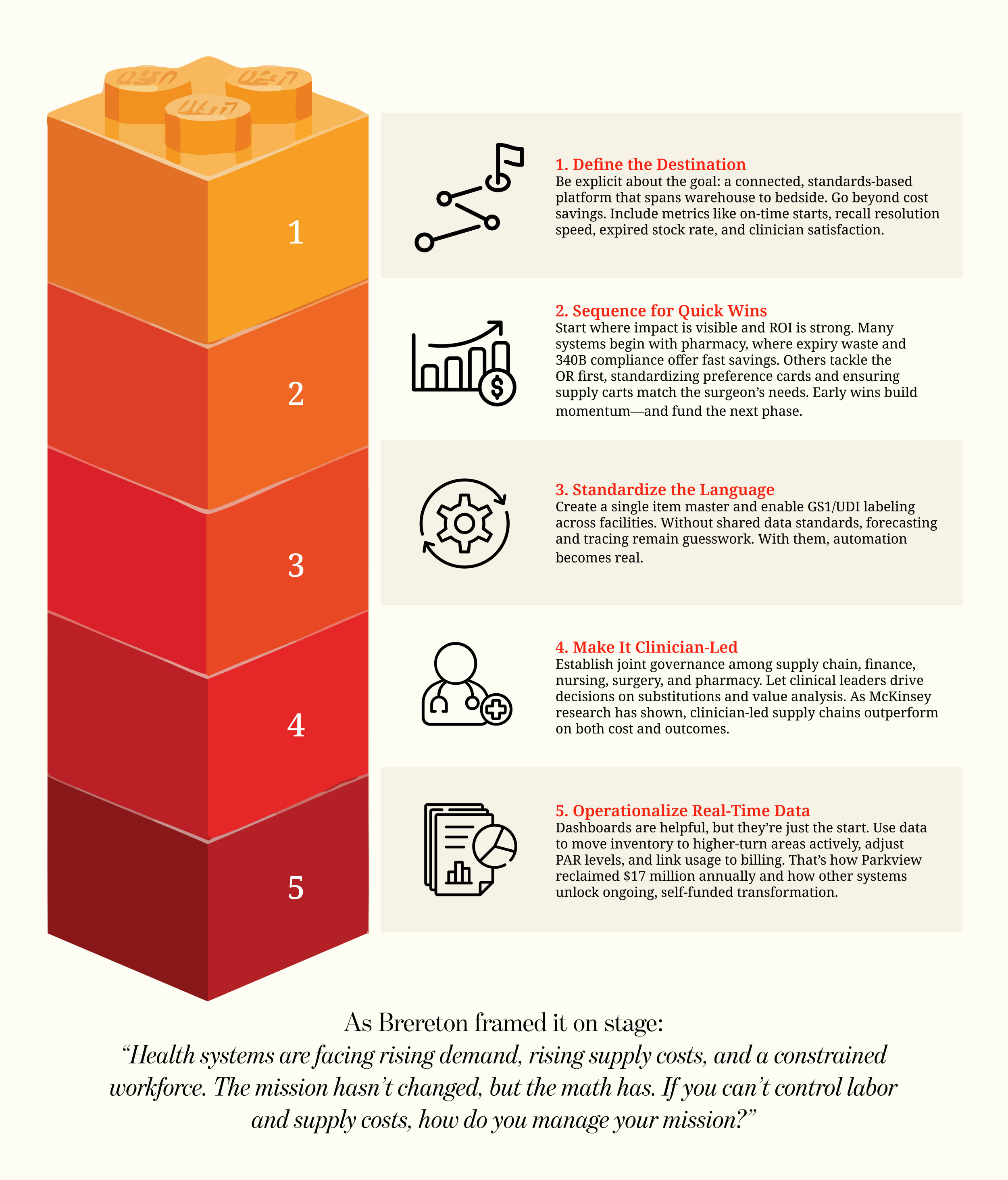
Modernizing the supply chain doesn't require boiling the ocean. As Brereton explained, the best systems start small with a vision, a quick win and a clear strategy to scale. "This can be built like Lego — one piece at a time," he said. "But you have to start with the vision."
Based on industry best practices, a pattern of five steps tends to work in successful transformations:
Newsweek
The Bottom Line for Leaders
A modern supply chain isn't an IT upgrade. It's the core infrastructure for quality, safety and sustainability. The evidence is accumulating: shortages delay care, but visibility returns time to patients, and standardization reduces waste.
The surgeon Brereton described didn't finish on time because he rushed. He finished on time because his hospital made sure the right product was in the right place at the right moment, every time. Build that capability, piece by piece, and the payoff will be felt where it matters most: in the operating room, in the pharmacy, and in the lives of patients who get care when they need it.


U.S.WorldScienceHealthRankingsOpinionEntertainmentFact CheckMy TurnEducationEventsSportsPodcastsBetter PlanetBetter WorkplacesMightierAutosNewslettersUnconventionalVantageExpertsLeadershipDev Pragad
Trending
Israel at War Vladimir Putin Russia-Ukraine War Donald Trump
Subscriptions
Membership Monthly $4.99 Membership Yearly $49.00 Membership+Print Monthly $9.99 Membership+Print Yearly $99
Newsletters in your inbox See all
The Bulletin (Daily)See Sample
The Gist of It (Daily)
Geoscape (Twice a Week)
The 1600 (Daily)
Inside Trump Policy (Weekly)
Newsweek AI (Weekly)
Sports Daily (Daily)
The Josh Hammer Report (Weekly)See Sample
For The Culture (Three Times a Week)See Sample
Discoveries (3 Times a Week)
Like & Subscribe (Daily)
Breaking News (As it Breaks)
The Debate (Twice a Week)
Pawsitively (Daily)
Better Planet (Weekly)
The Good Life (Weekly)
Newsweek Pulse (2x3 Times a Month)
Sign up now
You can unsubscribe at any time. By signing up you are agreeing to our Terms of Service and Privacy Policy
In The Magazine  September 19
2025 Issue
Company
About UsMastheadDiversityAnnouncementsArchivePolicies and StandardsMission StatementLeadershipNewslettersPress Center
Editions:
Contact
AdvertiseCareersContact UsCorrections
Terms of Use
Cookie PolicyCopyrightPrivacy PolicyTerms & ConditionsTerms of Sale Privacy Settings
© 2026 NEWSWEEK DIGITAL LLC