10
Loading video...

By Alice Gibbs
Senior Reporter
0
Share
Newsweek is a Trust Project member
See more of our trusted coverage when you search.Prefer Newsweek on Googleto see more of our trusted coverage when you search.
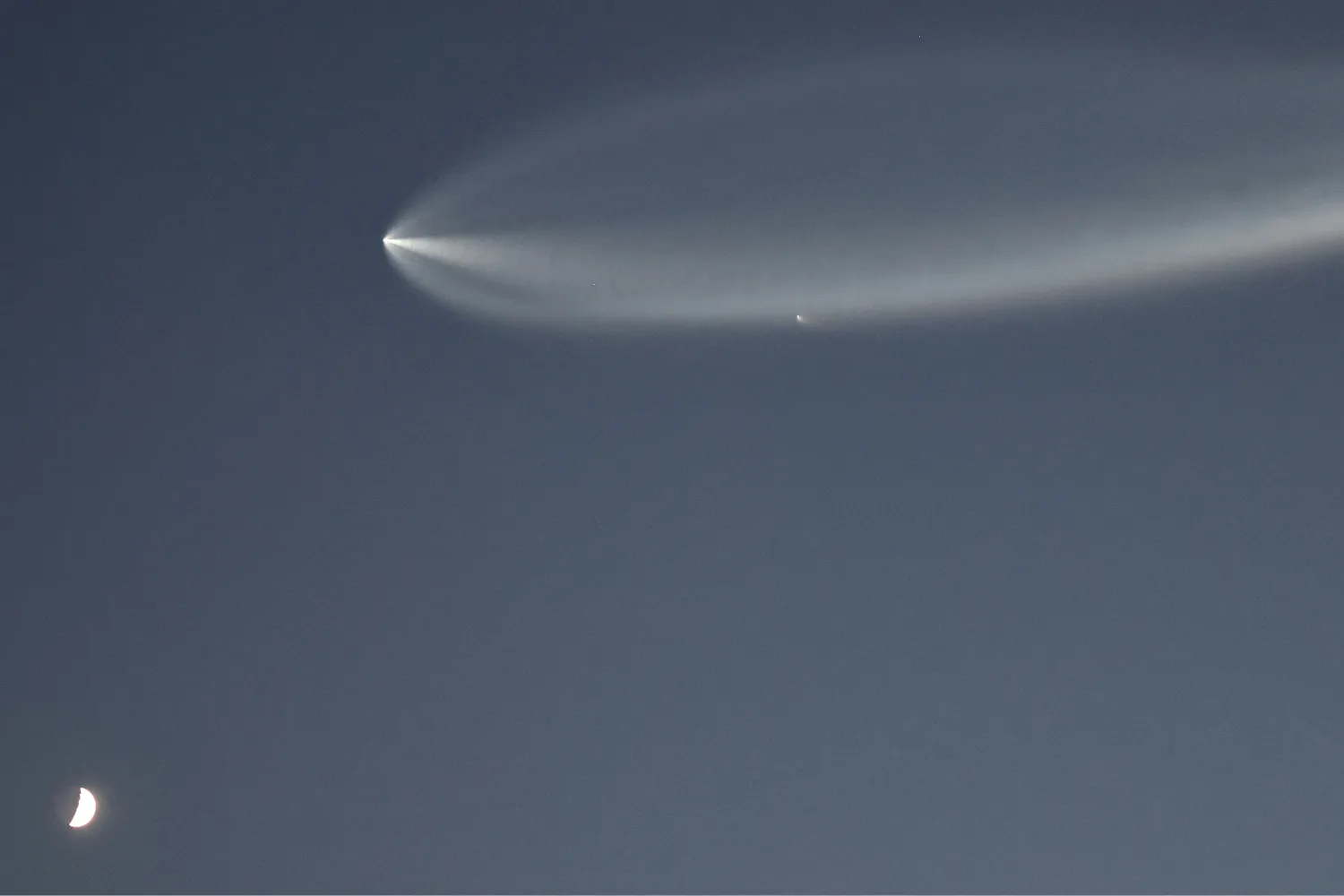
A piece of a SpaceX Falcon 9 rocket that has been drifting through space since a January 2025 launch is believed to have collided with the Moon on Wednesday, striking the lunar surface at about 5,400 mph.
The rocket stage was originally used to send two private lunar landers toward the Moon before being left in a long-term orbit that was later altered by gravitational forces and solar activity.
While a rocket impact on the Moon may sound dramatic, scientists do not expect the collision to cause any major changes to the lunar surface. NASA estimates the impact will likely leave a crater about 60 feet wide and 12 feet deep, while ejecting a plume of lunar dust and rock into the surrounding area. The collision poses no threat to Earth and is not expected to have any meaningful effect on the Moon as a whole.
Read More
Trump Administration Accused of Destroying Reflecting Pool Evidence1 min read

Golden Dome’s New Space Interceptors Could Revive a Reagan-Era Vision5 min read

Trump’s New Robotics Rules: The Household Items Impacted5 min read

NASA plans to collect data from the impact and search for evidence of the newly formed crater and any material ejected from the collision.
The agency has said observations of impacts can help scientists understand how lunar dust and debris behave, provide insights into the Moon's geology and improve models used for future exploration missions.
The scientific interest has echoes of the Apollo era, when NASA deliberately crashed items into the Moon after completing their missions.
...
What Will the Impact Actually Do to the Moon?
Despite the attention surrounding the collision, NASA says the impact is expected to be relatively modest by lunar standards.
The Falcon 9 upper stage is predicted to create a crater about 60 feet wide and 12 feet deep near the Moon's Einstein and Bell craters, while scattering dust and rock outward in a plume.
There is also interest in whether the impact generated a measurable moonquake, a seismic tremor caused by vibrations traveling through the Moon's interior.
Nicholas Schmerr, a professor of geology at the University of Maryland and planetary seismologist, told Newsweek that the impact likely produced both a new crater and a detectable seismic event, had instruments been available to record it.
"The Falcon 9 impact will almost certainly create a new impact crater on the Moon, although it will be smaller than the Saturn V Stage IVB impacts made during Apollo," Schmerr said. "The Lunar Reconnaissance Orbiter Camera will almost certainly look for that new crater. Its final morphology is unknown and by imaging it we will learn more about how craters form in response to this type of impactor."
Schmerr added that the collision may also have produced a visible flash and short-lived ejecta plume, although specialized equipment would have been needed to observe it.
"The impact could create a visible flash and short-lived plume of ejecta, but likely a good telescope and special observation equipment would be needed to see it," he said. "There was an observation campaign by Earth-based telescopes last night to look for the flash from the impact."
"The impact will almost certainly create a nice moonquake"
Nicholas Schmerr
"The impact will almost certainly create a nice moonquake," Schmerr said. "Unfortunately no stations are currently recording on the Moon, so we will have to wait until new equipment goes there to record future impacts."
NASA says the crash event is not unusual in terms of the energy delivered to the lunar surface. A meteoroid carrying roughly the same impact energy strikes the Moon about every six days. Because the Moon lacks an atmosphere, it is constantly absorbing impacts from space, meaning the Falcon 9 collision is unlikely to have any meaningful effect on the Moon as a whole.
"The impact poses no danger to Earth and NASA scientists are planning to collect lunar data from the event and refine techniques for tracking objects in space," NASA spokesperson Jimi Russell said in a statement.
NASA Used to Crash Rockets Into the Moon on Purpose
The idea of intentionally crashing spacecraft into the Moon may sound unusual, but it was once a key part of NASA's lunar science program.
During the Apollo missions, astronauts placed seismometers on the lunar surface to record moonquakes and other vibrations.
To create seismic signals that scientists could study, NASA deliberately directed Saturn V third stages toward the Moon after they had completed their work of launching astronauts into space.

...
NASA later carried out similar impacts using lunar modules after crews had safely returned to the command module. Scientists then monitored the resulting seismic waves to better understand the Moon's internal structure.
One famous example came after Apollo 13. Although the mission is remembered for the onboard explosion that forced astronauts to abandon their lunar landing attempt, NASA has noted that the crash of the mission's Saturn V third stage into the Moon successfully generated seismic data for researchers.
While the SpaceX impact will likely generate a moonquake, the ability to record such events is no longer in place.
Clive Neal, professor of planetary geology at the University of Notre Dame, told Newsweek: "It's a shame we don't have any active seismometers on the Moon anymore to record the impact."
He also noted that the impact of Falcon 9 is likely to have been less significant than those in the Apollo era. “The upper stage of the Falcon 9 is about 4,000 kg (4.4 tons), whereas that of the Saturn V was about 13,500 kg (14.8 tons) so that was much bigger and generated a larger seismic event or moonquake,” Neal said. “However, the speed of the impact will also play a part in the magnitude of the event."

...
Could SpaceX's Accident Help Scientists?
NASA has already indicated that it plans to collect lunar data related to the impact and use the event to improve understanding of artificial impacts on the Moon. The agency also plans to use observations to refine techniques for tracking objects in deep space.
Researchers are expected to search for the newly formed crater using NASA's Lunar Reconnaissance Orbiter, which has previously photographed impact sites left behind by Apollo-era missions. Before-and-after images could reveal how much material was displaced, how large the crater ultimately proves to be, and whether scientists need to adjust models used to predict the effects of future lunar impacts.
"We really need a global seismic and geophysical network on the Moon to ensure the safety of a future Moon base"
Clive Neal
The event effectively provides scientists with an unexpected real-world experiment. While the collision was accidental, the data gathered could help researchers better understand how spacecraft interact with the lunar surface, information that may become increasingly valuable as NASA, commercial companies and international partners prepare for more frequent missions to the Moon in the years ahead.
Neal said the incident also highlights why scientists want a new seismic monitoring network on the Moon as plans for long-term human activity on the lunar surface advance.
"We really need a global seismic and geophysical network on the Moon to ensure the safety of a future Moon base, which in turn would help define areas of the Moon where more impacts and high-magnitude shallow moonquakes occur," he said. "In other words, don't build it there."
Contact Newsweek editors on this story: John Fitzpatrick and Emma Lee-Sang
View 0 Comments
Submit Correction
View Editorial & AI Guidelines