10
Loading video...

By Dan Cody
Digital Media Reporter
0
Share
Newsweek is a Trust Project member
See more of our trusted coverage when you search.Prefer Newsweek on Googleto see more of our trusted coverage when you search.
SpaceX's latest attempt to launch and test its next-generation Starship rocket ended in failure Thursday evening when the upper-stage vehicle exploded mid-flight over the Atlantic Ocean.
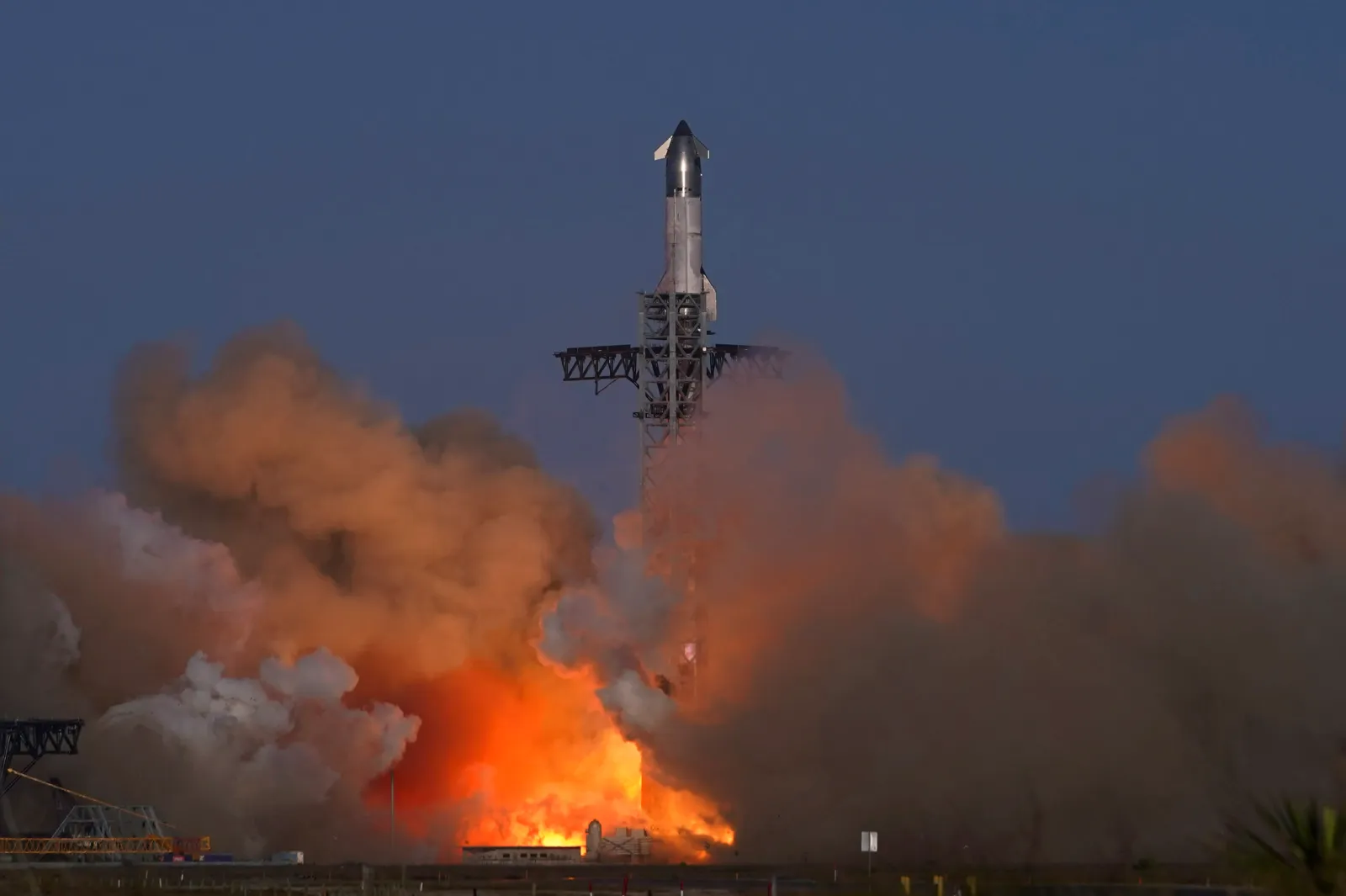
The uncrewed Starship lifted off from SpaceX's Starbase facility in South Texas at 6:30 p.m. ET, riding atop a 232-foot-tall Super Heavy booster.
While the launch initially proceeded as planned, with the booster successfully separating and returning to the launch tower for a "catch" maneuver, issues with the upper stage of Starship became evident shortly after separation.
Read More on News
What Went Wrong?
Less than 10 minutes into the flight, several Raptor engines on the Starship upper stage failed, causing the spacecraft to lose control. "Once you lose enough of those center engines, you're going to lose attitude control," said Dan Huot, SpaceX communications manager, during a live-streamed broadcast. "And so we did see the ship start to go into a spin, and at this point, we have lost contact with the ship."
...
SpaceX later issued a statement confirming that "prior to the end of the ascent burn, an energetic event in the aft portion of Starship resulted in the loss of several Raptor engines." The company added, "this in turn led to a loss of attitude control and ultimately a loss of communications with Starship."
According to Spaceflight Now, three minutes after losing contact, the rocket's self-destruct system activated, causing Starship to explode and scatter flaming debris along its flight path in a dramatic display.
SpaceX continued: "Final contact with Starship came approximately 9 minutes and 30 seconds after liftoff." It also emphasized that Starship was within its designated launch corridor, and "any surviving debris would have fallen within the pre-planned Debris Response Area." The company said "there are no toxic materials present in the debris and no significant impacts expected to occur to marine species or water quality."
Observers in Florida and the Caribbean were able to witness Starship's fiery breakup as debris streaked across the sky.
Some captured videos showing the upper-stage spacecraft breaking apart over the Atlantic. Footage shared by observers in the Exumas and Titusville, Florida, showed debris resembling an artificial meteor shower.
Impact on Air Traffic
The explosion led to a temporary airspace shutdown, with the Federal Aviation Administration (FAA) halting flights into major Florida airports, including Miami, Fort Lauderdale, Palm Beach, and Orlando.
The FAA later confirmed that falling space debris was the reason for the precautionary measure, which lasted until 8 p.m. ET. Departures from Miami International Airport and Fort Lauderdale-Hollywood International Airport were delayed by an average of 30 to 45 minutes due to the incident.
FAA Orders SpaceX To Investigate
The FAA is requiring SpaceX to perform a mishap investigation into the loss of the Starship vehicle. According to the agency's statement, "a mishap investigation is designed to enhance public safety, determine the root cause of the event, and identify corrective actions to avoid it from happening again." The FAA emphasized that it "will be involved in every step of the SpaceX-led mishap investigation process and must approve SpaceX's final report, including any corrective actions." The FAA clarified that "a return to flight is based on the FAA determining that any system, process, or procedure related to the mishap does not affect public safety."
This is the second consecutive failure of a Starship upper stage within two months. A similar explosion occurred during Starship Flight 7 on January 16, when a leak near a tank containing liquid oxygen led to a catastrophic breakup over the Turks and Caicos Islands. That incident also prompted an FAA review, and some debris was found on beaches and roadways in the island nation. It remains unclear if similar debris recovery efforts will be needed after Flight 8.
SpaceX's Response
Despite the failure, SpaceX remains committed to its rapid iteration development strategy, where test flights are designed to push the limits of the Starship system. The company posted on X (formerly Twitter): "Success comes from what we learn, and today's flight will offer additional lessons to improve Starship's reliability."
In response to the January failure, SpaceX implemented new fuel line modifications, venting adjustments, and engine thrust changes—but the failure in Flight 8 suggests further modifications are needed. "We will review the data from today's flight test to better understand root cause," the company added in its post-flight statement.
What Happens Next
While Starship's long-term goal is to support missions to the Moon and Mars, including NASA's Artemis program, these ongoing test flights serve as crucial stepping stones. SpaceX has not yet announced a timeline for the next Starship flight but is expected to submit a report to the FAA with proposed corrective actions before moving forward.
View 0 Comments
Submit Correction
View Editorial & AI Guidelines