Photo-illustration by Newsweek/Getty

By Amy McVay Abbott
0
Share
Newsweek is a Trust Project member
See more of our trusted coverage when you search.Prefer Newsweek on Googleto see more of our trusted coverage when you search.
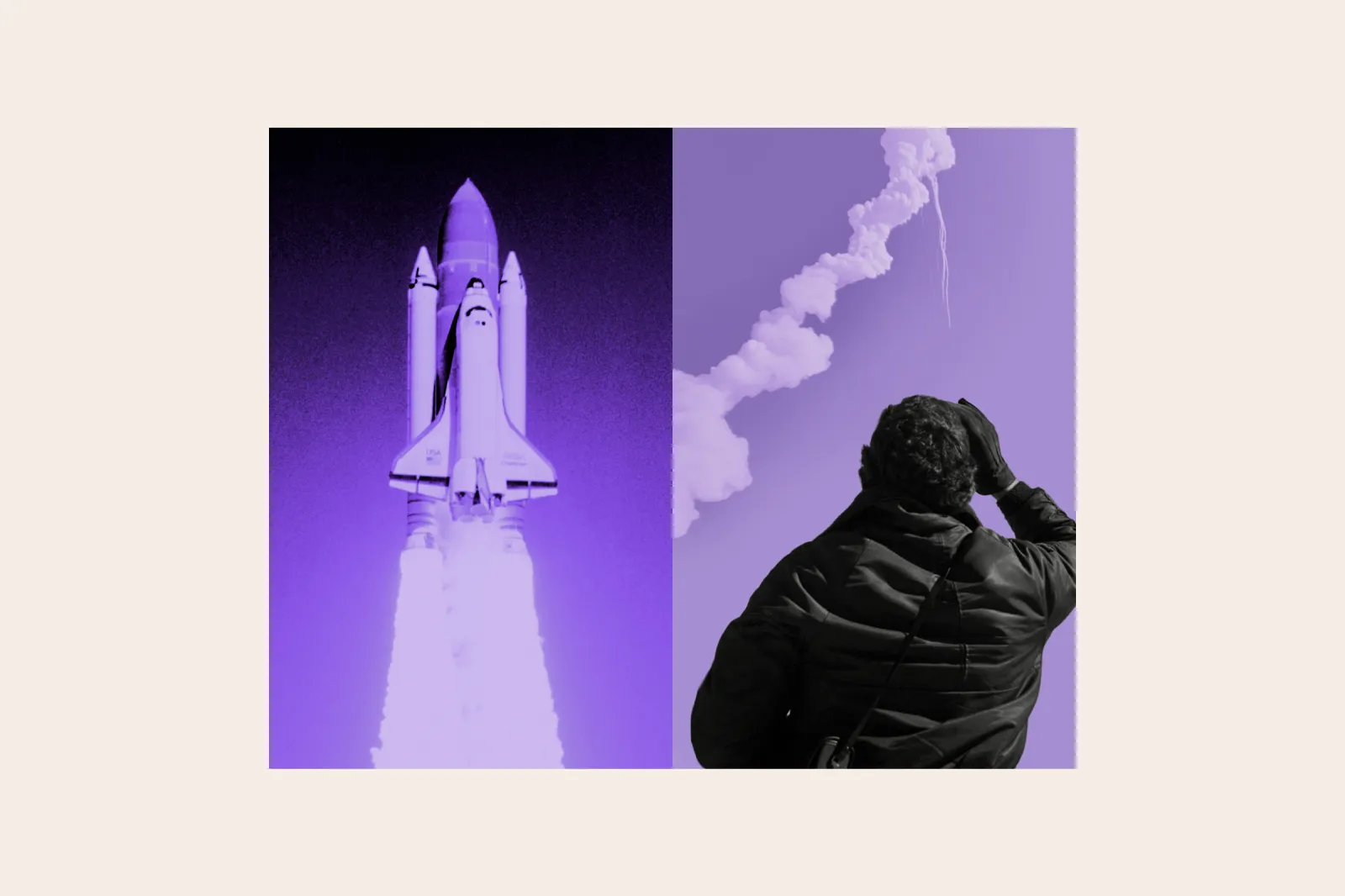
On January 28, 1986, I stood outside to watch the Space Shuttle Challenger launch—and then explode.
Forty years later, the chilly winter morning is one I can never forget, nor can I forget the seven astronauts who would not live another day.
As a boomer born in the year of Sputnik, I was fascinated by space. Because the Sunshine State is so flat, launches from Cape Canaveral are visible from miles away on a clear day. Although the sky was bright blue and the sun shone, this was the coldest day since I’d moved to Florida in 1982. Winter temperatures rarely dropped in central Florida, yet the Challenger Shuttle launch had been canceled on both the previous Sunday and Monday due to poor weather.
Read More on My Turn
My Husband Froze His Eggs Before He Transitioned. Now I’m Having His Baby6 min read

I Was Single at 37 and Had Given Up on Love—One Message Changed Everything10 min read

I Thought Going Gray Meant I’d Stopped Caring about My Looks. Then the Compliments Started6 min read

In my office at Humana Women's Hospital—Tampa, I listened to the radio for updates. The launch was a go. I walked outside to the parking circle, which faced east toward the Cape, and pulled my jacket tightly around me, flipping up its collar for warmth. Despite the cold, I was excited to see another launch, as thrilled as I was at age 11 when my parents let me stay up to watch Neil Armstrong and Buzz Aldrin walk on the moon.
What some flyers called "the bird" rose in the east, and I felt excited about the "Teacher in Space" program, which featured the first civilian astronaut, Christa McAuliffe.
I was 29 and could relate to McAuliffe, though she was a few years older than I was. Like my parents, my husband would soon be an educator, and I admired teachers, especially this young, ambitious woman. And now this teacher, an ordinary civilian, married with two kids, walked out of her New Hampshire classroom and onto NASA's shuttle. McAuliffe felt like someone I could have been friends with, had we shared college days.
I viewed her courage with the same awe and respect I saw in the sky full of stars, and I related to her as a woman of my generation filled with curiosity and wanderlust. Today, this ordinary woman would become extraordinary in the pantheon of great explorers.
Across central Florida, tourists gawked from theme parks and beaches, office workers took an outside break, and drivers pulled off the Bee Line Expressway to catch the launch.
The Challenger, attached to its rocket boosters, rose above the horizon, its blazing trail of fuel slowly propelling the spaceship, then faster, until it curved eastward over the Atlantic Ocean. Most of my co-workers returned inside after seeing the spacecraft in the air. I didn't want the launch to be over. I stayed outside, unwilling to let the magic go.
Most of my co-workers returned inside after seeing the spacecraft in the air. I didn't want the launch to be over. I stayed outside, unwilling to let the magic go.
In a moment, everything changed.
In a moment, everything changed. The rocket didn't continue on a smooth trajectory like the other Shuttle launches I had witnessed. An enormous white ball of vapor appeared in the eastern sky. The Challenger Mission 51-L rocket trail split and spun out in a dozen directions like some errant firecracker.
My stomach churned, and my body reacted before my brain could comprehend what I had just seen.
I rushed inside to find the television in the lobby, where CNN was broadcasting live from the Cape. One announcer said, "Obviously, there's been a major malfunction."
I immediately thought of the McAuliffe children, her husband, and parents who were in the bleachers on top of a NASA building down the coast from the launch site. Family members and friends of all the astronauts, politicians, government officials and media filled the site, and I thought, "Why don't they turn these cameras off?"
But the cameras stayed on for a few minutes, and we saw the families' expressions of unexplained horror.
And I remembered hearing on the news that McAuliffe's classroom in New Hampshire was watching live.
I would not become a mother for five more years, but my heart broke for the McAuliffe children and all children impacted by whatever this horror was.
I knew I had witnessed something terrible, but my heart wouldn't let me process the shock. I was filled with questions, but no answers.
Had the astronauts survived the apparent explosion only to drown in the Atlantic Ocean a few miles off the coast?
Could NASA send a ship to rescue them?
The television pundit said the shuttle was 3.2 nautical miles away. My mind whirled over all the possibilities but returned to the two alternatives I had already imagined: that seven souls died in a midair explosion or fell to the sea and drowned—mothers and fathers, sons and daughters, friends and lovers, all gone.
I expected a perfect, gravity-defying launch of the Space Shuttle, the marriage of the human mind and engineering to explore the greater universe.
Yet, months later, the world learned that Challenger failed when rocket booster O-rings became brittle and cracked in the frigid weather at 73 seconds, right after the command, "Go at throttle up."
Once the full history was known, we learned that certain engineers had warned NASA that danger could occur in cold weather.
After the Challenger explosion, I never watched another live launch. We moved out of Florida in 1988 when my husband graduated, six months before the launches began again.
Taking huge risks for the greater good requires courage, whether from an ordinary teacher or an astronautical engineer. Bravery is the secret ingredient, the elixir that combines effort, science and technology for something larger than the self.
Exploring whatever's out there isn't going to stop. Consider explorer George Mallory's answer to the question, "Why climb Mount Everest?" He said, "Because it's there."
Humans will continue to explore and discover new horizons, and lives will be lost.
But 40 years later, four decades in which I enjoyed a long marriage, motherhood, beloved family and friends, hobbies and travel, and now a new daughter-in-law, I still mourn for the lives lost and the losses of their friends and families. I will always grieve them, and I will remember them as clearly as I remember the clear, blue January sky.
Amy McVay Abbott is a retired health care executive who lives in southwestern Indiana. She is the author of "Centennial Farm Family: Cultivating Land and Community 1837-1937."
Do you have a personal essay you want to share with Newsweek? Send your story to MyTurn@newsweek.com.
View 0 Comments
Submit Correction
View Editorial & AI Guidelines