
...

By Kate Nalepinski
Reporter
0
Share
Newsweek is a Trust Project member
See more of our trusted coverage when you search.Prefer Newsweek on Googleto see more of our trusted coverage when you search.
The Trump administration's sweeping new tariff proposal has sparked comparisons to the Smoot-Hawley Tariff Act of 1930, which some economists blame for exacerbating the Great Depression.
President Donald Trump's latest tariff initiative envisions a dramatic overhaul of United States trade policy, featuring across-the-board tariffs on major trade partners. This includes a 10 percent baseline tariff on imports.
Why It Matters
Trump's plan could implement higher tariffs than enacted during the Great Depression, raising the average U.S. import duty to more than 22 percent.
Read More on Politics
In a note to clients, JPMorgan Chief U.S. Economist Michael Feroli said that the average effective tariff in the U.S. will move from around 10 percent to just over 23 percent.
"A White House official mentioned that other section 232 tariffs (e.g. chips, pharma, critical minerals) are still in the works, so the average effective rate could go even higher," Feroli said. "Moreover, the executive order states that retaliation by US trading partners could result in even higher US tariffs."
...
What Was the Smoot-Hawley Tariff Act?
Signed into law in June 1930, the Smoot-Hawley Tariff Act sharply raised U.S. tariffs on over 20,000 imported goods to protect American farmers and manufacturers during the early days of the Great Depression. Sponsored by Senator Reed Smoot and Representative Willis Hawley, the act increased average tariff rates from 13.5 percent to nearly 20 percent.
Although designed to protect domestic industry, the law quickly triggered retaliation from major U.S. trading partners. Exports collapsed. U.S. imports fell by two-thirds within three years, and exports saw similar declines.
Did Smoot-Hawley Cause the Great Depression?
While the Smoot-Hawley Act is often cited as a contributor to the economic collapse of the 1930s, not all economists agree on the extent of its impact.
Nobel Prize-winning economist Milton Friedman attributed the prolonged downturn primarily to restrictive monetary policies rather than tariffs.
What Are Reciprocal Tariffs?
Reciprocal tariffs are duties imposed by one country in response to those levied by another. In Trump's framework, these are not strictly one-to-one matches but are calculated based on what the administration perceives as the total impact of direct tariffs and indirect trade barriers—such as subsidies, quotas, and technical standards.
Trump argues that many trade partners impose hidden costs on U.S. exports, justifying his proposal for higher blanket tariffs on their goods. "We have not been treated fairly," Trump said during a Rose Garden announcement, referencing what he calls "decades of one-sided trade deals."
Kentucky Senator Rand Paul is one of few Republicans in Congress who have criticized Trump's tariffs on Canada and referenced Smoot-Hawley earlier this week.
"Tariffs have also led to political decimation. When [former President William] McKinley most famously put tariffs on in 1890, they lost 50 percent of their seats in the national election," Paul said. "When [Smoot-Hawley] put on their tariff in the early 1930s, we lost the House and the Senate for 60 years. So they're not only bad economically, they're bad politically."
Trump's Tariff Chart Explained
Trump's plan calls for country-specific tariffs as high as 60 percent. China, for example, would face a 60 percent tariff, while others such as Vietnam (46 percent), Thailand (36 percent), and India (26 percent) are also heavily targeted. Traditional allies like Canada and the European Union would see 25 and 20 percent tariffs, respectively.
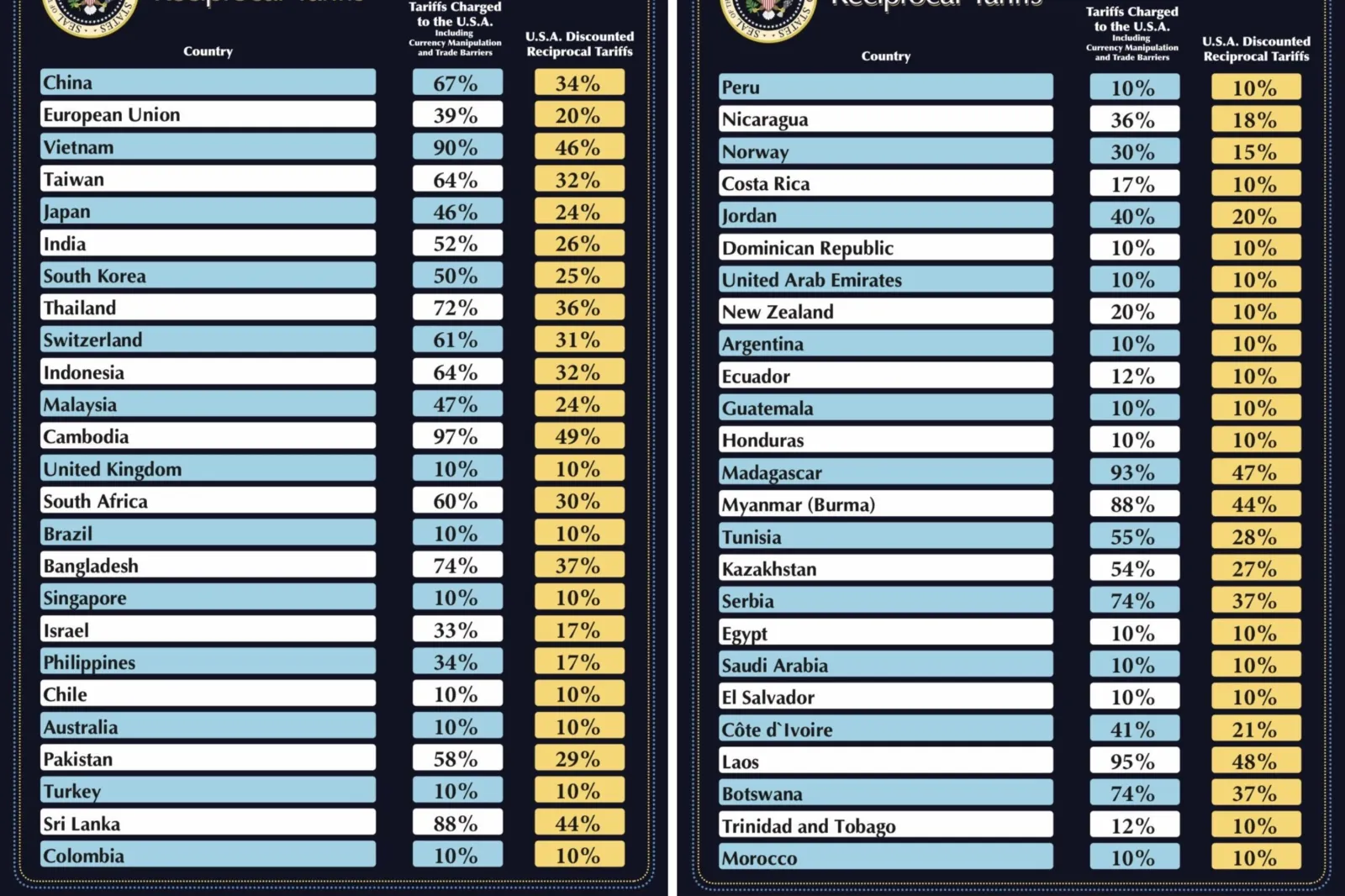
...
How the Smoot-Hawley Tariff Act Compares to Trump's Reciprocal Tariffs
Trump's proposed framework would increase this figure to more than 22 percent on average, surpassing the tariff levels introduced by Smoot-Hawley nearly a century ago.
Fortune calculated that the average duty under Trump's plan would hit 22.7 percent, compared to Smoot-Hawley's 20 percent.
But Trump's tariffs differ in strategy. Smoot-Hawley focused largely on agriculture and manufacturing; Trump's plan targets all major exporters to the U.S., with punitive rates based not just on current tariffs but also on non-tariff barriers such as quotas and regulatory standards.
The economic risks appear similar: Both policies prompted or could prompt foreign retaliation. China has already announced a 34 percent retaliatory tariff on U.S. goods.
Whether Trump's tariff strategy will bolster U.S. industry or backfire like its 1930s predecessor remains to be seen, but Americans are bracing for potential consequences.
View 0 Comments
Submit Correction
View Editorial & AI Guidelines