
10
Loading video...

By Gabe Whisnant
News Editor
0
Share
Newsweek is a Trust Project member
See more of our trusted coverage when you search.Prefer Newsweek on Googleto see more of our trusted coverage when you search.
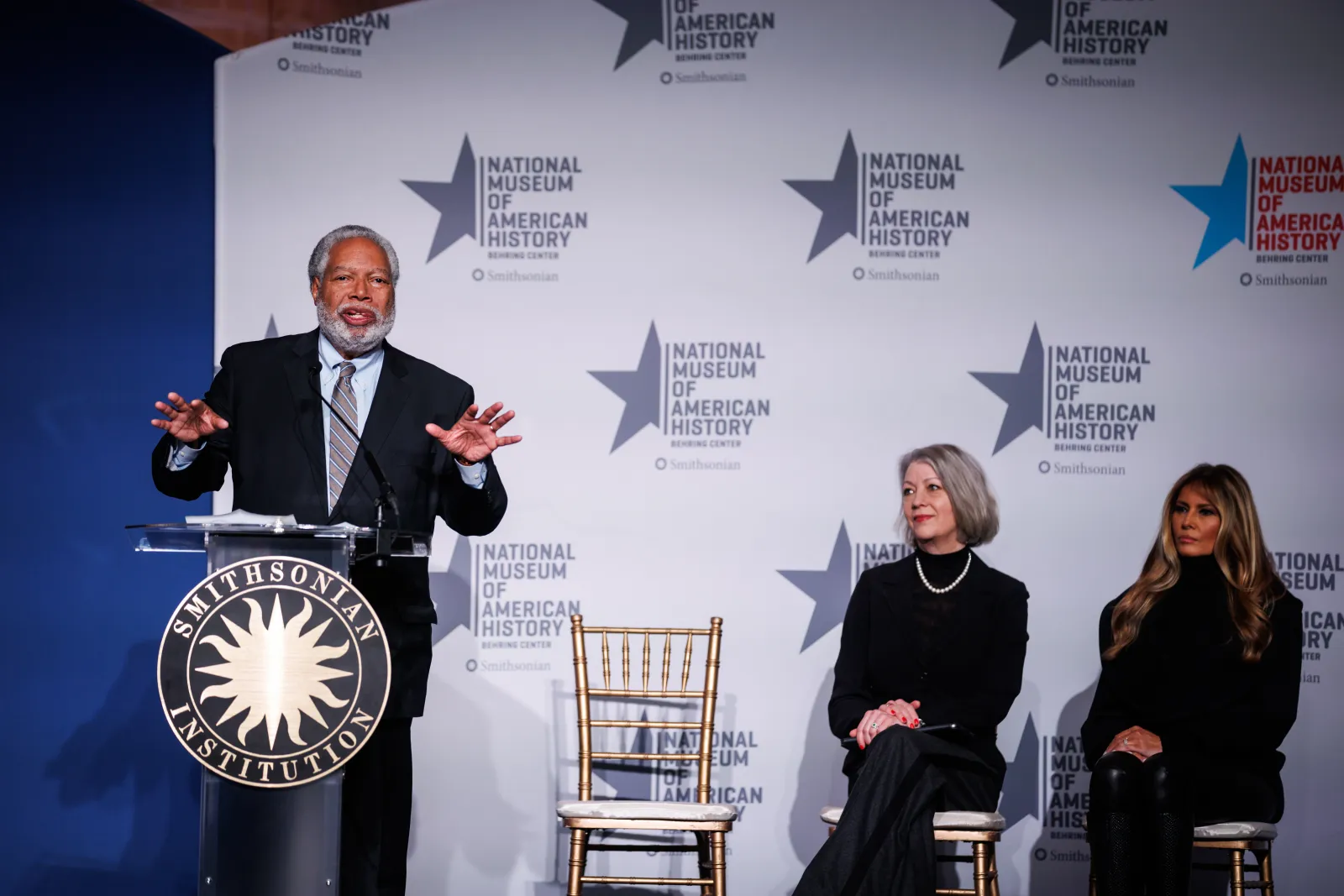
Lonnie G. Bunch III, the first Black secretary of the Smithsonian Institution and one of the most influential museum leaders in the United States, announced Tuesday that he will step down at the end of 2026 after seven years leading the nation's largest museum complex.
His departure comes after a tumultuous year in which President Donald Trump's administration intensified scrutiny of the Smithsonian, accusing some museum leaders of promoting politically biased interpretations of American history amid the nation's 250th anniversary celebrations. The Smithsonian said Bunch would leave his post at the end of the year after serving as secretary since 2019.
"I depart with very mixed emotions and heartfelt gratitude," Bunch said in a statement announcing his retirement.
Read More on News
Newsweek has reached out to the White House via email on Tuesday afternoon for comment.
Calling Bunch "a student of history" who devoted his life to telling "America's full history," Senator Catherine Cortez Masto, a Nevada Democrat and member of the Smithsonian Board of Regents, praised his more than 30 years of service to the Smithsonian. In a statement shared with Newsweek via email, Cortez Masto said she hopes the institution's next secretary will demonstrate the same commitment to arts, culture, science and history.

...
Smithsonian Chief Lonnie Bunch Announces Retirement at 73
Bunch, 73, is a historian, author and longtime museum executive who has spent more than four decades in the museum field.
Before becoming secretary of the Smithsonian in 2019, he was best known as the founding director of the National Museum of African American History and Culture in Washington, D.C. Under his leadership, the museum opened in 2016 after years of planning and fundraising and quickly became one of the Smithsonian's most visited institutions.
His appointment as secretary marked a historic milestone for the Smithsonian. Bunch became the first African American to lead the institution in its nearly 180-year history.
As secretary, he oversaw a sprawling enterprise that includes 21 museums, the National Zoo, major research centers and educational programs that draw millions of visitors annually.

...
Bunch's path to the top of the Smithsonian began in New Jersey, where he was born in Newark and raised in nearby Belleville. A trained historian, he attended Howard University before earning bachelor's, master's and doctoral degrees in American and African American history from American University.
After beginning his career at the Smithsonian's National Air and Space Museum, Bunch went on to hold leadership positions at museums in California, Chicago and Washington before becoming the founding director of the National Museum of African American History and Culture and, later, the first Black and first historian to lead the Smithsonian Institution.
Why Is Bunch Leaving Now?
The Smithsonian did not cite a specific reason for Bunch's departure beyond his decision to retire.
However, his announcement comes amid unprecedented pressure from the Trump administration.
In July, a White House report sharply criticized Smithsonian leadership, particularly officials at the National Museum of American History, accusing them of advancing ideological interpretations of the nation's past. The report said some museum leaders could not be trusted to present American history in a manner that was "inspiring, unifying, and worthy of our great republic."

...
The administration later increased pressure on the institution. In August, Trump directed officials to install signs outside the National Museum of American History informing visitors that some exhibits were allegedly inaccurate, a move that prompted pushback from museum leadership. The White House had argued that the museum failed to present history "in a way that is inspiring, unifying, and worthy of our great republic."
Anthea Hartig, director of the National Museum of American History, rejected that characterization during congressional testimony, telling lawmakers that the White House report "does not fairly or accurately characterize the full body of work at the museum."
Trump Admin Threatens to Revoke Funding for Smithsonian
The tensions stem from a broader effort by Trump to influence how federal institutions present American history as the country prepares to celebrate its 250th anniversary in 2026.
In March 2025, Trump signed an executive order titled "Restoring Truth and Sanity to American History," arguing that some cultural institutions had engaged in efforts to "rewrite" the nation's past.
The administration's efforts extended beyond museum exhibits. Trump also proposed reducing federal support for some Smithsonian programs and directed agencies to review public-facing historical content across museums, parks and other cultural sites.
The order specifically referenced the National Museum of African American History and Culture and sparked reviews of exhibitions, educational materials and public-facing content across federal cultural institutions.
Later, the White House launched a wider review of Smithsonian museums and exhibits, directing officials to evaluate whether content aligned with what the administration described as American ideals and values.
The review initially targeted eight Smithsonian museums, including the National Museum of American History, the National Museum of African American History and Culture, the National Portrait Gallery and the National Air and Space Museum. The review extended to the National Museum of Natural History, the Smithsonian American Art Museum, and the Hirshhorn Museum and Sculpture Garden.
The March executive order's reach extended beyond Smithsonian museums. It prompted changes at National Park Service sites, including the removal or revision of some exhibits and interpretive signs, as the administration sought to align federal historical presentations with its vision for the nation's 250th anniversary.
In June, the Trump administration was ordered to restore signs and exhibits at national parks covering topics such as slavery, climate change and Indigenous history, with a federal judge ruling that their removal set "a dangerous precedent of censorship and sanitization."
...
What's Next for the Smithsonian
Despite the administration's pressure campaign, the Smithsonian operates independently of the executive branch.
Museum directors report to the secretary, while overall oversight comes from the Smithsonian Board of Regents, whose members include Vice President JD Vance, Chief Justice John Roberts, members of Congress and citizen regents.
Because of that structure, Trump does not have direct authority to fire Smithsonian leaders in the same way he has reshaped other cultural institutions, including the Kennedy Center.
Roberts, who serves as the Smithsonian's chancellor, praised Bunch's tenure following the announcement.
"He has pursued excellence in the telling of our nation's story," Roberts said in a statement.
Bunch's retirement now sets up a high-stakes search for his successor, one that will unfold as the Smithsonian remains at the center of a national debate over how American history should be presented to the public.
The Associated Press contributed to this story.
Contact Newsweek editors on this story: Samantha Beech and Gray R. Thomas
View 0 Comments
Submit Correction
View Editorial & AI Guidelines