...

By Melissa Fleur Afshar
Reporter
0
Share
Newsweek is a Trust Project member
See more of our trusted coverage when you search.Prefer Newsweek on Googleto see more of our trusted coverage when you search.
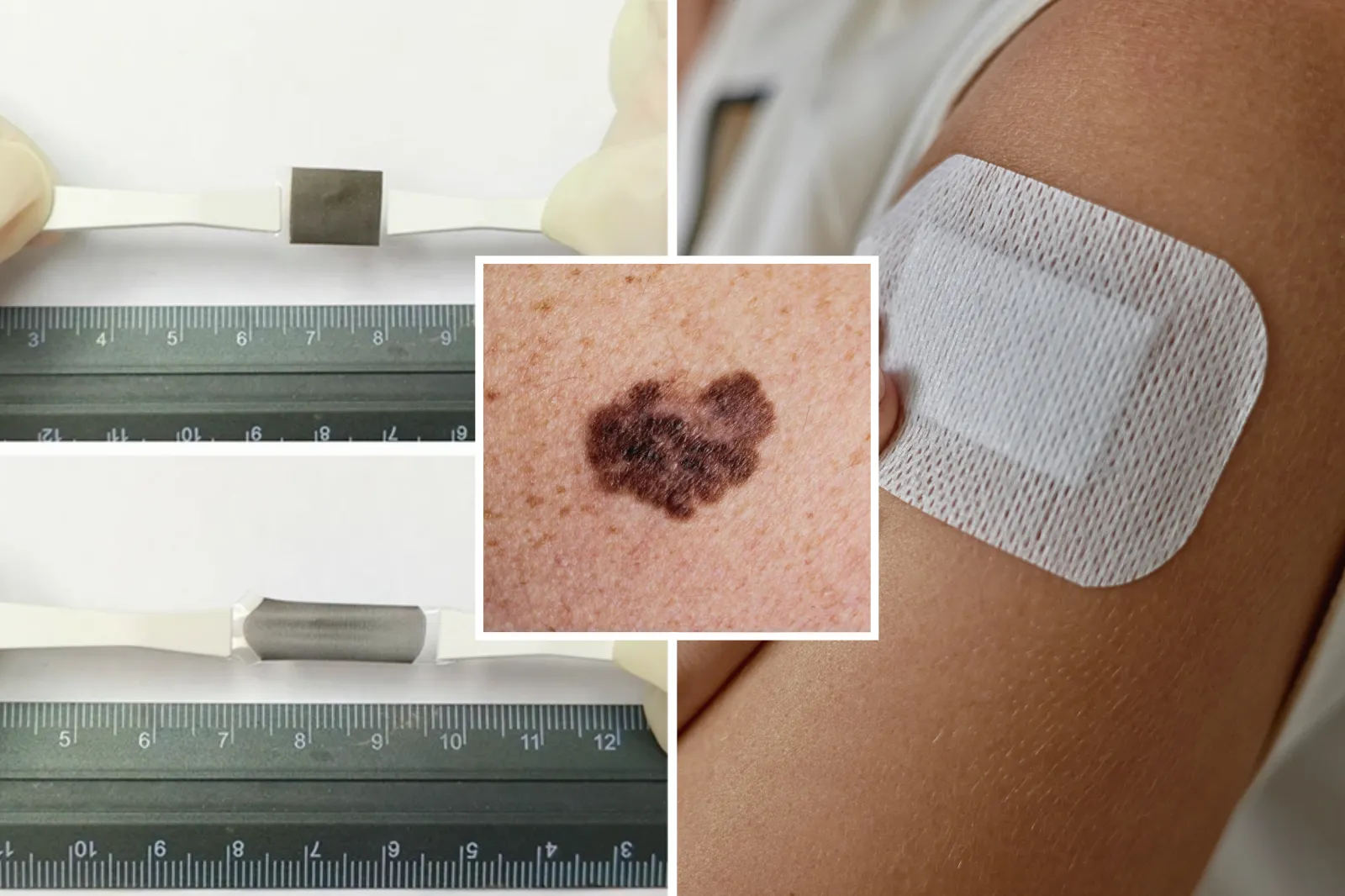
Could something like a warm plaster one day treat skin cancer? Researchers say so. Scientists have developed a way to treat melanoma using a heat‑activated patch that can kill cancer cells without the need for invasive surgery.
In early laboratory and animal tests, the patch sharply reduced melanoma tumors while leaving surrounding healthy tissue intact, raising hopes for a safer, more targeted approach to treating one of the deadliest forms of skin cancer.
The technology—described by the research team as a stretchy, bandage‑like patch—is designed to sit directly on the skin above a melanoma lesion.
Read More on Science
When gently heated, the patch releases copper ions that penetrate the underlying skin to destroy cancer cells. The approach may help prevent the cancer from spreading, or 'metastasizing.'
The researchers say that the patch was found to be effective in reducing tumors in experiments on mice and did not cause detectable harm to other tissues or organs.
...
Why Is Melanoma So Hard To Treat?
Melanoma is a serious type of skin cancer that develops in pigment‑producing cells called melanocytes. While it is less common than other forms of skin cancer, it is far more dangerous because it can spread quickly to other parts of the body.
Melanomas typically form in the outermost and middle layers of the skin, and treatment can be challenging without risking damage to the healthy tissue around the cancer cells. Surgery is often effective but can be invasive—especially for larger or hard‑to‑reach tumors.
Recent advances in nanotechnology have opened the door to more targeted cancer treatments, and the new patch breakthrough builds on that progress.
The device is made using laser‑induced graphene, a porous carbon material created by etching patterns into a surface with, as the name suggest, a laser beam. The researchers filled the tiny pores of this graphene with copper(II) oxide and embedded the material into a soft, stretchy silicone polymer to form a skin patch.
The patch is breathable, flexible and chemically inert, meaning it does not react with or irritate the skin of most wearers. The researchers hypothesized that gently heating the patch would trigger it to release copper ions. These ions can interact with the DNA of cancer cells, killing them through a process known as oxidative stress.
The team also predicted that this process would activate an immune response that could slow or prevent tumor cells from migrating to other parts of the body.
To test these ideas, the researchers first placed the patch over melanoma cells grown in the laboratory. They activated it by warming it to 108 degrees Fahrenheit using a low‑power laser. In this state, the patch released copper ions directly into the melanoma cells beneath it.
The researchers found that most of the cancer cells were killed off and that the movement of surviving cells was significantly weakened.
The team then conducted a preliminary 10‑day study in mice with melanoma, to see how the patches would fare on living beings. The patches were placed over the tumors and activated with a laser for one hour on both days one and five of the experiment.
By the end of the study, melanoma lesions were found to have reduced by a whopping 97 percent. Tissue analysis also showed that cancer cells had not spread beyond the original tumor boundaries—and, remarkably, the tests found no buildup of copper ions inside the animals’ organs or blood.
Based on these early results, the researchers hope that the patch can one day offer a safe and speedy way to treat melanoma.
Do you have a tip on a health story that Newsweek should be covering? Do you have a question about melanoma? Let us know via health@newsweek.com.
Reference
Xu, X., Cheng, L., Li, B., Wang, X., Chen, S., Li, Z., Zhou, L., Liu, T., Zhou, Y., Li, Z., Li, X., Chen, S., Gu, M., & Ye, R. (2026). A Stretchable, Transparent, Photothermally Stimulated Laser-Induced Graphene Patch for Noninvasive Skin Tumor Treatment. ACS Nano, 20(10), 8671–8690. https://doi.org/10.1021/acsnano.5c21102
View 0 Comments
Submit Correction
View Editorial & AI Guidelines