...

By Gabe Whisnant
News Editor
0
Share
Newsweek is a Trust Project member
See more of our trusted coverage when you search.Prefer Newsweek on Googleto see more of our trusted coverage when you search.
The House voted Wednesday to roll back President Donald Trump’s tariffs on Canada, marking a rare — though largely symbolic — rebuke of the White House as six Republicans joined Democrats despite opposition from GOP leaders.
The measure passed 219-211, marking one of the first significant instances of the Republican-controlled House confronting Trump over a signature policy. The resolution seeks to terminate the national emergency that Trump declared to justify imposing the tariffs.
However, undoing the policy would ultimately require Trump’s approval, which appears unlikely. The measure now heads to the Senate.
Read More on News
Trump Warns Republicans After Tariff Vote
Shortly after the vote, the president posted, "Any Republican, in the House or the Senate, that votes against TARIFFS will seriously suffer the consequences come Election time, and that includes Primaries! Our Trade Deficit has been reduced by 78%, the Dow Jones has just hit 50,000, and the S&P, 7,000, all Numbers that were considered IMPOSSIBLE just one year ago.
He continued, "In addition, TARIFFS have given us Great National Security because the mere mention of the word has Countries agreeing to our strongest wishes. TARIFFS have given us Economic and National Security, and no Republican should be responsible for destroying this privilege."
Full List of Republicans Voting Down Trump's Canada Tariffs
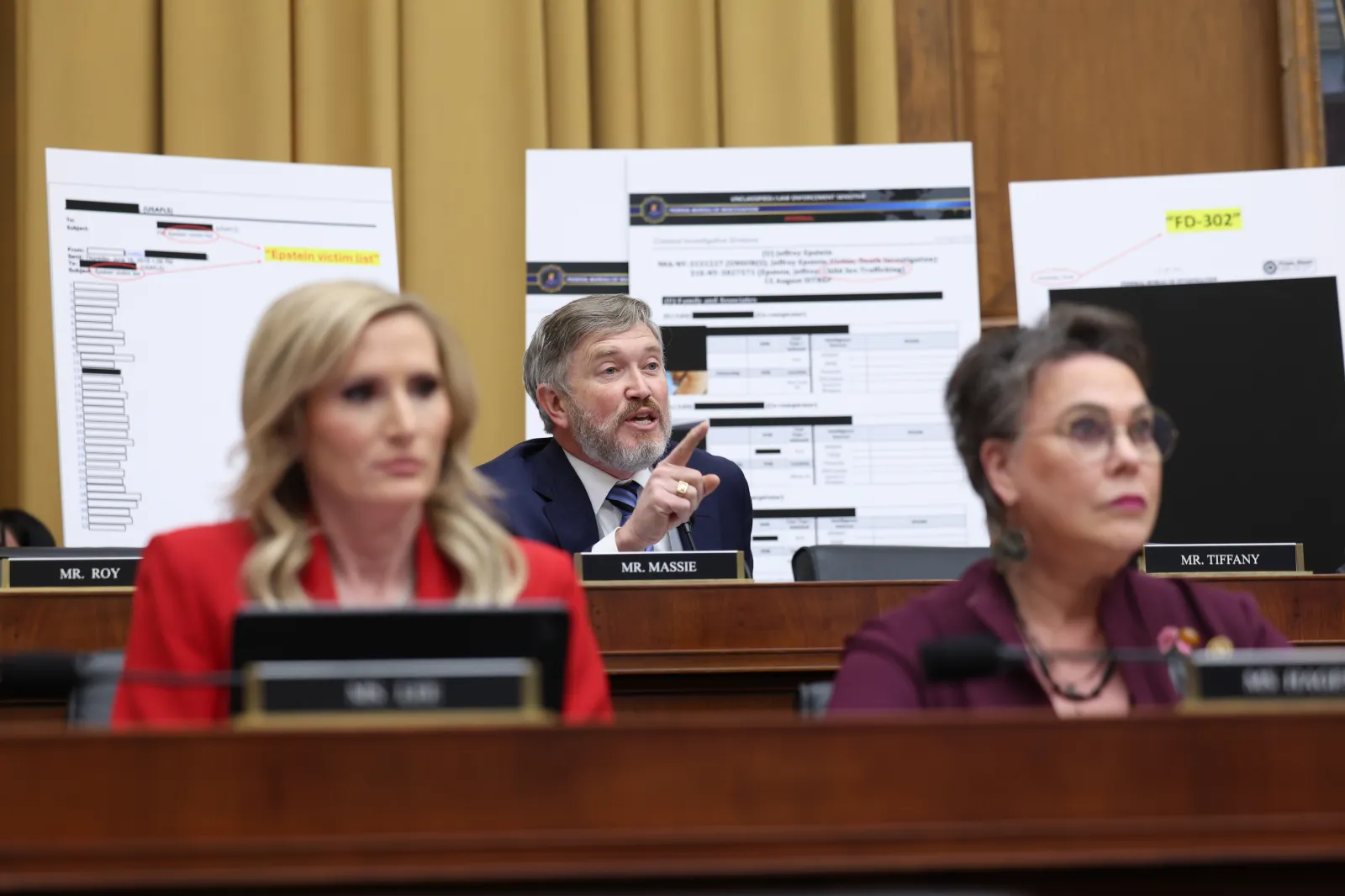
Republican Representatives Thomas Massie of Kentucky, Brian Fitzpatrick of Pennsylvania, Dan Newhouse of Washington, Kevin Kiley of California, Ashley Hurd of Texas and Don Bacon of Nebraska voted in favor of ending the tariffs.
...
House Vote Signals Unease Over Trade Policy
Trump has long argued that tariffs are a powerful tool to pressure U.S. trading partners into negotiations. But some lawmakers are facing mounting frustration from businesses and constituents grappling with rising costs and economic uncertainty tied to trade disputes.
Representative Gregory Meeks of New York, the top Democrat on the House Foreign Affairs Committee and the resolution’s sponsor, framed the vote as a question of economic relief for families.
“Today’s vote is simple,” Meeks said. “Will you vote to lower the cost of living for the American family or will you keep prices high out of loyalty to one person — Donald J. Trump?”
The vote comes as economic concerns loom large ahead of midterm elections. The Senate has already approved a separate measure expressing opposition to Trump’s tariffs on Canada and other countries, though both chambers would need to pass identical legislation and send it to the president for signature — or face a veto.
Trump in late January escalated tensions with Canada by threatening to impose a 100 percent tariff on certain imports over a proposed trade arrangement between Canada and China, intensifying strains with Prime Minister Mark Carney.
Trump posted on Truth Social Wednesday night, "Canada has taken advantage of the United States on Trade for many years. They are among the worst in the World to deal with, especially as it relates to our Northern Border. TARIFFS make a WIN for us, EASY. Republicans must keep it that way!"
GOP Leadership’s Strategy Falls Short
House Speaker Mike Johnson sought to prevent the vote, urging lawmakers to wait for a pending Supreme Court ruling in a lawsuit challenging the tariffs. He pushed through a procedural maneuver designed to block floor action.
But that effort unraveled late Tuesday as several Republicans broke ranks during a procedural vote, allowing the Democratic-backed resolution to advance.
“The president’s trade policies have been of great benefit,” Johnson, a Republican from Louisiana, said earlier, arguing lawmakers should allow more time for the executive and judicial branches to resolve the matter.
Behind closed doors and on the House floor, Johnson and GOP leaders worked to shore up support, but ultimately failed to stop the vote.
At the White House on Wednesday, Kevin Hassett, director of the National Economic Council, criticized the effort.
“We’re disappointed in what the people have done,” Hassett said. “The president will make sure they don’t repeal his tariffs.”

...
Republicans Divided Over Tariffs and Congressional Authority
The vote exposed tensions within the Republican conference over trade policy and the balance of power between Congress and the presidency.
Representative Don Bacon, a Nebraska Republican, said he was not persuaded by Johnson’s call to wait for the Supreme Court to weigh in on the legality of the tariffs.
“Why doesn’t the Congress stand on its own two feet and say that we’re an independent branch?” Bacon said. “We should defend our authorities. I hope the Supreme Court does, but if we don’t do it, shame on us.”
Bacon, who is retiring rather than seeking reelection, has argued that tariffs are poor economic policy and harmful to businesses and consumers.
Other Republicans were more cautious. Representative Keith Self of Texas said lawmakers ultimately need to support the president. Representative Darrell Issa of California said he does not want to limit Trump’s leverage on trade and was prepared to back the tariffs “at this time.”
While largely symbolic without presidential approval, the House vote underscores growing discomfort among some Republicans over the economic and political ramifications of Trump’s tariff strategy — and highlights the challenges party leaders face in maintaining unity as trade tensions continue.
Debate Over Trump’s National Emergency Authority
The resolution would end the national emergency that Trump declared last year as the legal basis for imposing tariffs outside the terms of the U.S.-Mexico-Canada Agreement.
The administration has argued that illicit drug flows from Canada constitute an unusual and extraordinary threat to national security, justifying the emergency declaration and the tariffs.
Representative Brian Mast, a Republican from Florida and chairman of the House Foreign Affairs Committee, defended the policy and said fentanyl trafficking remains a serious crisis.
“Let’s be clear again about what this resolution is and what it’s not,” Mast said. “This is Democrats trying to ignore that there is a fentanyl crisis.”
Experts say most fentanyl entering the United States is produced by Mexican cartels and smuggled across the southern border, primarily through California and Arizona. Smaller quantities are produced in Canada and trafficked into the U.S.
This article includes reporting by the Associated Press.
Updates: 2/11/26, 7:16 p.m. ET: This article was updated with new information and remarks.
In a polarized era, the center is dismissed as bland. At Newsweek, ours is different: The Courageous Center—it's not "both sides," it's sharp, challenging and alive with ideas. We follow facts, not factions. If that sounds like the kind of journalism you want to see thrive, we need you.
When you become a Newsweek Member, you support a mission to keep the center strong and vibrant. Members enjoy: Ad-free browsing, exclusive content and editor conversations. Help keep the center courageous. Join today.


View 0 Comments
Submit Correction
View Editorial & AI Guidelines