...

By Ryan Chan
China News Reporter
0
Share
Newsweek is a Trust Project member
See more of our trusted coverage when you search.Prefer Newsweek on Googleto see more of our trusted coverage when you search.
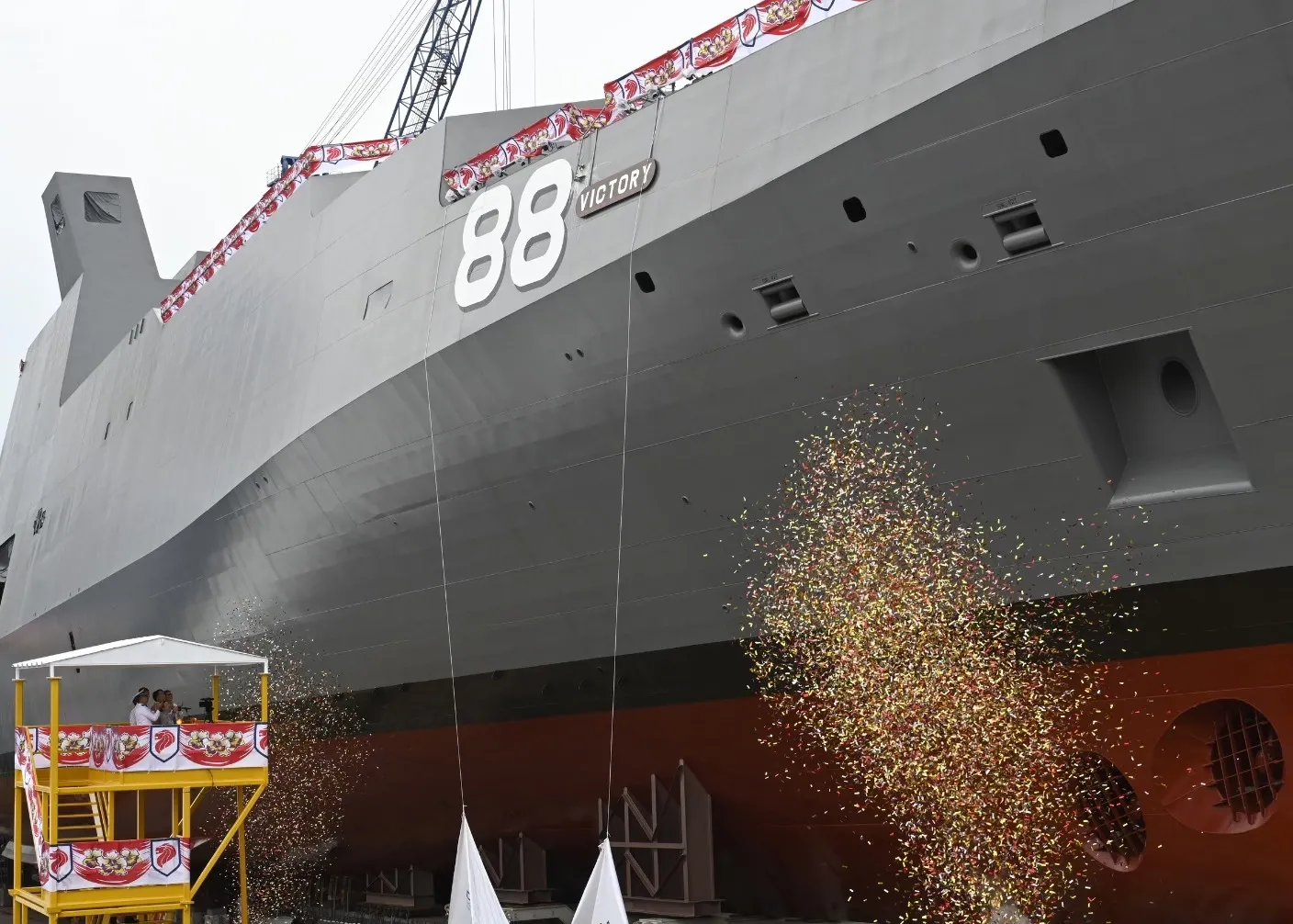
Singapore, a strategic partner of the United States in the South China Sea, launched the largest and most complex warship it has ever built, a vessel capable of serving as a mothership for drones that help safeguard the city-state's sea lines of communication.
The Southeast Asian island nation will continue to work with "like-minded partners" to ensure the sea lines of communication in this critical part of the world remain open and accessible to all, Minister for Defense Chan Chun Sing said at a ceremony on Tuesday.
Why It Matters
Singapore maintains what it describes as a longstanding, reliable and steadfast strategic partner status with the United States, as the two countries have close cooperation in defense and security, including the island nation's military training units stationed in U.S. territory.
Read More on World
Located at the southern end of the Strait of Malacca, a key shipping route connecting the Indian Ocean to the South China Sea, Singapore is an international maritime and shipping hub that considers maintaining open sea lines of communication paramount.
Sea lines of communication, or SLOCs, are the principal maritime routes between ports used for trade, military or other purposes. In the South China Sea, where China and its neighbors assert overlapping sovereignty claims, SLOCs are vulnerable to conflict.
What To Know
Singapore's first Victory-class Multi-Role Combat Vessel (MRCV), named Victory, was launched at ST Engineering's Benoi Shipyard. It is 492 feet long, has a displacement of 8,800 tons, and is capable of operating for over 8,000 miles or 21 days.
...
The major feature of this class of vessels is that it combines the combat capabilities of a modern frigate with the capacity to carry and control unmanned surface, aerial and underwater vehicles, which expand the mothership's surveillance and operational reach.
Compared with other ships of similar size and capability, the Victory-class is designed with advanced automation to be operated safely and effectively with a smaller crew. It is also equipped with advanced sensors and weapons for high-end warfare operations.
In his speech at the ship's launching ceremony, Chan stated that Singapore's strategic lines of communication have extended further, and the naval force therefore needs new capabilities "to make sure that no one with ill intent can disrupt our day-to-day lives."
"It is critical to our lives and our livelihoods, and also to the global economy because of the critical geostrategic location that Singapore is in," the minister said, adding that the navy, unlike in the past, is no longer limited to defending Singapore's near shores.
Singapore is vulnerable if its sea lines of communication are hindered, as 90 percent of its food is imported and most arrives by sea. It also plays a vital role in the movement of raw materials and cargo, handling one-seventh of the world's transshipment containers.
The Victory will continue its outfitting, systems integration and trials while its crew begins training to operate it. A total of six ships of the class are planned to replace the existing Victory-class missile corvettes, and all will be delivered from 2028 onward.
What People Are Saying
Singapore's Minister for Defense Chan Chun Sing said at the Victory's launching ceremony on Tuesday: "Going forward, we will face an even tougher global security environment. But what has not changed is the need for us to defend and secure our strategic lines of communications, whether in the air, at sea, or in cyberspace."
Singapore's Ministry of Defense wrote in a fact sheet on Tuesday: "The [Multi-Role Combat Vessels], alongside the [Republic of Singapore Navy]'s existing assets, will enhance Singapore's ability to safeguard our [sea lines of communication], and contribute to regional security architecture and international efforts to ensure that our access to the sea remains unimpeded."
What Happens Next
It remains to be seen whether Singapore will place additional orders of weapons from the U.S., as it recently announced the acquisition of four Boeing P-8 maritime patrol aircraft to modernize its capabilities in maintaining "maritime situation awareness."
View 0 Comments
Submit Correction
View Editorial & AI Guidelines