...

By Hollie Silverman
News Editor
0
Share
Newsweek is a Trust Project member
See more of our trusted coverage when you search.Prefer Newsweek on Googleto see more of our trusted coverage when you search.
A series of earthquakes shook California over that last 24 hours, ranging in strength from 2.5 to 2.7 in magnitude, according to the United States Geological Survey (USGS).
No damage or injuries have been reported, and no tsunami warnings have been issued as a result of the seismic activity.
The Context
According to the USGS, moderate quakes can be a reminder and a warning, prompting residents to review emergency plans as experts caution that California remains overdue for a major earthquake.
Read More on News
What To Know
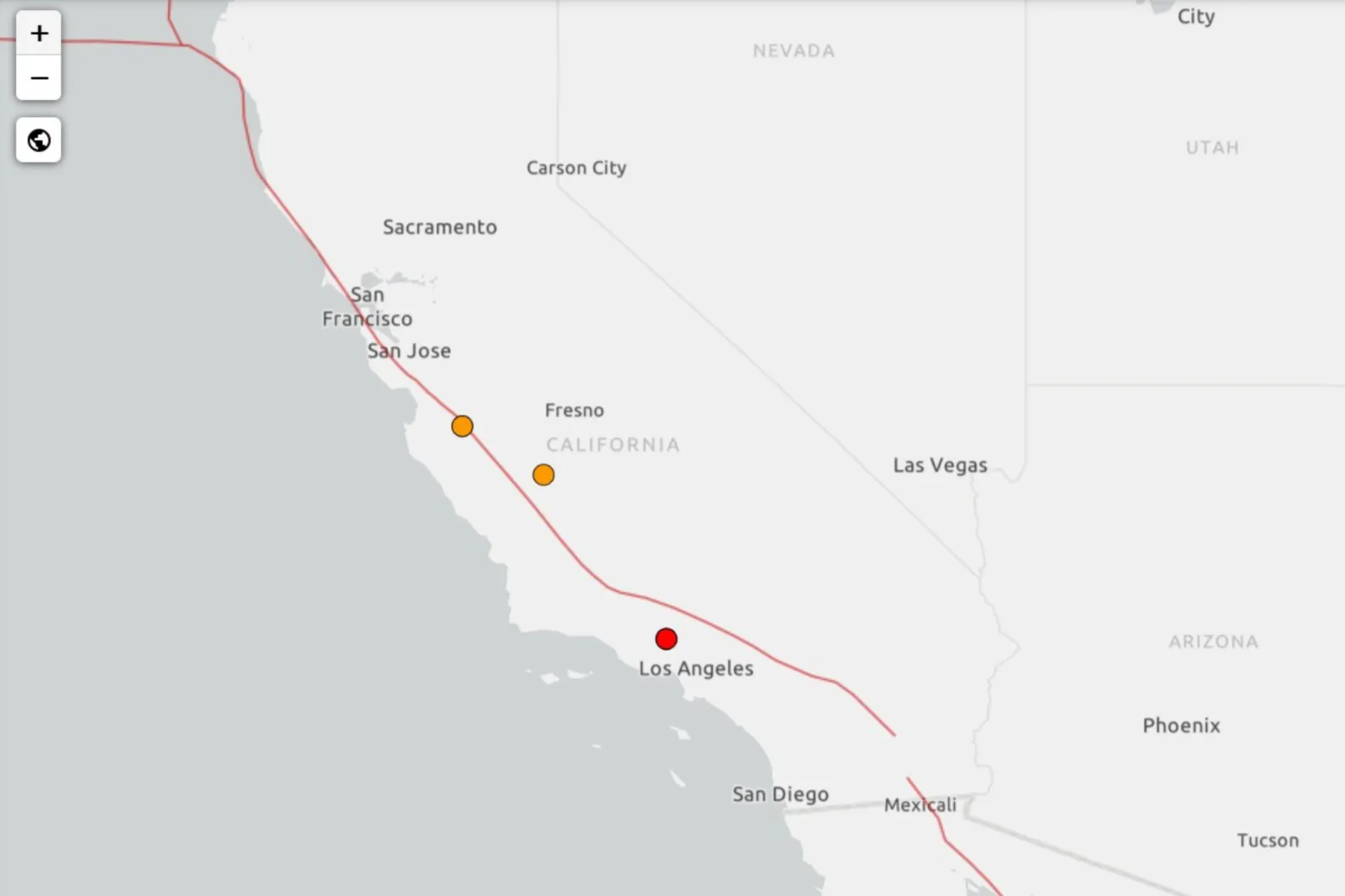
The first earthquake struck about 5 miles northwest of Pinnacles, California, Friday, at a shallow depth of four miles. Hours later, about 6 miles from Avenal, California, another quake hit at shallow depth.
On Saturday, two more earthquakes struck back-to-back outside Santa Clarita, California, at strength of 2.5 and 2.7 magnitude, both at shallow depths, meaning they can be felt more widely because they are closer to the surface.
The quakes come as California continues to deal with the effects of an atmospheric river that has caused flash flooding, landslides, rescues, as well as road closures and evacuations.
The Southern California Earthquake Data Center (SCEDC) recorded dozens of seismic events between December 20 and Saturday.
Magnitudes ranged from below 1.0 to at least 4.0, with the most significant quakes including a magnitude 4.0 near Battle Mountain, Nevada, a 3.9 near San Ramon, California, and a 3.5 near Ridgemark, California.
A cluster of quakes struck last week near Santa Rosa by The Geysers geothermal field and in the Bay Area's San Ramon suburb, as confirmed by both the SCEDC and USGS data. Many earthquakes were shallow, making them widely felt but causing no major reported damage or casualties.
...
Understanding Earthquake Swarms
An earthquake swarm is a sequence of small quakes that happen over days, weeks, or months, often without a single dominant main shock. Unlike aftershock sequences, swarms can occur with quakes of similar size and may be caused by fluids interacting with fault lines or complex fault slip patterns.
Regions such as San Ramon have a history of such swarms—with at least six recorded since 1970. Experts believe the recent activity is linked to "a lot of fluid-filled cracks, thanks to very complex fault geometry," USGS research geophysicist Sarah Minson told SFGate last month.
Why Is California Prone to Earthquakes?
California sits atop several major fault systems, most notably the San Andreas Fault, which stretches 750 miles and is responsible for some of the largest quakes in U.S. history. Other significant faults include the Rodgers Creek, Calaveras, and Hayward faults. Seismic hazards are intensified in densely populated areas, as more than 70 percent of Californians live within 30 miles of a major fault.
What Causes an Earthquake?
Earthquakes are triggered by the sudden release of energy along fault lines, causing the ground to shake as seismic waves radiate from the epicenter.
The San Andreas and related faults are strike-slip faults, where tectonic plates slide past each other horizontally, sometimes producing powerful, destructive shocks. Human activity—such as geothermal energy production at The Geysers—may also induce small, local quakes, but major seismic hazards remain linked to natural fault movement.
What People Are Saying
USGS seismologist Annemarie Baltay told the Los Angeles Times this week: “There’s gonna be a big earthquake in the Bay Area. We just can’t say exactly when and where. So, you should be prepared for that.”
Research geophysicist with USGS, Sarah Minson, recently told SFGate: “We think that this place [San Ramon] keeps having earthquake swarms due to a lot of fluid-filled cracks, thanks to very complex fault geometry—unlike, say, the San Andreas Fault, which is this nice clean edge.”
What Happens Next
Seismic monitoring agencies, including the USGS and California Institute of Technology, continue tracking earthquake activity across the state.
Following a moderate quake, there remains a small but measurable risk of a larger event in the immediate days after—estimated at about 5 percent in the subsequent 72 hours by USGS.
Local officials encourage residents to remain prepared, review earthquake safety guidelines, and expect additional aftershocks as part of normal seismic activity.
View 0 Comments
Submit Correction
View Editorial & AI Guidelines