...

By Rachael O'Connor
Reporter
0
Share
Newsweek is a Trust Project member
See more of our trusted coverage when you search.Prefer Newsweek on Googleto see more of our trusted coverage when you search.
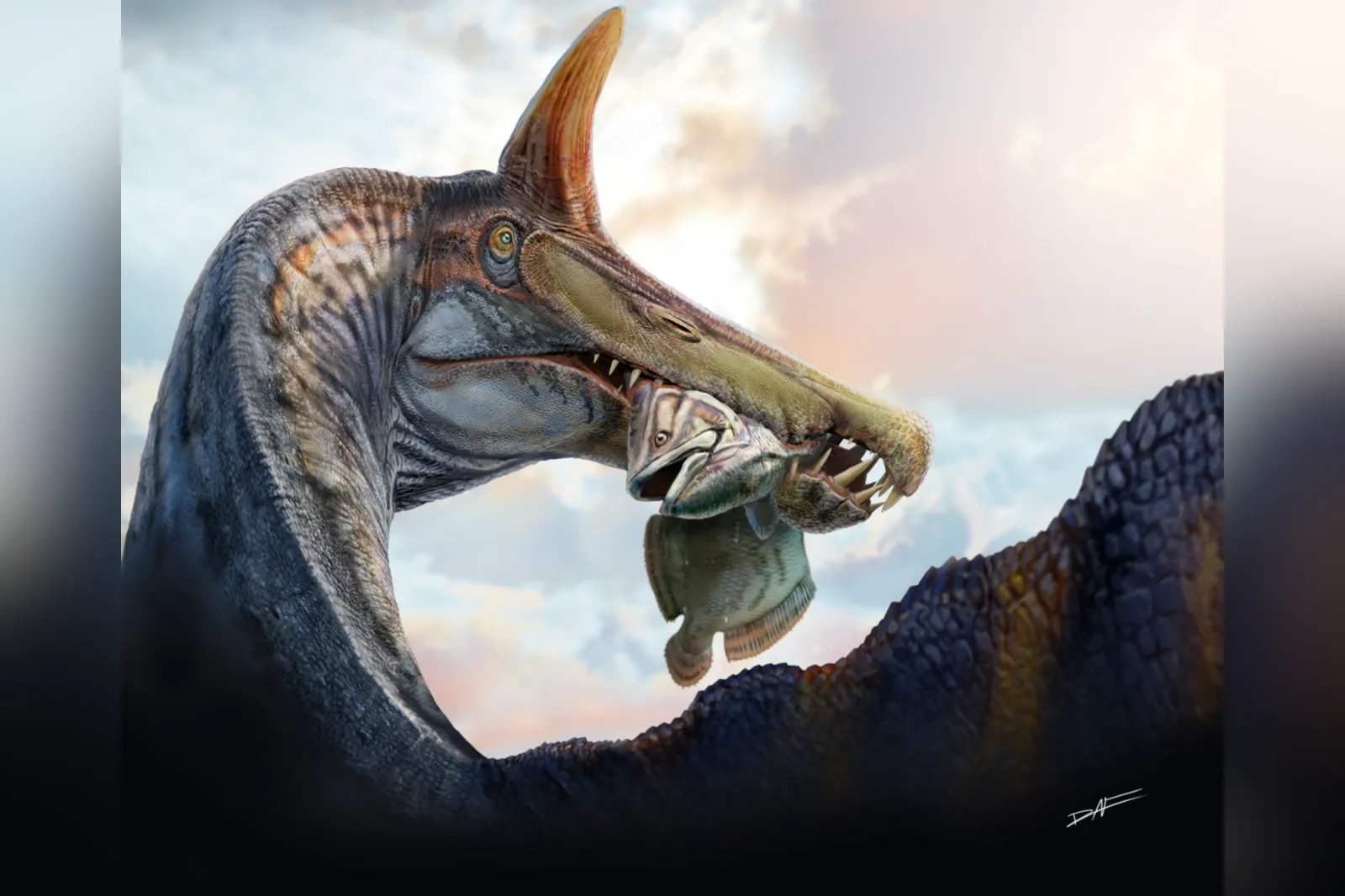
A scimitar-crested "hell-heron" of a new dinosaur species left paleontologists amazed after it was unearthed in the central Sahara.
The fossilised remains of the new Spinosaurus were first discovered in 2019, and left researchers baffled at first; it was unexpected to find such a species seperated from the ocean at the time at which it lived, some 95 million years ago.
Before this find, spinosaurid bones and teeth had only been found along former shorelines, with experts hypothesizing that the fish-eating theropods may have been a fully aquatic species.
Read More on Science
However, the new sub-species—named S. mirabilis, named after the Latin for "astonishing" in reference to its oversized, scimitar-shaped crest, which is some 12 inches long—was found in Niger, up to 600 miles away from the ancient coastline.
It was only when researchers returned to the dig site in 2022, this time with a larger team, and found further crests from the then unidentified species that they realized how significant the find was.
S. mirabilis is believed to have had a crest sheathed in keratin, likely brightly colored and curving toward the sky, in the shape of a blade. Its skull had interlock rows of upper and lower teeth to help catch fish.
Paul Sereno of the University of Chicago, who led the 20-person team, said in a statement that the discovery was "so sudden and amazing, it was really emotional for our team."
"I’ll forever cherish the moment in camp when we crowded around a laptop to look at the new species for the first time, after one member of our team generated 3D digital models of the bones we found to assemble the skull—on solar power in the middle of the Sahara. That’s when the significance of the discovery really registered.”
...
Now, with evidence that the species lived hundreds of miles from water, the researchers suggest that S. mirabilis may have "had no problem wading on its sturdy legs into two meters of water but probably spent most of its time stalking shallower traps for the many large fish of the day."
The discovery came after a local man led the team into the Sahara, where he claimed to have seen huge fossil bones—and they almost immediately discovered the teeth and jaw bones of the new Spinosaurus.
After the initial discovery, Sereno's team at his South Side Fossil Lab in Washington Park scanned the teeth and bones in order to assemble a digital skull rendering, followed by an artist creating a reconstruction of the new species.
The team's discovery has now been featured on the cover of Science, and the team has prepared a replica of the Spinosaurus mirabilis skull to feature at the Dinosaur Expedition exhibit at the Chicago Children's Museum.
Sereno said: "“Letting kids feel the excitement of new discoveries—that’s key to ensuring the next generation of scientists who will discover many more things about our precious planet worth preserving."
Do you have a tip on a science story that Newsweek should be covering? Do you have a question about paleontology? Let us know via science@newsweek.com.
Reference
Sereno, P. C., Vidal, D., Myhrvold, N. P., Johnson-Ransom, E., Ciudad Real, M., Baumgart, S. L., Sánchez Fontela, N., Green, T. L., Saitta, E. T., Adamou, B., Bop, L. L., Keillor, T. M., Fitzgerald, E. C., Dutheil, D. B., Laroche, R. A. S., Demers-Potvin, A. V., Simarro, Á., Gascó-Lluna, F., Lázaro, A., … Ramezani, J. (2026). Scimitar-crested Spinosaurus species from the Sahara caps stepwise spinosaurid radiation. Science, 391(6787). https://doi.org/10.1126/science.adx5486
View 0 Comments
Submit Correction
View Editorial & AI Guidelines