...

By Ian Randall
Deputy Science Editor
0
Share
Newsweek is a Trust Project member
See more of our trusted coverage when you search.Prefer Newsweek on Googleto see more of our trusted coverage when you search.
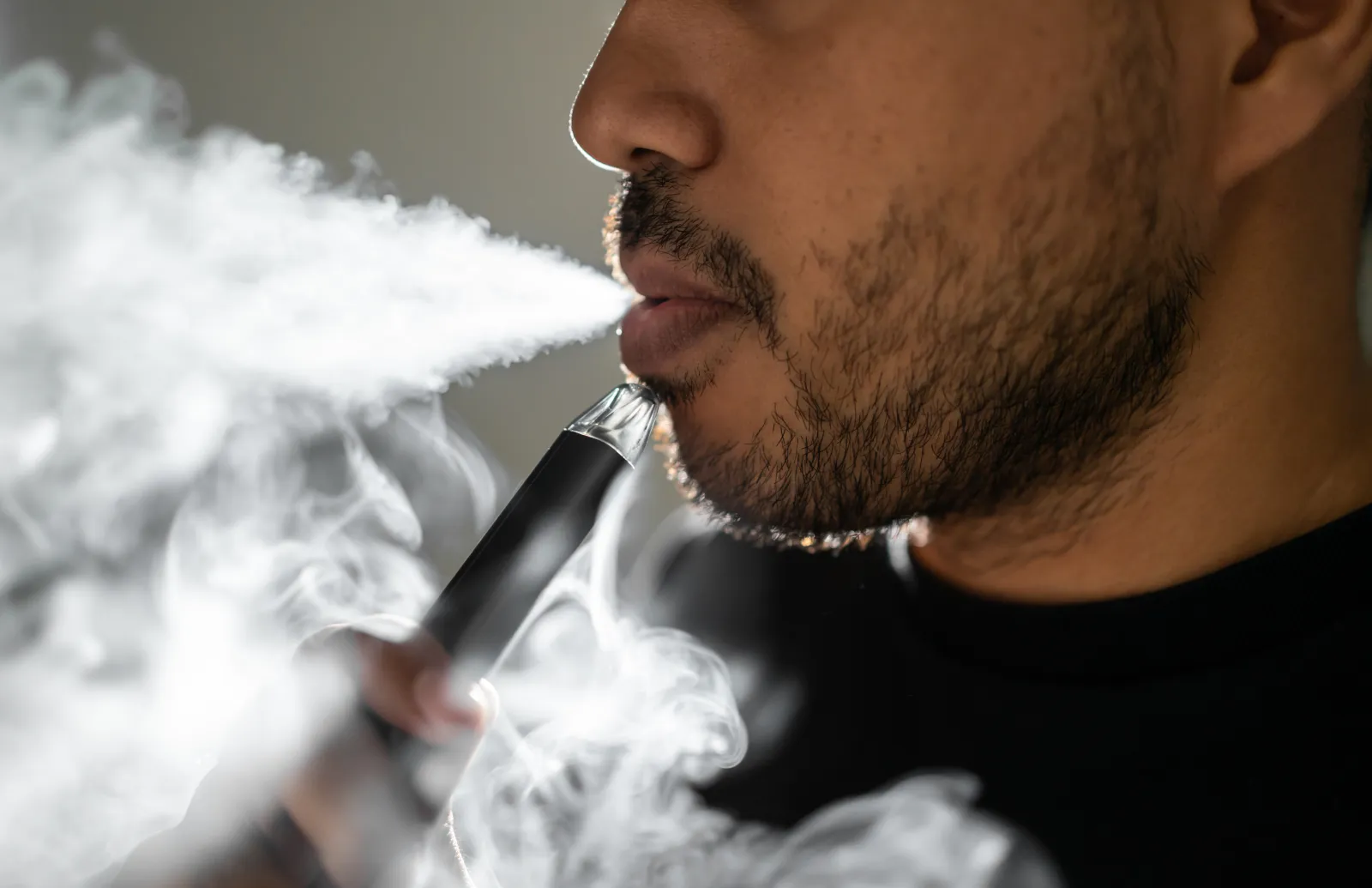
Breathing in lingering, secondhand e-cigarette vapors has the potential to damage lung tissues.
This is the warning of a new study by researchers from the University of California Riverside, who found that aged vape aerosols contain fine particles bearing metals and highly reactive compounds that can combine to produce harmful radical particles.
"Our study reveals that the chemical cocktail of metal nanoparticles and reactive peroxides in aged e-cigarette aerosols creates a unique profile of respiratory health risks," said paper author and environmental scientist Ying-Hsuan Lin in a statement.
Read More on Health
The finding, Lin added, highlights "that secondhand vapor is something bystanders shouldn’t have to breathe."
...
Previous studies have found that the vapors released by e-cigarettes contain volatile organic compounds that react with indoor ozone to create new compounds, such as peroxides.
At the same time, vape liquids and their resulting plumes often contain heavy metals and other metals that have the potential to react with peroxides to produce harmful compounds such as free radicals.
To better assess how secondhand vape plumes might impact health, Lin and colleagues set out to explore how indoor ozone impacts the metal and peroxide composition of the vapor.
For their experiments, the researchers manufactured a basic vape liquid that contained no nicotine and one floral-smelling flavoring ingredient.
This liquid was then loaded into two different vape pens and puffed into an enclosed chamber with ozone-bearing air.
After leaving the aerosols to age for 90 minutes, the team collected samples from the chamber to analyze.
The researchers’ analysis revealed that aerosol particles released from both pens contained iron, aluminum and zinc ions, as well as trace amounts of heavy metals—including arsenic, tin and lead.
Both sets of aged aerosols were found to contain similar levels of peroxides. However, the team noted that smaller, "ultrafine" particles contained higher percentages of metals and peroxide compounds than larger aerosols.

...
The team also wanted to assess what happens when these aged vape aerosols react in wet environments—such as might be found inside a lung. To do this, the researchers placed samples in a water-based solution.
Analysis confirmed that the aged aerosols went on to create radicals, with ultrafine particles notably producing around 100 times more radicals relative to their weight than larger-grade particles.
Given how ultrafine particles are capable of penetrating deep into the lungs and to enter the sensitive, fluid lined alveoli—the tiny sacs where the lungs exchange oxygen for carbon dioxide in the blood—such vape particles have the potential to damage lung tissues, the researchers said.
The team added that individuals with preexisting lung conditions such as chronic obstructive pulmonary disease or asthma may be particularly vulnerable.
The researchers said that the present survey was undertaken under controlled, laboratory conditions and with a simplified vape fluid.
Accordingly, the team added, more research is needed both in real-world indoor settings and using commercially available e-cigarette liquids.
Do you have a tip on a health story that Newsweek should be covering? Do you have a question about e-cigarettes? Let us know via health@newsweek.com.
Reference
Woo, W., Tian, L., Diamond, C., Lum, M., Lyons, T., & Lin, Y.-H. (2026). Interplay of Metals and Organics in E-Cigarette Aerosols Enhances the Production of Reactive Oxygen Species within Ultrafine Particles: Implications for Passive Vaping Exposures. Environmental Science & Technology, 60(1), 949—958. https://doi.org/10.1021/acs.est.5c11870
View 0 Comments
Submit Correction
View Editorial & AI Guidelines