Petr Znachor/BC CAS

By Soo Kim
Reporter
0
Share
Newsweek is a Trust Project member
See more of our trusted coverage when you search.Prefer Newsweek on Googleto see more of our trusted coverage when you search.
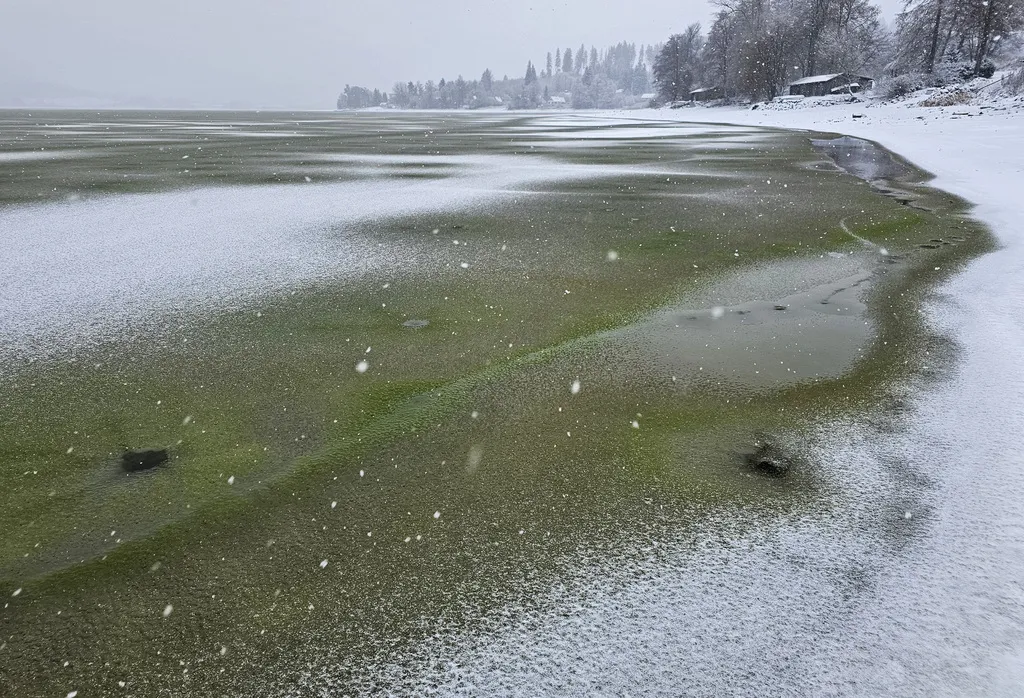
Scientists have found large amounts of “green ice” on Lake Lipno in the South Bohemian region of the Czech Republic.
The unusual natural phenomenon was captured in December by hydrobiologists from the Biology Centre of the Czech Academy of Sciences, who discovered that a large accumulation of cyanobacteria—also known as blue-green algae—in the water caused the ice to turn green.
With very few scientific records of this rare phenomenon worldwide, the green ice on Lake Lipno is among the best-documented cases of blue-green algae occurring under ice.
Read More on Science
The latest find shows that "even common cyanobacterial species can exhibit atypical behavior under certain conditions," the researchers said in a statement.
...
“Green ice on Lake Lipno fits into the long-term changes we observe here in connection with eutrophication and ongoing climate change. It suggests that we may witness similar surprises more frequently in the future,” hydrobiologist Petr Znachor from the Biology Centre said in a statement.
According to a microscopic analysis of water samples collected by the scientists, the organism responsible for the latest event was the common cyanobacterium Woronichinia naegeliana, which also dominates Lake Lipno during the summer and fall.

...
An excess of nutrients in the water, especially phosphorus, which mostly results from human activities, is the primary driver of cyanobacterial growth.
Cyanobacterial blooms gradually disappear with the arrival of autumn and tend to vanish by the end of September on most Czech reservoirs.
However, Lake Lipno is an exception, with long-term data showing that cyanobacteria often dominate the lake until November and can occur in smaller amounts during December and January, the researchers note.

...
At the end of last year, cyanobacterial biomass remained near the surface of the water for an unusually long period, from autumn until the reservoir froze over, most likely due to a mix of calm weather, weak winds, and a long duration of sunshine.
The accumulated cyanobacteria formed striking green patches beneath the thin ice cover, which were visible both from the shore and in aerial photographs.
The green ice was most pronounced during a temporary warming around Christmas Eve. After it refroze, there was a formation of “cyanobacterial eyes," which are areas of clear ice above dark cyanobacterial aggregates caused by differences in the absorption of solar radiation. This phenomenon continued until the end of the year and likely ended after heavy snowfall reduced light penetration beneath the ice, according to the institute.
The latest event confirms that Lake Lipno has been burdened by an excess of nutrients in the water, known as eutrophication, for a long while and is impacted by ongoing climate warming, “with ecological changes occurring even outside the traditional summer season,” the researchers said.
Do you have a tip on a science story that Newsweek should be covering? Do you have a question about cyanobacteria? Let us know via science@newsweek.com.
View 0 Comments
Submit Correction
View Editorial & AI Guidelines