...

By Hannah Millington
Health Reporter
0
Share
Newsweek is a Trust Project member
See more of our trusted coverage when you search.Prefer Newsweek on Googleto see more of our trusted coverage when you search.
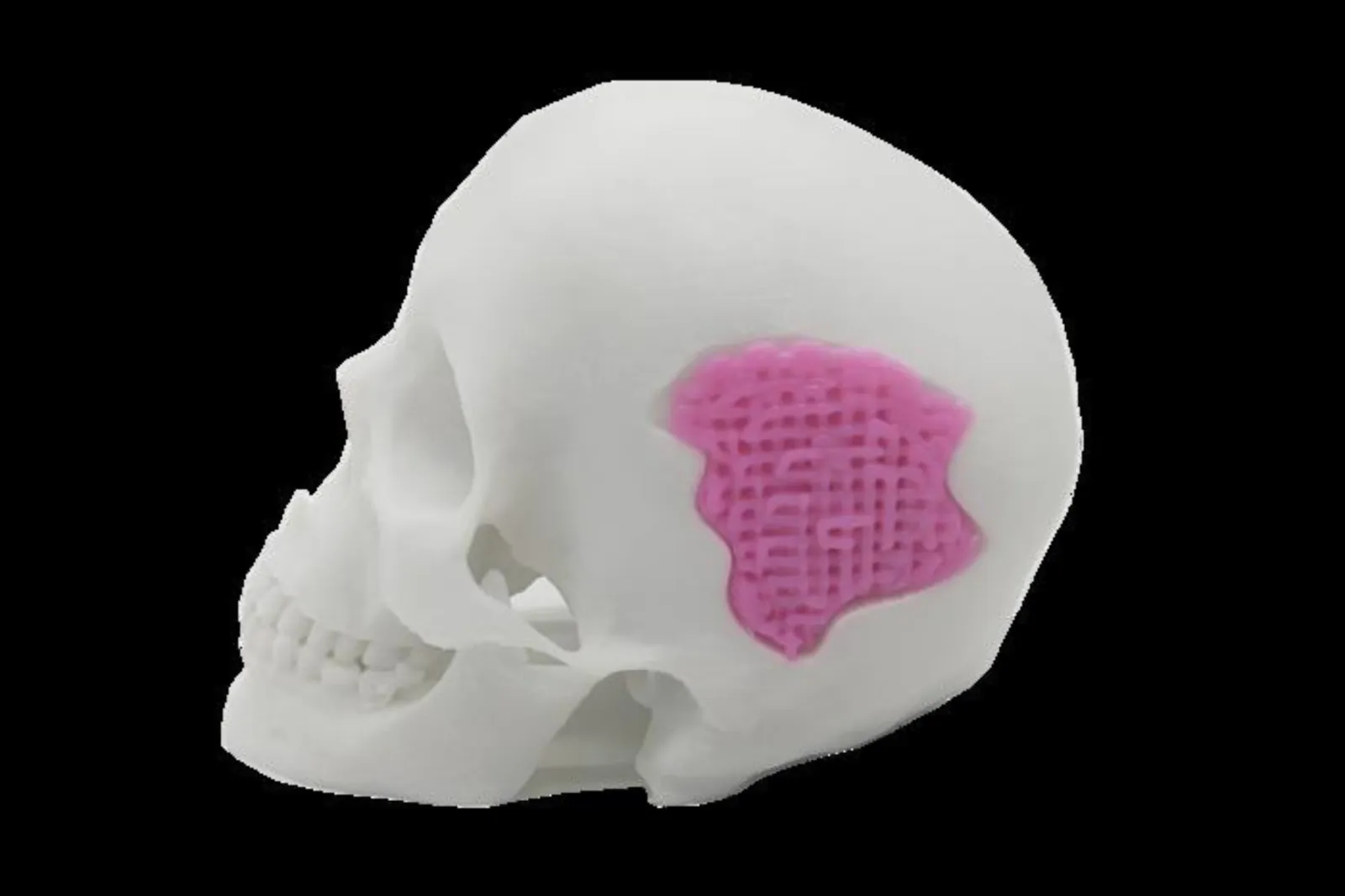
A 3D printable bio-active glass could be used to repair bone damage and help them grow back, a study suggests.
The newly developed bio-glass—made with “green” and "cost-efficient" methods—was found to be an effective bone replacement material in rabbits, according to peer-reviewed research conducted in China.
Findings reveal it sustained bone cell growth better than regular glass and an already commercially available and widely used bone substitute made of animal bone grafts.
Read More on Health
Bone implants have historically been made of metal and donor bone. This study adds to mounting research on the benefits of 3D-printed materials.
"Many orthopedic surgeries request customized bone graft, such as bones of our face and head," study author professor Huanan Wang of the Dalian University of Technology told Newsweek, explaining what the bio-glass could be used for.
...
The main ingredient found in glass—silica, which comes from sand—means it can exist in liquid form and be 3D printed into a variety of shapes, including the exact structure of a missing section of bone.
However, the study authors wrote in the paper: “3D printing of ceramics or glass typically requires sacrificial organic plasticizers and high-temperature sintering, which is time- and cost-consuming, potentially cytotoxic [damaging to living cells] and may compromise the bioactivity and functionality of the inorganic components [ceramic/glass].”
With this in mind, the researchers set out to combat the need for toxic chemicals or glass to be fused at temperatures (typically) higher than 2,000 degrees Fahrenheit. To do this, they combined oppositely charged silica particles and calcium and phosphate ions to form a printable, bio-active glass gel.
After being shaped with a 3D printer, the glass was hardened into its final shape in a furnace at a “relatively cool” 1,300 F—and all through an additive-free process.
The team then tested the new bio-glass against a 3D-printed plain silica glass gel and an available dental bone substitute by repairing skull damage in living rabbits.
Insights gained from cross-scale analysis of structural and mechanical features allowed them to develop robust “colloidal gels without compromising the self-healing ability.” Colloidal gels are soft materials typically found in cosmetics and building materials.
“We further demonstrated the excellent printability, shape-fidelity and reprocessability of the inorganic gels,” the authors added.
Although the existing commercial product was found to grow bone faster, the bio-glass sustained growth longer, according to the team. After eight weeks, most bone cells present had grown on the bio-glass structure.
The plain glass, however, had barely any bone cell growth.
“This ‘green’ inorganic 3D-printing strategy enabled cost-efficient and bioactivity-preserved fabrication of bioglass-based bone substitutes, which led to improved in vivo osteogenesis [bone formation] and osteointegrity [the implant being fused with bone],” the authors wrote.
They said the work provides an avenue for customized fabrication of functional inorganic 3D structures to be used in biomedical, machinery, energy and chemical industries.
"More efforts are needed next to carry out further testing to make our fabrication technique more robust and more efficient. Then we need to test our printed bio-glass bone substitute for larger animal bone repair tests before further applications in the human body," said Wang.
"Bioglass has been already used in clinics for bone substitution, but 3D-printed bioglass has not reaching clinical trial yet. But our study here showed the remarkable outcomings using this green 3D printing strategy and we believe this technique has a very prospective future for further translation into clinics."
Do you have a tip on a health story that Newsweek should be covering? Do you have a question about broken bone repair? Let us know via health@newsweek.com.
Update 09/26/25, 6:10 a.m. ET: This article was updated to include comment from study author professor Huanan Wang.
References
Dou, Z., Li, D., Chen, K., Li, X., Ying, Q., Zhang, Y., Zheng, H., Fan, D., Jian, G., An, C., Zhang, L., Zhang, Y., Liao, J., Ren, C., Zhao, Y., Xiao, J., Chen, T., & Wang, H. (2025). Rational Design of Purely Inorganic Self-Healing Colloidal Hydrogels To Enable “Green” 3D Printing of Bioglass-Based Bone Substitutes. ACS Nano, 19(36), 32192–32208. https://doi.org/10.1021/acsnano.5c06377
View 0 Comments
Submit Correction
View Editorial & AI Guidelines