...

By Micah McCartney
Reporter
0
Share
Newsweek is a Trust Project member
See more of our trusted coverage when you search.Prefer Newsweek on Googleto see more of our trusted coverage when you search.
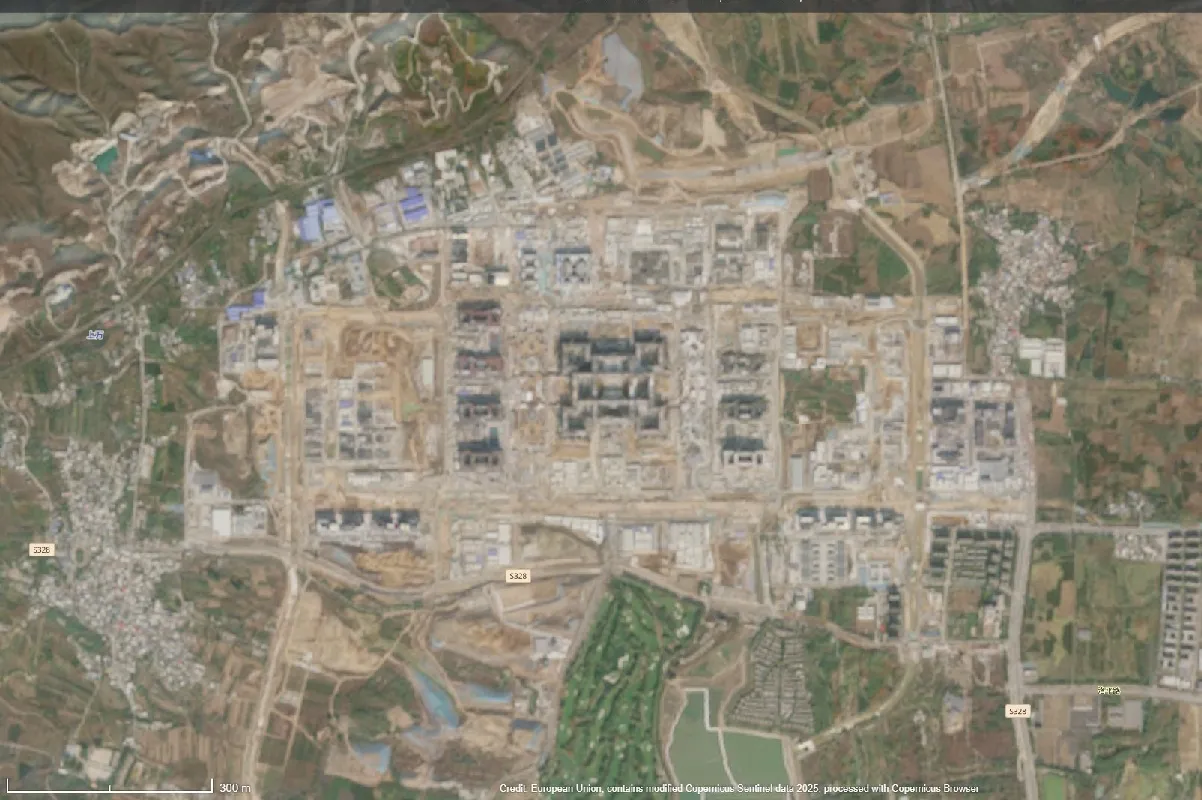
New high-definition satellite imagery shows steady progress on a sprawling site outside Beijing that analysts believe could be a military command complex designed to protect China's leaders from a nuclear strike by the United States.
Why It Matters
The vast site, dubbed “Beijing Military City” by open-source analysts, is located roughly 20 miles southwest of the Chinese capital. Its construction footprint hints at a complex nearly 10 times the size of the Pentagon.
Read More on World
Chinese President Xi Jinping has ordered the People’s Liberation Army (PLA) to become a “world-class” force by mid-century, a phrase widely understood as shorthand for matching or surpassing U.S. military capabilities.
While Beijing has accelerated its buildup of naval ships, long-range missiles, and nuclear warheads, experts say Xi is also pursuing hardened infrastructure capable of surviving a decapitation strike. Such a facility could allow China’s leadership to continue military operations in the event of a major war with the United States.
Newsweek reached out to the Chinese Ministry of Defense via email for comment.
What To Know
A time-lapse created by Newsweek using imagery from the European Space Agency’s Sentinel-2 satellites shows visible monthly progress since construction began in mid-2024.
Not everyone is convinced the site is built with a doomsday purpose in mind.
“The land area is much larger than a normal military camp and military school, so it can only be assumed that it is a site for an administrative organization or a large training base,” Hsu Yen-chi, a researcher at the Council on Strategic and Wargaming Studies think-tank in Taiwan, told the Financial Times.
If the site is meant to be a hardened command center, it remains unclear what that implies for China’s approach to command and control. Beijing’s military hierarchy is traditionally centralized under the Communist Party’s leadership, which prioritizes political loyalty and tight oversight of senior officers.
A recent report by the California-based RAND Corporation think tank noted that some PLA researchers have begun advocating for a mission command model similar to that of the U.S., which would delegate limited decision-making authority to lower-ranking officers to improve response times in fast-moving conflicts.
“PLA adoption of mission command could worsen PLA crisis behavior because of weaker coordination and control of frontline forces by PLA senior leadership,” the RAND authors wrote. “On the other hand, it could also blunt traditional U.S. military strategies by speeding up communications—and therefore decisions—on the Chinese side.”
...
What People Are Saying
Lyle Morris, senior fellow for foreign policy and national security at the Asia Society Policy Institute, wrote on X in February: “One thing I can say with almost certainty: the deep bunkering suggests preparations for a nuclear C2 command.
"Given the CCP’s utter paranoia about a U.S. first strike against the Mainland, this would be a compound for all senior CCP civilian and PLA leadership to move to for command and control during a nuclear war or crisis. China doesn’t want to repeat what happened in 1969.”
What Happens Next
Multiple flashpoints in the region have the potential to draw the U.S. and China into a conflict. One scenario is a Chinese invasion of Beijing-claimed Taiwan. Another could center on a deadly miscalculation near a disputed South China Sea territory claimed by both China and U.S. Mutual Defense Treaty ally, the Philippines.
View 0 Comments
Submit Correction
View Editorial & AI Guidelines