...

By Amir Daftari
News Reporter
0
Share
Newsweek is a Trust Project member
See more of our trusted coverage when you search.Prefer Newsweek on Googleto see more of our trusted coverage when you search.
Satellite images show the significant advances on Saudi Arabia's $500 billion Neom project as new structures are built for the massive initiative, a key component of Crown Prince Mohammed bin Salman's Vision 2030 strategy.
Neom is beginning to take form across critical support zones beyond its high-profile urban centerpiece, The Line.
Newsweek has reached out to Neom for comment.
Read More on News
Why It Matters
While Neom's glossy promotional material has drawn global attention, critics have questioned how much of the project exists beyond renderings. With access to the site restricted and few official updates, independent evidence of construction has been limited.
The latest satellite images via Google Earth showcase Neom's shift from concept to reality, with major milestones set for completion by global events like the 2029 Asian Winter Games and the 2034 FIFA World Cup. This marks a pivotal moment for Saudi Arabia, which seeks to diversify the economy and reduce dependence on oil.
What to Know
The satellite imagery reveals key indicators of real-world development: large-scale earthworks, completed buildings, grid-like infrastructure layouts, and support facilities in operation. While much of Neom remains in the planning or preparatory stage, these areas demonstrate momentum.
This Neom community appears to be home to employee housing, schools, sports facilities, and offices. Located 22—25 miles (35—40 kilometers) west of The Line, it functions as a logistical and operational center, essential for housing staff, engineers, and international consultants.
A side-by-side satellite image comparison—from a barren landscape in 2018 to a fully developed campus in October 2024—visually confirms the site's transformation.
Roughly 12—15 miles (20—24 kilometers) northeast of Oxagon, Neom's planned industrial hub, this site appears to serve as high-volume housing for workers. Satellite imagery shows organized housing blocks, utility structures, solar panels, and sports areas, emphasizing the site's critical role in supporting construction and logistics for Oxagon, The Line, and other sectors.
A comparison of satellite images from 2017 and 2024 highlights the significant transformation of the area.
Between December 2015 and September 2024, Neom Community 13 has evolved from open land into a sizable residential and infrastructure compound. The site now includes worker housing, solar arrays, wastewater facilities, and a circular green structure that closely resembles a cricket field—consistent with Neom's broader effort to integrate sports amenities into employee communities.
Roughly 22 miles (35 km) northwest of The Line and 31 miles (50 km) north of Oxagon, this area provides vital accommodation and logistical support for ongoing construction across the Neom zone.
Work on The Line
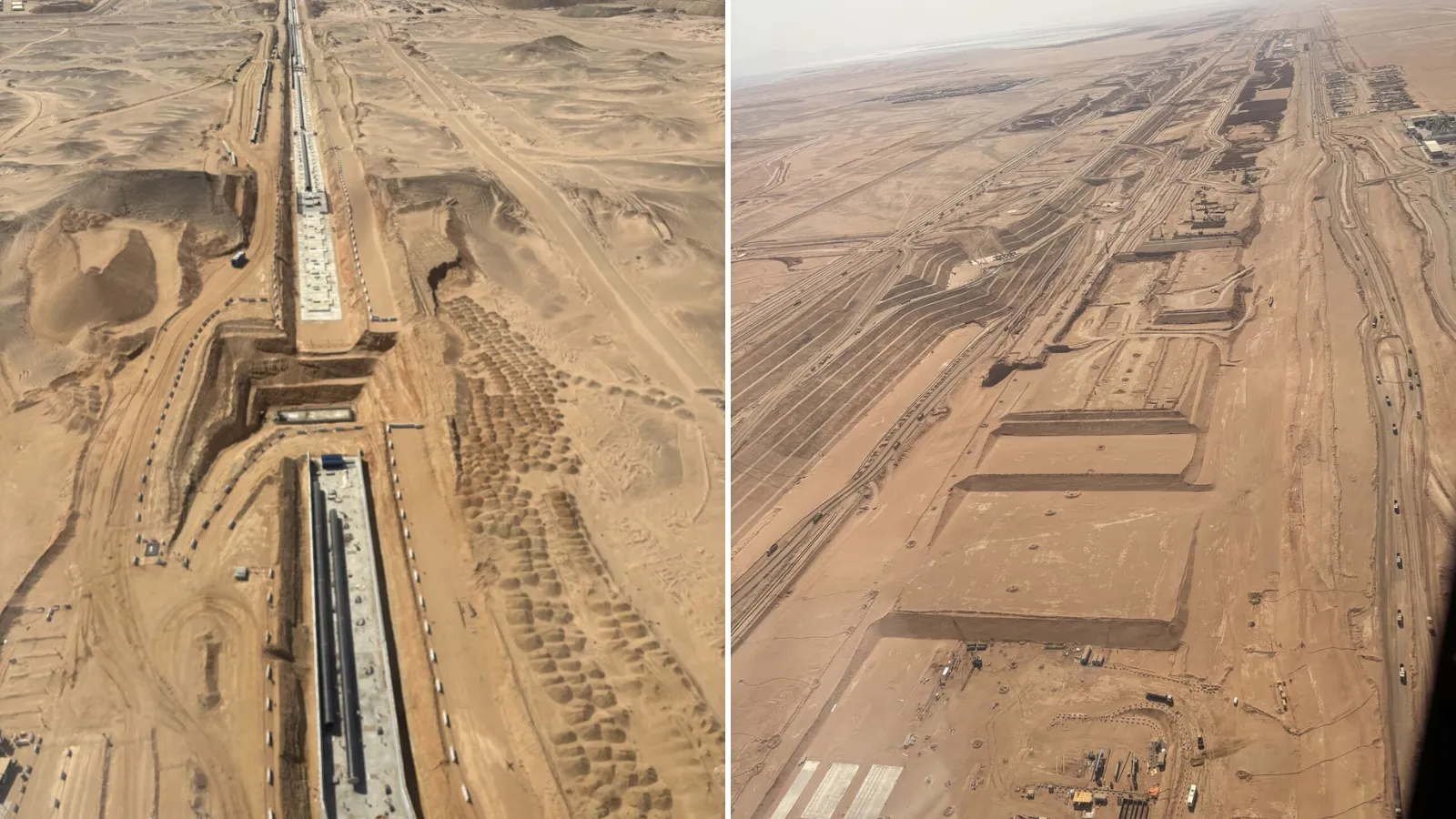
Earlier this week, Giles Pendleton, Chief Operating Officer for The Line, released new on-site photos showing ground infrastructure visibly taking shape in Tabuk Province.
The images reveal the 200-meter-wide city outline emerging from the desert—offering one of the clearest confirmations yet that physical work on Neom's signature linear city has begun.
...

...
Criticism and Challenges Persist
Neom has drawn international criticism for alleged human rights violations, particularly concerning the displacement of the Huwaitat tribe. Environmental groups have also raised alarms over the project's ecological footprint. Experts remain skeptical about whether ambitious elements—such as The Line's mirrored skyscrapers—can be delivered at the promised scale.
What Happens Next
Further construction updates are expected throughout 2025 as Neom aims to operationalize key zones ahead of major global events.

...
Updated 04/29/25, 07:45 a.m. ET: This article has been updated with new imagery from Neom's Community 13.
View 0 Comments
Submit Correction
View Editorial & AI Guidelines