...

By Sam Stevenson
Associate News Editor
0
Share
Newsweek is a Trust Project member
See more of our trusted coverage when you search.Prefer Newsweek on Googleto see more of our trusted coverage when you search.
Open clashes between Supreme Court justices over asylum law spilled into sharp exchanges during a high‑stakes immigration hearing on Tuesday.
Why It Matters
The Supreme Court is considering whether the government can turn away asylum seekers before they enter the United States. And it all hinges on how justices interpret a single phrase written by Congress decades ago.
Read More on Politics
Newsweek contacted the Department of Justice, which is defending the government’s interpretation of the asylum statute at issue in the case, via email for comment. Newsweek also emailed the Institute for Constitutional Advocacy and Protection (ICAP), whose attorney argued the case on behalf of immigrant rights organizations, for comment.
...
What To Know
At issue is federal law allowing asylum claims from individuals who are “physically present in the United States or who arrive in the United States.”
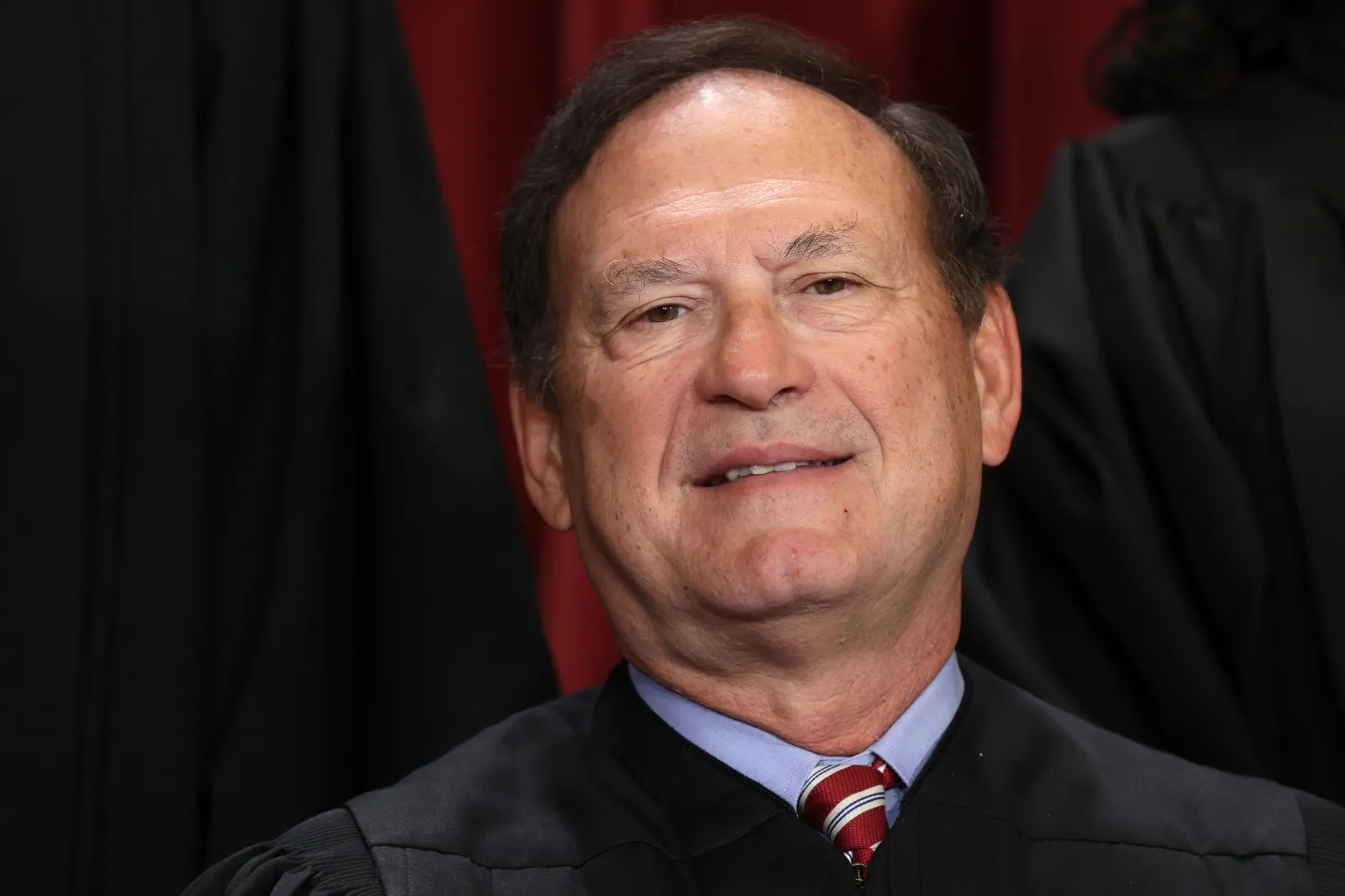
Justice Samuel Alito led one of the most pointed lines of questioning during the hearing, openly challenging how the asylum statute had been described, including by fellow justices during the argument. Alito took aim at repeated references to migrants “arriving at” the country, arguing that the wording blurs a distinction Congress deliberately wrote into the statute.
Although his questions were directed to Kelsi Brown Corkran, the ICAP attorney representing immigrant rights organizations, Alito made clear that his concern extended beyond the advocate’s argument. He suggested that the same imprecision had surfaced elsewhere on the bench, implicitly calling out how Justices Sonia Sotomayor and Ketanji Brown Jackson had framed the issue.
To underline the point, Alito offered a simple analogy.
Someone who comes to the front door of a house and knocks, he said, may have arrived at the house, but has not arrived in it.
The distinction, he argued, mirrors the situation of migrants stopped at ports of entry before crossing onto U.S. soil.
Corkran responded by grounding her argument in timing and ordinary language.
She said someone standing at the threshold, face to face with an immigration officer and prepared to step across, can reasonably be described as “arriving in” the United States in the present tense. Once fully inside, arrival becomes a completed act. Congress, she argued, understood that distinction when it drafted the law.
The exchange unfolded amid broader tension among the justices.
Sotomayor warned that turning people away at the border risks violating U.S. treaty obligations and repeating historical mistakes. She invoked the United States’ decision during World War II to refuse entry to ships carrying Jewish refugees.
“The majority of those people were shipped back or had to go back from where they came and were killed,” Sotomayor said. “That’s what we’re doing here.”
Jackson pressed a different concern, repeatedly emphasizing that the disputed policy is not currently in effect. She urged the court to vacate the lower‑court rulings without defining what “arrives in” means at all, and questioned whether the court should resolve a dispute over a dormant policy.
As exchanges grew sharper, Chief Justice John Roberts stepped in more forcefully than usual to maintain order. At one point, he interrupted as Jackson and Justice Amy Coney Barrett spoke over one another, calling out, “Please!”
He later cut off Sotomayor to ensure DOJ attorney Vivek Suri was allowed to finish responding.
The hearing laid bare a court divided not only over immigration policy, but over statutory interpretation, judicial restraint, and the consequences tied to a single word in federal law.
What People Are Saying
Supreme Court Justice Samuel Alito said: “Do you think someone who comes to the front door of a house and knocks at the door has arrived in the house? The person may have arrived at the house.”
What Happens Next
The Supreme Court is expected to issue a ruling later this term, a decision that could shape how future administrations handle asylum claims amid increased migration and border pressure.
In a polarized era, the center is dismissed as bland. At Newsweek, ours is different: The Courageous Center—it's not "both sides," it's sharp, challenging and alive with ideas. We follow facts, not factions. If that sounds like the kind of journalism you want to see thrive, we need you.
When you become a Newsweek Member, you support a mission to keep the center strong and vibrant. Members enjoy: Ad-free browsing, exclusive content and editor conversations. Help keep the center courageous. Join today.


View 0 Comments
Submit Correction
View Editorial & AI Guidelines